Securing the maximum Social Security benefit requires precise timing and proactive financial planning, with top-tier earners eligible to collect up to $5,181 per month in 2026.
While few retirees qualify for the absolute highest social security payout, anyone can implement proven social security optimization tips to significantly increase their monthly income. Your final check amount depends directly on your 35 highest-earning years, your wage history against national caps, and the exact date you file.
Taking specific, informed actions today protects you against costly filing penalties, unlocks valuable spousal strategies, and ensures you capture every dollar you have earned throughout your career.

The Exact Formula Behind the Maximum Social Security Benefit
The Social Security Administration (SSA) does not choose your monthly benefit at random; they use a strict mathematical formula based on your earnings history and filing age. Understanding how the government calculates this amount helps you identify the exact levers you can pull to increase your monthly checks.
The calculation rests on your Primary Insurance Amount (PIA), which is the benefit you receive if you claim at your Full Retirement Age (FRA). To establish your PIA, the SSA indexes your historical earnings for inflation and selects your 35 highest-earning years. They divide the total indexed earnings from those 35 years by 420 (the number of months in 35 years) to establish your Average Indexed Monthly Earnings (AIME). Finally, the SSA applies a formula with specific bend points to your AIME to produce your base monthly benefit.
To qualify for the absolute maximum Social Security check, you must meet three strict benchmarks:
- Work at least 35 full years: If you work only 32 years, the SSA inserts three zero-earning years into your average, which drastically reduces your baseline benefit.
- Earn at or above the taxable wage base for all 35 years: In 2026, the maximum taxable wage base is $184,500 (up from $176,100 in 2025 and $168,600 in 2024). You must have hit the inflation-adjusted maximum cap in every one of your 35 calculation years.
- Delay claiming benefits until age 70: You must bypass early claiming at 62 and your Full Retirement Age to accumulate the maximum allowable delayed retirement credits.
For 2026, the maximum monthly payouts based on claiming age are:
- Age 62 (Earliest claiming age): $2,969 per month
- Full Retirement Age (Age 67 for those born in 1960 or later): $4,152 per month
- Age 70 (Maximum delayed benefit): $5,181 per month

How to Increase Your Social Security Check at Any Stage
Even if you did not earn the maximum taxable wage base in every year of your career, you can still use deliberate methods to learn how to increase your Social Security check before you submit your application.
1. Audit Your Official Social Security Earnings Record
Your benefit calculations are only as accurate as the data on file with the government. Employers occasionally misreport wages, or paperwork errors omit entire years of your work history. Log into your personal account on the Social Security Administration (SSA) website and download your complete earnings statement. Compare your listed annual wages against your historical W-2 forms and tax returns. If you discover missing or incorrect earnings, submit Form SSA-7008 with supporting tax documentation to correct the record immediately.
2. Replace Low-Earning Years with Peak Salary Years
Because the SSA counts your top 35 years, working an extra year or two at today’s higher salary can replace an early-career year when you earned very little. For example, if you earned minimum wage during summer jobs in your twenties, those low-earning years remain in your top 35 calculation if you stop working at year 32. Working through age 65 or 66 at your current peak earnings eliminates those early low-income years from the equation, raising your average indexed earnings and your lifetime monthly check.
3. Bridge the Income Gap to Delay Claiming
Delaying your application is the most reliable way to boost your monthly payout. If you retire from your primary job at age 62 or 65, avoid filing for Social Security immediately if you have other assets available. Drawing down funds from a 401(k), traditional IRA, or brokerage account allows your Social Security benefit to grow uninterrupted. Guaranteed 8% annual delayed retirement credits between your FRA and age 70 represent a return that virtually no commercial annuity or guaranteed bond can match.
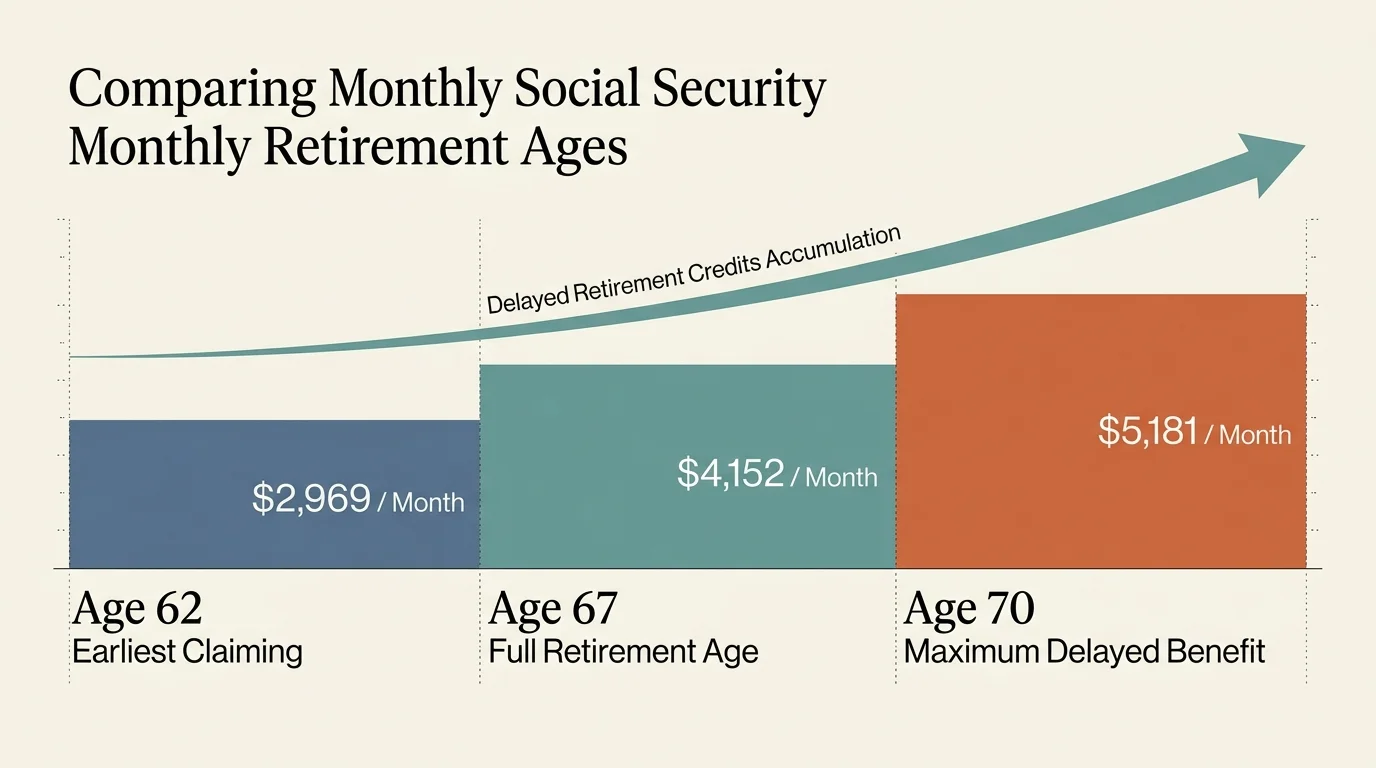
Claiming Age Comparison: How Filing Timing Transforms Your Check
Your Full Retirement Age serves as the baseline for your benefit calculation. If you were born in 1959, your FRA is 66 years and 10 months. If you were born in 1960 or later, your FRA is 67. Filing prior to your FRA permanently slashes your monthly benefit, while waiting past your FRA permanently increases it.
The following table illustrates how claiming age affects both baseline benefits and maximum payouts in 2026 for an individual with an FRA of 67:
| Claiming Age | Benefit Percentage relative to FRA | 2026 Maximum Monthly Check | Strategic Impact on Lifetime Income |
|---|---|---|---|
| Age 62 | 70% (30% permanent reduction) | $2,969 | Locks in the lowest monthly payment; best if facing serious health issues or acute financial hardship. |
| Age 65 | 86.7% (13.3% permanent reduction) | $3,601 | Reduces monthly checks permanently, but provides cash flow earlier in retirement. |
| Age 67 (FRA) | 100% (Baseline Primary Insurance Amount) | $4,152 | Receives full earned benefit without early-filing penalties or delayed credits. |
| Age 70 | 124% (24% permanent increase) | $5,181 | Maximizes monthly cash flow, cost-of-living adjustments, and survivor protection. |
Filing at age 62 results in a permanent 30% reduction compared to your FRA benefit. Conversely, delaying past age 67 earns you delayed retirement credits of two-thirds of 1% per month (8% per year) until age 70. This creates a 77% difference in monthly income between claiming at 62 and claiming at 70.
The 2026 Retirement Earnings Test: Working While Claiming
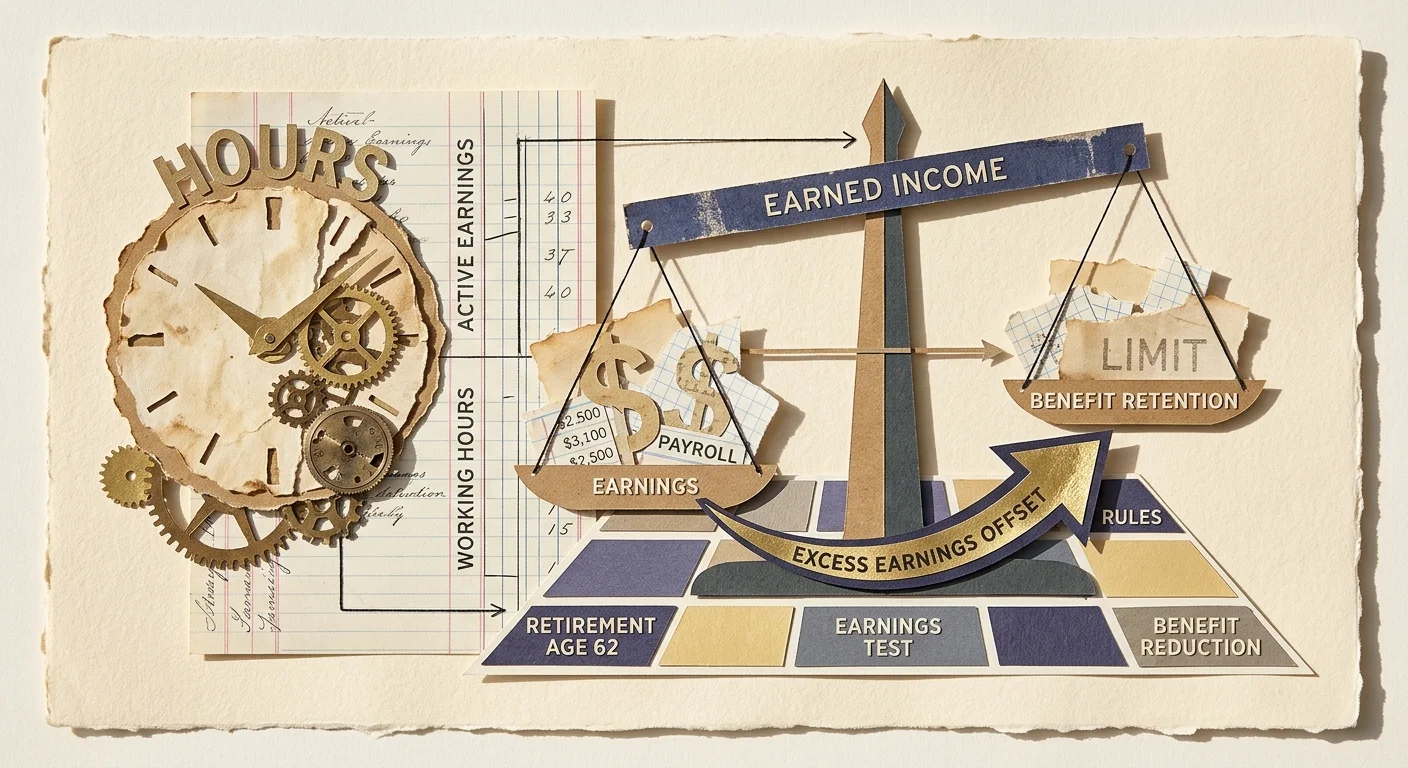
Many Americans choose to work part-time or consult during retirement. However, if you claim benefits before reaching your Full Retirement Age while continuing to earn an income, the SSA applies the Retirement Earnings Test.
For 2026, the earnings test rules operate under specific thresholds:
- Under Full Retirement Age all year: You can earn up to $24,480 per year. The SSA withholds $1 in benefits for every $2 you earn above this threshold.
- The year you reach Full Retirement Age: You can earn up to $65,160 in the months leading up to your birthday month. The SSA withholds $1 in benefits for every $3 earned above this limit.
- Month reaching FRA and onward: The earnings limit disappears entirely. You can earn an unlimited income with zero withholding.
Money withheld under the earnings test is not lost forever. When you reach your Full Retirement Age, the SSA recalculates your monthly benefit upward to credit you for the months benefits were withheld. However, working while claiming early creates unexpected cash flow bottlenecks and defeats the purpose of early filing.

Advanced Social Security Claiming Strategy for Couples
Married couples have distinct opportunities to optimize their combined lifetime benefits. Treating Social Security as a joint asset rather than two separate benefits is the foundation of a smart social security claiming strategy.
Maximize the Higher Earner’s Benefit
The higher-earning spouse should delay claiming until age 70 whenever feasible. This approach serves a dual purpose: it maximizes the household monthly benefit during their lifetime, and it locks in the highest possible survivor benefit for the surviving spouse. When one spouse passes away, the surviving partner steps into the higher of the two monthly benefit amounts and relinquishes their smaller check. Maximizing the larger check creates permanent longevity insurance for the surviving partner.
Spousal Benefits Rules
A lower-earning or non-working spouse can receive a spousal benefit worth up to 50% of the primary earner’s FRA amount (PIA). To claim a spousal benefit, the primary worker must have already filed for their own benefit. Furthermore, the lower-earning spouse must reach their own FRA to collect the full 50%; claiming spousal benefits at age 62 reduces the spousal payment to as little as 32.5% of the primary earner’s PIA.
Divorced Spouse Benefits
If you were married for at least 10 consecutive years and are currently unmarried, you may qualify for benefits based on your former spouse’s earnings record. Your ex-spouse must be at least 62 years old. If you have been divorced for at least two years, your ex-spouse does not even need to have filed for their own benefits yet for you to claim your spousal share. Review guidance from the Consumer Financial Protection Bureau (CFPB) — Retirement tools to explore how divorce impacts your broader household cash flow.

Costly Mistakes to Avoid
Navigating Social Security involves complex regulations where a single miscalculation can cost you tens of thousands of dollars over your retirement. Protect your nest egg by avoiding these common missteps:
- Filing at 62 out of fear: Concerns about the solvency of the Social Security trust funds prompt many workers to claim early. Even if Congress modifies future funding formulas, existing retirees have historically received full protections. Filing early locks in a lifetime 30% reduction.
- Ignoring taxes on benefits: Up to 85% of your Social Security benefit may be subject to federal income tax if your provisional income (adjusted gross income + non-taxable interest + half of your Social Security benefits) exceeds $34,000 for single filers or $44,000 for married couples filing jointly. Coordinate withdrawals using the IRS Retirement Plans guidelines to keep your provisional income within lower brackets.
- Waiting past age 70 to apply: Delayed retirement credits stop accumulating the month you reach age 70. Waiting until age 71 or 72 yields zero additional income and forfeits monthly checks permanently.
- Failing to coordinate Medicare Part B premiums: If you collect Social Security while enrolled in Medicare, your Part B premiums are automatically deducted from your monthly check. High earners subject to Income-Related Monthly Adjustment Amounts (IRMAA) will see higher deductions, reducing their net take-home benefit.
- Missing the 12-month withdrawal window: If you claim benefits early and regret the decision, you have a one-time opportunity within the first 12 months to withdraw your application using Form SSA-521. You must repay all benefits received to date, but this resets your record and allows your benefit to grow as if you had never filed.

Don’t DIY These Decisions: When to Seek Professional Guidance
While online calculators provide helpful baseline estimates, personal circumstances often demand professional analysis. A single claiming error cannot always be undone, making specialized advice well worth the investment.
Consider consulting a professional under the following circumstances:
- Complex Tax Scenarios: A certified public accountant (CPA) or tax-focused financial planner can help you structure traditional IRA withdrawals, Roth conversions, and capital gains to minimize taxes on your Social Security benefits.
- Blended Families and Minor Dependents: If you have minor children, a disabled adult child, or complex family structures, a Social Security claiming specialist can ensure you capture family maximum allowances without triggering penalties.
- Significant Health or Longevity Disparities: A fee-only fiduciary financial advisor can model break-even ages across multiple claiming scenarios, factoring in personal health history, family longevity, and portfolio sustainability.
- Estate and Asset Protection Planning: An elder law attorney helps coordinate Social Security survivor benefits with trust distributions and long-term care planning.
Frequently Asked Questions About Social Security Benefits
Can I increase my Social Security check if I continue working after age 70?
Yes, but only if your current earnings are high enough to replace one of the previous 35 years in your top-earnings calculation. Working past 70 will not earn you additional delayed retirement credits, but the SSA automatically reviews all wage reports annually and recalculates your PIA if your new earnings surpass an older indexed year.
What is the single most effective way to get the highest Social Security payout?
Delaying your claim until age 70 is the most powerful method. Waiting past your Full Retirement Age provides a guaranteed 8% annual increase in your monthly check through delayed retirement credits, up to age 70. This increases your monthly base payment by 24% to 32%, depending on your birth year.
How does the SSA calculate Cost-of-Living Adjustments (COLA) on delayed benefits?
You do not miss out on annual Cost-of-Living Adjustments by delaying your claim. The SSA applies all annual COLAs to your underlying primary insurance amount starting at age 62, regardless of whether you have filed. When you finally claim at 67 or 70, your check includes every compounded COLA adjustment enacted since you turned 62.
Where can I view an accurate estimate of my future monthly benefits?
You can review your personalized estimates directly through the Social Security Retirement Estimator and your online SSA account. These tools project your monthly payout at ages 62, FRA, and 70 based on your real-time earnings history.
Taking Action Today
Maximizing your Social Security check requires deliberate preparation well before you submit your retirement paperwork. Audit your earnings record today, calculate your 35-year baseline, and evaluate your household longevity to design a claiming timeline that serves your long-term needs.
“The best time to plan for retirement was 20 years ago. The second best time is today.”
Treat your Social Security claiming date as a major investment decision. By delaying your filing age where possible, monitoring your work history, and coordinating benefits with your spouse, you can secure the highest possible monthly income and protect your financial independence throughout retirement.
This article is for informational purposes only and does not constitute financial, legal, or medical advice. Medicare rules, Social Security benefits, and tax laws change regularly—verify current details at Medicare.gov, SSA.gov, or with a licensed professional.
Last updated: February 2026. Medicare and Social Security rules change annually—always verify current details at official government sources.