You and your former coworker can earn the exact same salary for thirty-five years, yet retire with vastly different monthly bank deposits. Understanding these hidden Social Security benefit factors can put thousands of extra dollars into your pocket.
Your lifetime earnings record establishes your baseline entitlement, but filing age, federal wage indexing, and health care deductions determine your actual check. Strategic claiming decisions will dictate your final standard of living.
Examining why Social Security checks differ empowers you to secure the maximum monthly income available under federal law.
The Timing Trap: Claiming Age and Delayed Retirement Credits
The single largest factor separating two identical earners is the age at which they choose to file for benefits.
Your Primary Insurance Amount (PIA) represents the monthly benefit you earn by waiting until your Full Retirement Age (FRA).
For anyone born in 1960 or later, your federal Full Retirement Age is 67.
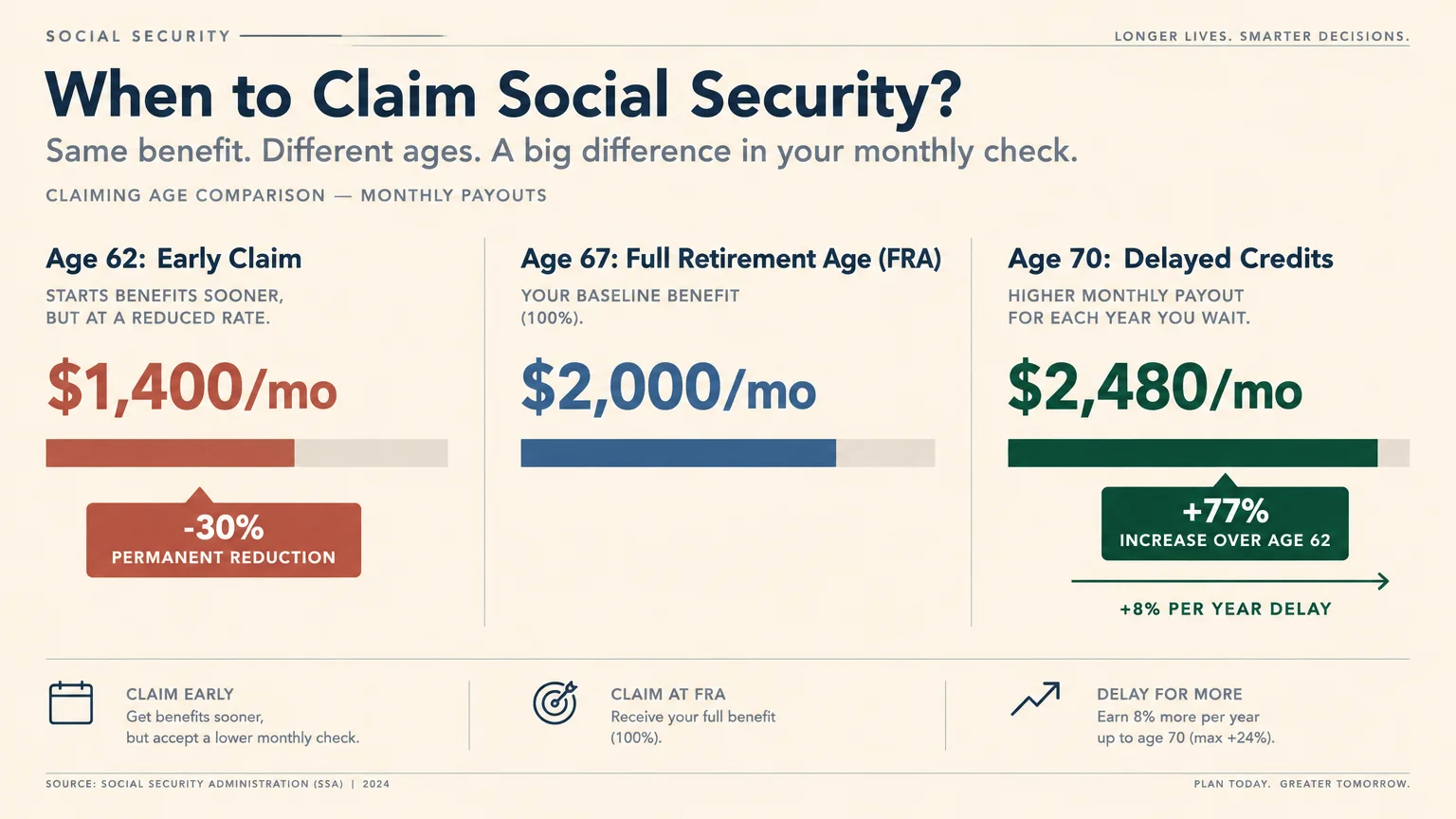
If you claim benefits at age 62, the Social Security Administration applies a permanent 30% reduction to your monthly check.
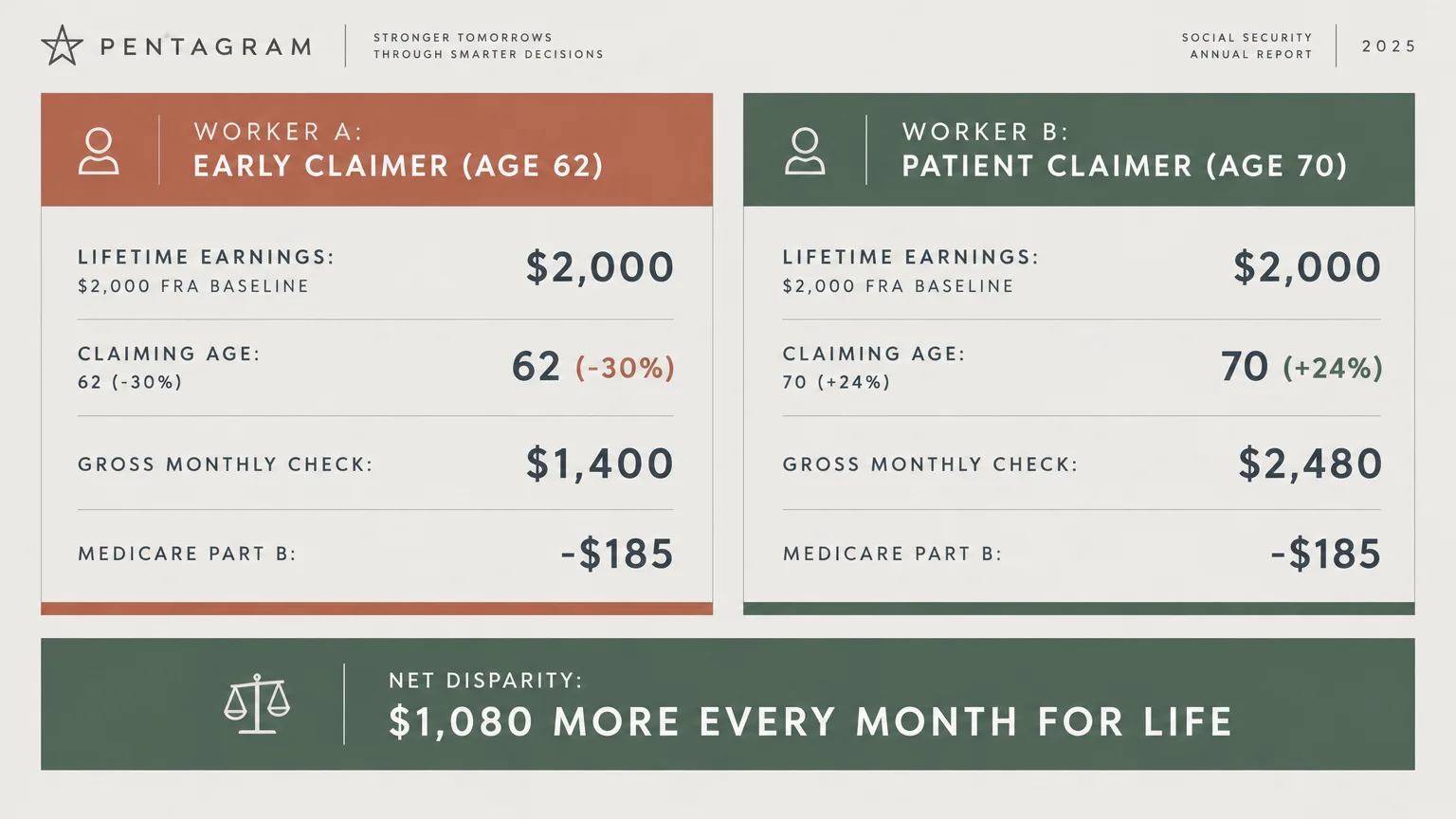
A monthly entitlement of $2,000 at age 67 drops to just $1,400 if you claim early at 62.
Delaying your application past full retirement age triggers delayed retirement credits; these credits increase your payout by 8% per year.
These credits accumulate monthly at a rate of two-thirds of 1% until you reach age 70.
Waiting until age 70 boosts that same $2,000 baseline benefit up to $2,480 every single month.
Comparing the age 70 check of $2,480 to the early check of $1,400 reveals an astonishing 77% increase.
Both workers logged the exact same hours and paid the exact same payroll taxes; timing alone generated the disparity.
Annual cost-of-living adjustments (COLA) widen this cash gap further as compounding percentages favor the larger base benefit.

Wage Indexing: How Your Birth Year Alters the Benefit Formula
The federal government does not simply total your lifetime pay stubs when calculating your retirement check.
Instead, the agency uses a process called the National Average Wage Indexing (NAWI) formula.
This social security benefit calculation adjusts your highest 35 years of past earnings to reflect national wage inflation over time.
The indexing formula locks in during the year you celebrate your 60th birthday—two years before initial eligibility at 62.
Because the government sets indexing factors at age 60, economic conditions in that specific calendar year carry enormous weight.
Two workers with identical wage records born in different years receive different Average Indexed Monthly Earnings (AIME).
The formula then applies two statutory thresholds known as “bend points” to determine your primary benefit amount.
These bend point brackets adjust every calendar year based on nationwide economic growth.
A retiree turning 62 during a strong wage boom enjoys higher indexing ratios than a peer retiring after a recession.
Once you turn 62, wage indexing halts; future increases come exclusively through standard Consumer Price Index adjustments.

The Invisible Cut: Medicare Premiums and IRMAA Surcharges
Your gross entitlement on paper rarely matches the direct deposit that hits your personal checking account.
For most American retirees, Medicare Part B premiums come out of monthly Social Security payments automatically.
The standard monthly Part B deduction stands at $185.00 per enrolled beneficiary.
You can review official coverage regulations directly through Medicare.gov before making health coverage choices.
Higher-income retirees face an additional surcharge called the Income-Related Monthly Adjustment Amount (IRMAA).
The Social Security Administration reviews your tax return from two years prior to determine your monthly surcharge tier.
IRMAA thresholds start at a modified adjusted gross income of $106,000 for single filers.
Married couples filing joint tax returns face surcharges when their income exceeds $212,000.
Substantial withdrawals from traditional IRAs, business sales, or capital gains can push you into steep IRMAA brackets.
Top-tier surcharges can add more than $400 per month to Part B costs, alongside extra Part D fees.
Two identical lifetime earners can receive drastically different take-home deposits simply because one generated additional outside investment income.
Working in Retirement: The Impact of the Earnings Test
Continuing to work while collecting early benefits represents another common reason why monthly checks shrink.
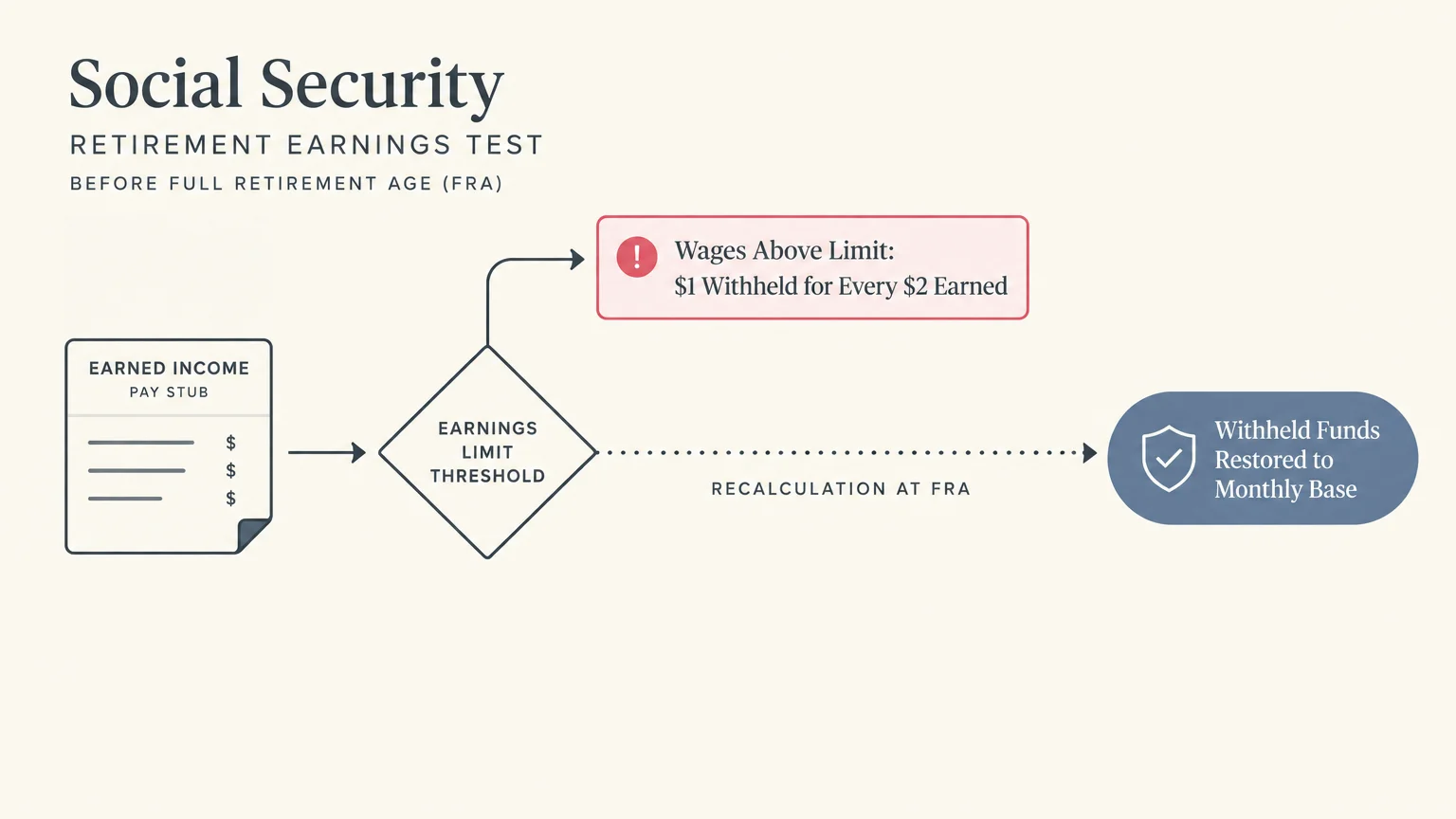
If you file before reaching your Full Retirement Age, the federal Retirement Earnings Test restricts your wage income.
The annual limit for individuals who remain under full retirement age all year is $23,400.
Social Security withholds $1 of benefits for every $2 you earn above that statutory threshold.
During the specific calendar year you reach full retirement age, a more generous threshold of $62,160 applies.
In that transition year, the agency withholds $1 for every $3 earned above the limit before your birth month.
These withheld funds are not permanently surrendered; the government recalculates your monthly benefit once you attain full retirement age.
However, during your working years, your monthly check drops significantly—or stops completely until you reach full age.
“It’s not how much money you make, but how much money you keep, how hard it works for you, and how many generations you keep it for.” — Robert Kiyosaki

Spousal and Auxiliary Benefits: The Marriage Advantage
Your marital status and your spouse’s career trajectory heavily influence your monthly Social Security check.
Federal law entitles eligible married individuals to claim an auxiliary spousal benefit of up to 50% of their partner’s PIA.
Suppose you and a coworker both earned modest career wages that generated a personal benefit of $1,100 per month.
If your coworker remains single, their monthly entitlement remains capped at that individual baseline of $1,100.
If you are married to a top earner whose full retirement benefit is $3,600, your entitlement adjusts upwards.
The agency provides a spousal top-off, lifting your monthly check to $1,800 at your full retirement age.
Divorced individuals can also claim auxiliary benefits on an ex-spouse’s earnings record under specific statutory conditions.
Your marriage must have lasted at least ten consecutive years, and you must currently remain unmarried.
Survivor benefits create an even more pronounced shift in long-term household income.
A surviving spouse can claim up to 100% of the deceased spouse’s actual check, including earned delayed retirement credits.

Taxes at the Federal and State Levels
Federal tax laws require up to 85% of your Social Security benefits to be taxed if your income passes certain targets.
The IRS calculates combined income by adding your adjusted gross income, nontaxable interest, and half of your annual benefit.
Many beneficiaries submit Form W-4V to elect voluntary federal withholding at rates of 7%, 10%, 12%, or 22%.
Electing voluntary withholding reduces your deposited check, even though your gross benefit entitlement remains identical to a peer’s.
Where you choose to live in retirement also changes how much of your check stays in your wallet.
Currently, 42 states and Washington, D.C., exempt Social Security benefits entirely from state income taxes.
States like Kansas, Missouri, Nebraska, and West Virginia recently completed full phaseouts of state benefit taxes.
Only eight states still tax benefits for specific income tiers: Colorado, Connecticut, Minnesota, Montana, New Mexico, Rhode Island, Utah, and Vermont.
Living across state borders can produce significant differences in net retirement cash flow for identical lifetime earners.
Head-to-Head Comparison: Identical Earners, Different Checks
Consider three workers—Arthur, Brenda, and Charles. Each earned an identical career wage record producing a $2,200 PIA at age 67.
Their tactical choices, medical deductions, and tax environments lead to wildly different bank deposits.
| Retiree Profile | Claiming Age | Gross Monthly Benefit | Medicare Part B & IRMAA | State Income Tax | Estimated Net Monthly Deposit |
|---|---|---|---|---|---|
| Arthur (Early filer, high income, taxing state) | 62 | $1,540.00 | $328.00 (Standard + Tier 1 IRMAA) | -$65.00 | $1,147.00 |
| Brenda (Full Retirement Age, average income) | 67 | $2,200.00 | $185.00 (Standard Part B) | $0.00 (Tax-free state) | $2,015.00 |
| Charles (Delayed filer, coordinated tax plan) | 70 | $2,728.00 | $185.00 (Standard Part B) | $0.00 (Tax-free state) | $2,543.00 |
Arthur receives a reduced gross payment of $1,540 because he claimed five years before his full retirement age.
His IRMAA surcharge and state tax liability shrink his actual take-home deposit down to $1,147.
Brenda claims at age 67, receiving her full $2,200 gross entitlement with only standard Medicare Part B deducted.
Charles delays his claim to age 70, boosting his gross payout to $2,728 per month.
Charles collects more than double Arthur’s net monthly cash flow despite their exact identical payroll contributions over 35 years.
“The goal of retirement is to live off your assets—not live off your regrets.”

Costly Mistakes to Avoid
Filing early because of rumors regarding Social Security insolvency is an expensive mistake that permanently reduces your lifetime income.
Congress has historically adjusted rules gradually rather than slashing benefits for Americans nearing retirement age.
Another dangerous trap is ignoring how required minimum distributions (RMDs) from pretax accounts trigger unexpected IRMAA tiers.
Failing to coordinate claiming dates with your spouse can forfeit tens of thousands of dollars in cumulative lifetime benefits.
You can estimate future payouts using the official Social Security Retirement Estimator before finalizing your timeline.
Finally, never assume your Social Security earnings record is completely accurate without verifying your work history online.
Missing wages or clerical reporting mistakes can permanently depress your Average Indexed Monthly Earnings formula.
Strategic Steps to Maximize Social Security Benefits
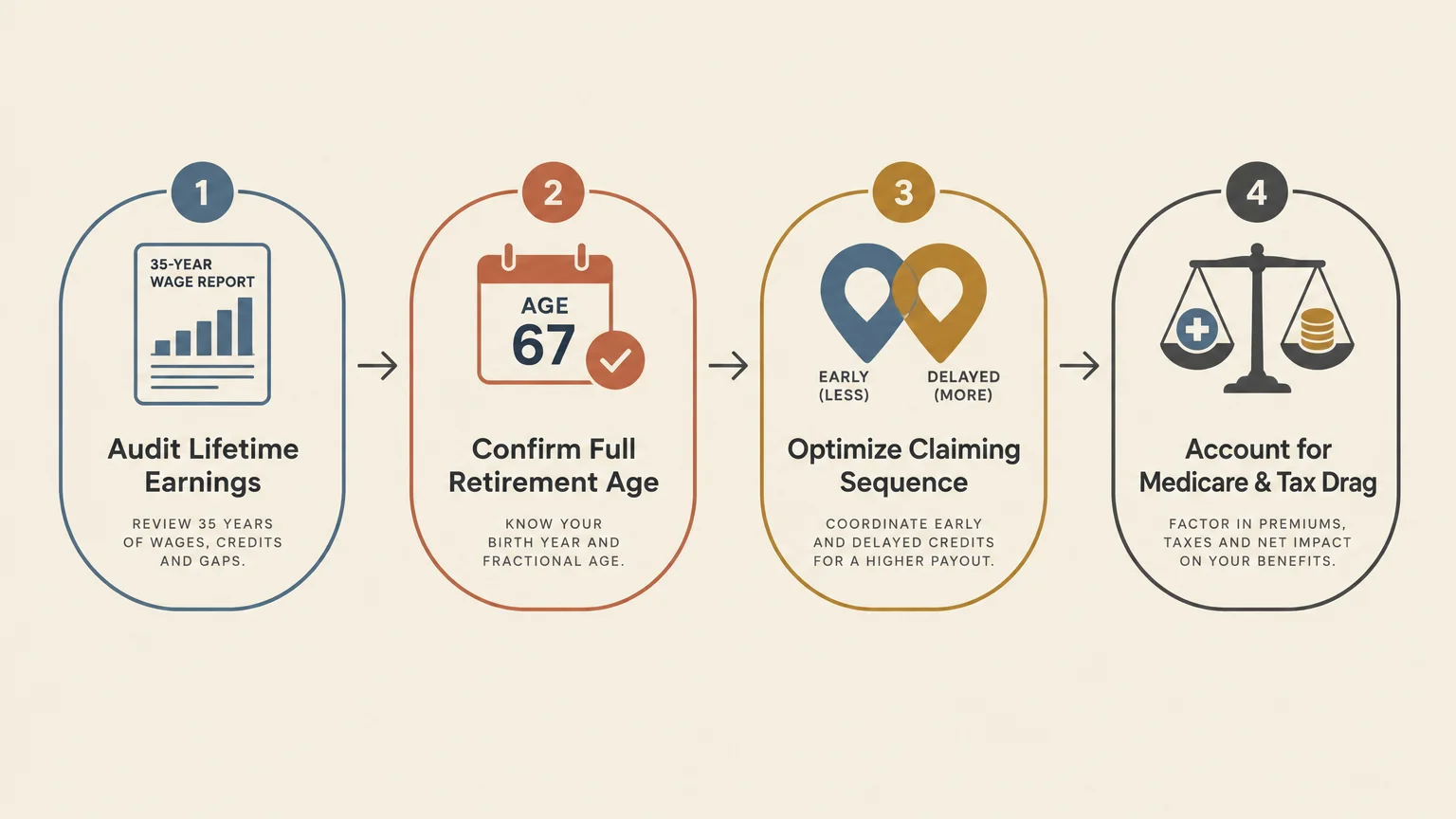
To maximize Social Security benefits, begin by downloading your official earnings record from the Social Security Administration (SSA) website.
Verify that your annual reported income matches your historical tax records for every working year.
If you have fewer than 35 years of covered earnings, zero-earning years drag down your average calculation.
Working additional years at higher wages replaces lower-earning or zero-earning years from your early career.
Carefully evaluate your family longevity, marital status, and liquidity needs before deciding on an early filing date.
Using bridge strategies—such as drawing from taxable savings first—allows your Social Security check to grow by 8% annually.
Explore tools provided by the Consumer Financial Protection Bureau (CFPB) to map out personalized claiming timelines.

Don’t DIY These Decisions
Navigating the complex interplay between taxes, pensions, and Social Security benefit calculation formulas can overwhelm even financially savvy retirees.
Working with qualified professionals prevents expensive errors that cannot be undone after legal deadlines expire.
Consider seeking objective guidance from these specialized resources:
- State Health Insurance Assistance Programs (SHIP) offer free, unbiased Medicare guidance to help you manage Part B enrollment and avoid premium penalties.
- Fee-only Certified Financial Planners (CFPs) build integrated retirement distribution plans that mitigate IRMAA surcharges and tax bracket spikes.
- Social Security claiming specialists utilize advanced optimization software to model complex spousal, survivor, and divorced auxiliary scenarios.
- Elder law attorneys structure assets to protect family wealth, coordinate Medicaid eligibility, and establish durable powers of attorney.
Professional input ensures you avoid blind spots while executing sound social security claiming strategies.
Frequently Asked Questions About Social Security Disparities
Why do identical earners receive different Social Security checks?
Claiming age, birth-year wage indexing factors, Medicare Part B deductions, IRMAA surcharges, and state tax rules create wide payment variations.
Marital auxiliary benefits and the federal Retirement Earnings Test also directly adjust monthly take-home payouts.
Does delaying Social Security past age 70 increase my monthly check?
No, delayed retirement credits stop accumulating once you celebrate your 70th birthday.
Claiming benefits beyond age 70 simply forfeits monthly checks with zero additional financial reward.
How does working after claiming early affect my monthly Social Security check?
If you claim before your Full Retirement Age, earnings exceeding $23,400 trigger benefit withholding under the earnings test.
The Social Security Administration restores withheld amounts by increasing your monthly benefit once you reach full retirement age.
Do all states tax Social Security retirement benefits?
No, 42 states and Washington, D.C., completely exempt Social Security checks from state-level income taxation.
Only eight states continue to tax benefits for certain income brackets: Colorado, Connecticut, Minnesota, Montana, New Mexico, Rhode Island, Utah, and Vermont.
Taking Control of Your Retirement Income
Your Social Security benefit represents a valuable, inflation-protected asset that deserves deliberate, strategic planning.
Log into your personal government account today to inspect your earnings history and compare your milestone claiming ages.
This article is for informational purposes only and does not constitute financial, legal, or medical advice. Medicare rules, Social Security benefits, and tax laws change regularly—verify current details at Medicare.gov, SSA.gov, or with a licensed professional.
Last updated: February 2026. Medicare and Social Security rules change annually—always verify current details at official government sources.