A sudden spike in income can trigger a surprise tax bill in retirement. A home sale or a large retirement withdrawal can expose you to the 3.8% net investment income tax.
Lawmakers created this surtax in 2013 to target wealthy investors. Yet the income limits have never changed with inflation, pulling everyday retirees into its net.
Understanding how this 3.8% tax works will help you protect your savings and avoid costly year-end surprises. Here is who owes the tax and how to keep your hard-earned money safe.

How the 3.8% Surtax Works
The Net Investment Income Tax (NIIT) is a 3.8% surtax created under Section 1411 of the tax code. You calculate it on IRS Form 8960 and attach it to your federal return.
The tax does not apply to all your earnings. Instead, it hits the lesser of your net investment income or the amount your income exceeds a fixed threshold.
Your modified adjusted gross income (MAGI) determines whether you cross the line. For most people living in the United States, MAGI is simply the adjusted gross income on their tax return.
The Frozen Thresholds Catching Retirees
Congress set the income thresholds in 2013 and never indexed them for inflation. Because of that freeze, normal wage growth and market gains push more middle-class retirees into the surtax every year.
In 2013, roughly 3.1 million tax returns paid this tax. By tax year 2023, that number surged past 8.1 million returns, collecting more than $39 billion in surtax payments.
Recent IRS data shows about 5.6% of 2025 tax returns included the surtax. That is up sharply from 3.7% just four years earlier.
The One Big Beautiful Bill Act, signed in July 2025, left these thresholds unchanged. While the law added a senior deduction for older adults, that deduction does not reduce your MAGI for this surtax.
The threshold you face depends entirely on your tax filing status. Non-grantor estates and trusts face a much lower threshold, which adjusts for inflation each year.
| Filing Status | MAGI Threshold | Adjusted for Inflation? |
|---|---|---|
| Single or Head of Household | $200,000 | No (Frozen since 2013) |
| Married Filing Jointly | $250,000 | No (Frozen since 2013) |
| Married Filing Separately | $125,000 | No (Frozen since 2013) |
| Estates and Non-Grantor Trusts | $16,000 (2026) / $15,650 (2025) | Yes (Tracks top tax bracket) |
What Counts as Investment Income
The surtax applies only to net investment income, which covers most taxable returns on your wealth. It also stacks on top of regular capital gains rates, raising the top federal capital gains rate to 23.8% in 2026.
- Taxable interest and ordinary dividends
- Net capital gains from stock and mutual fund sales
- Net rental income and royalty payments
- Taxable portions of nonqualified annuities
- Passive business income
Many common retirement income sources do not count as net investment income. Social Security benefits, wages, and active business earnings are completely exempt from this 3.8% tax.
Distributions from traditional IRAs and 401(k) plans are also exempt from net investment income. Qualified Roth withdrawals and municipal bond interest do not count as investment income either.
If you sell your primary home, Section 121 excludes up to $250,000 in gains for single filers and $500,000 for married couples. Only gains above those limits count as taxable investment income.
The Retiree Income Trap: RMDs and Capital Gains
While retirement distributions are not taxed as investment income, they still count toward your total MAGI. A large retirement withdrawal can push your total income past the statutory threshold.
Once your MAGI passes the limit, your existing dividends, interest, or capital gains face the extra 3.8% surtax. Even modest taxable investments can trigger the tax when paired with a big retirement distribution.
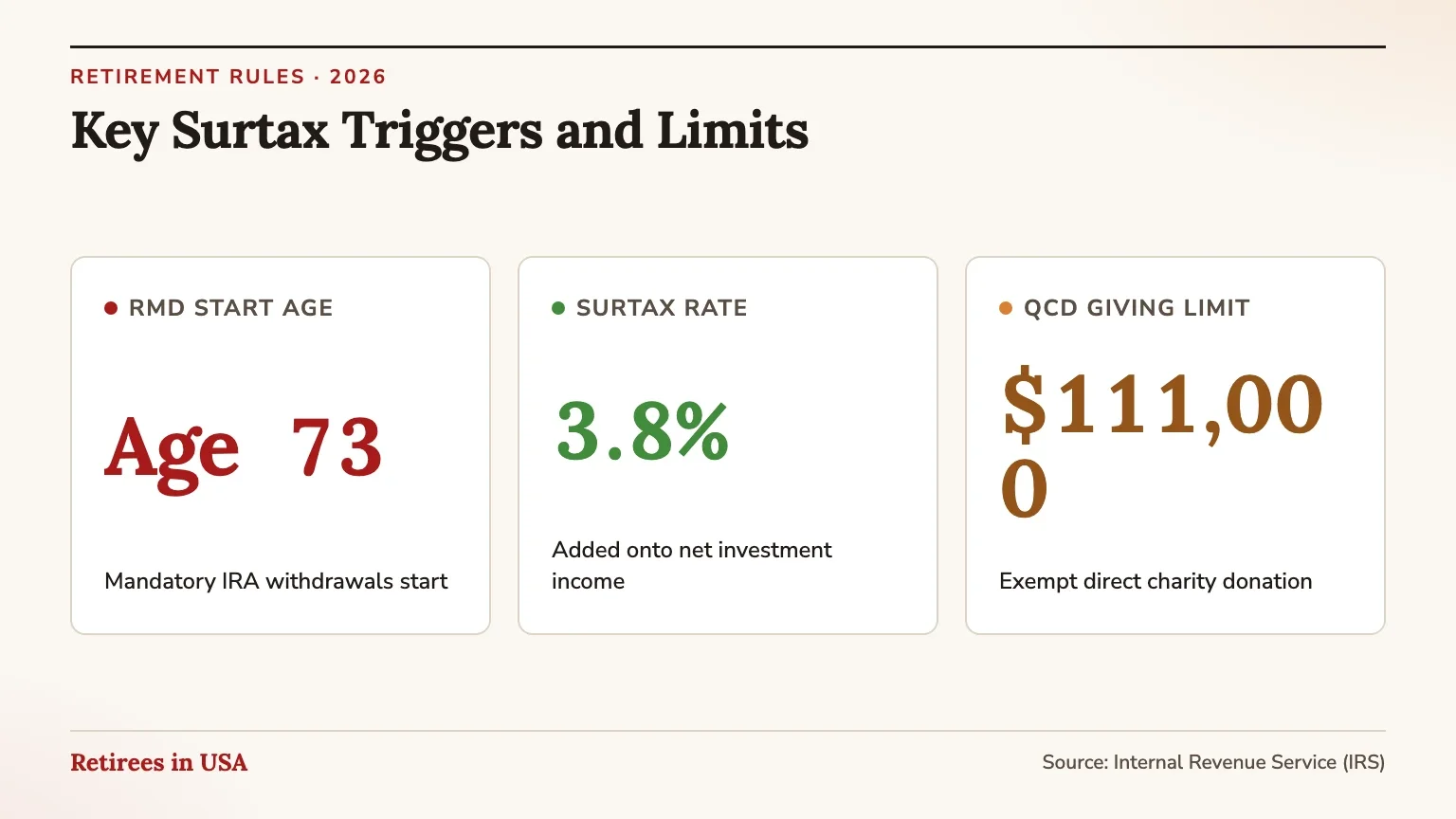
Under current law, Required Minimum Distributions (RMDs) begin at age 73 for people born between 1951 and 1959. These mandatory withdrawals can easily push unsuspecting retirees across the threshold.
You can explore distribution rules directly through IRS Retirement Plans resources. If you are 70½ or older, Qualified Charitable Distributions (QCDs) allow you to donate up to $111,000 in 2026 directly from an IRA without increasing your MAGI.
“It’s not how much money you make, but how much money you keep, how hard it works for you, and how many generations you keep it for.” — Robert Kiyosaki
The Widow’s Penalty and Trust Rules
Losing a spouse brings painful emotional grief and sudden tax complications. In the year of death, a surviving spouse can still file a joint return with the $250,000 threshold.
The following year, most surviving retirees must file as single taxpayers. That change drops their threshold by $50,000 down to $200,000, creating an unexpected tax cliff.
This drop often coincides with smaller standard deductions and higher Medicare Part B surcharges. You can check how income affects Medicare premiums at Medicare.gov.
Modest legal estates and trusts face an even steeper hurdle. For 2026, undistributed trust income triggers the 3.8% surtax at just $16,000 of income.
Don’t Make These Mistakes
Retirees often trigger the surtax because of timing errors. Avoiding these common mistakes can save thousands of dollars:
- Taking massive lump-sum IRA withdrawals in a single tax year.
- Completing large Roth conversions without checking your MAGI threshold.
- Selling a vacation home or rental property without planning for capital gains.
- Ignoring the impact of mandatory RMDs on your other taxable investments.
Spreading asset sales or Roth conversions over several calendar years keeps your MAGI below the cutoff. Careful timing protects your capital gains from the 3.8% charge.

When Professional Advice Is Worth It
Managing retirement income requires balancing multiple tax rules at once. The Consumer Financial Protection Bureau provides helpful retirement tools at CFPB Retirement.
Work with a certified public accountant (CPA) or fee-only financial planner before selling real estate or liquidating stocks. They can model multi-year withdrawal strategies to minimize surtax liability.
An estate planning attorney can also help you structure trusts properly. Distributing trust income directly to beneficiaries often prevents trusts from hitting the low $16,000 threshold.
Next Steps for Your Retirement Plan
Review your expected income each autumn before taking year-end distributions or capital gains. A few simple adjustments can keep your income under the threshold and protect your hard-earned wealth.
This article is for informational purposes only and does not constitute financial, legal, or medical advice. Medicare rules, Social Security benefits, and tax laws change regularly—verify current details at Medicare.gov, SSA.gov, or with a licensed professional.
Last updated: November 2026. Medicare and Social Security rules change annually—always verify current details at official government sources.