Millions of older Americans quietly leave thousands of dollars in state senior benefits on the table every year. Many assume their retirement savings or modest Social Security check automatically disqualifies them.
In reality, an online eligibility check takes about 10 minutes and requires no registration or Social Security number. A few basic household details can uncover help for groceries, Medicare premiums, prescriptions, utilities, and property taxes.
Whether you are checking for yourself or helping aging parents, knowing where to look turns a maze of agencies into one clear path.
Why Billions in State Senior Benefits Go Unclaimed
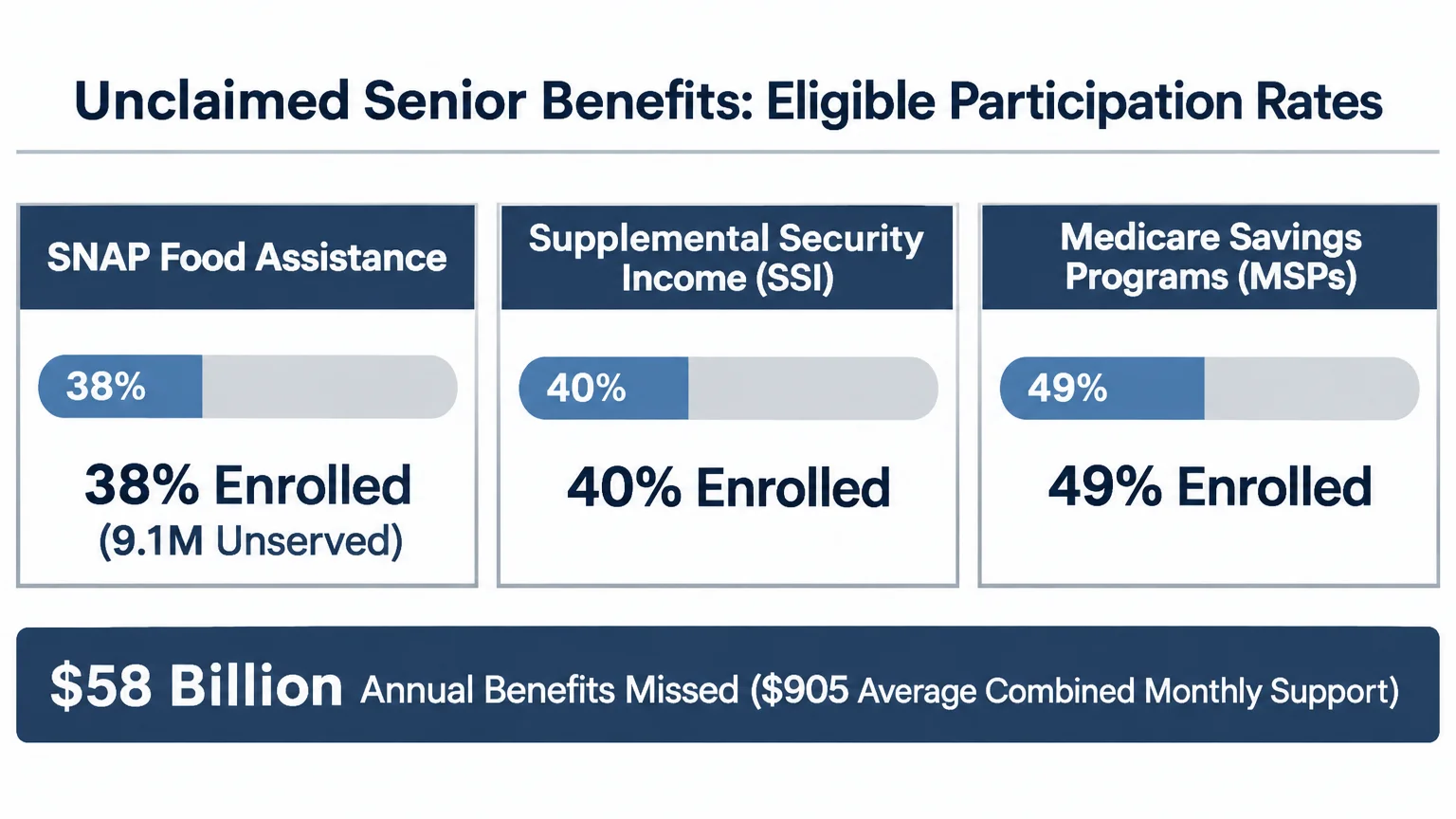
Confusion—not a lack of eligibility—keeps most retirees from getting support. According to a May 2026 National Council on Aging (NCOA) analysis of Urban Institute estimates, adults 65 and older miss out on $58 billion annually across three major programs.
Participation rates remain strikingly low among qualified seniors. Only 38% of eligible older adults enroll in SNAP food assistance, leaving 9.1 million qualified seniors unserved.
Enrollment sits at just 40% for Supplemental Security Income (SSI) and 49% for Medicare Savings Programs (MSPs). Together, those three programs alone average roughly $905 per month—nearly $10,862 a year—for an older adult who qualifies for all three.
Meanwhile, U.S. Census Bureau data cited by NCOA shows the poverty rate for Americans 65 and older climbed to 15% in 2024, surpassing the 12.9% national average. Checking your state’s options helps ensure your retirement budget covers rising healthcare and living costs.

Your 10-Minute Eligibility Check Step by Step
You do not need tax returns or bank statements to run an initial screen. Grab rough estimates of your monthly income, housing costs, and savings—then follow these four steps.
- Run a confidential benefits checkup: Visit NCOA BenefitsCheckUp, a free tool launched in 2001 that screens roughly 2,000 federal, state, and local programs using only your ZIP code and basic household answers.
- Check federal and state gateways: Because the federal government retired Benefits.gov in September 2024, official screening tools now live on USA.gov under its Benefit Finder and retirement sections.
- Review Medicare cost-relief options: Visit Medicare.gov or call your state Medicaid office if your monthly income hovers near federal thresholds, because many states apply much higher limits.
- Tap local community directories: Search the Eldercare Locator or dial 2-1-1 to connect with Area Agencies on Aging and local utility, food, or home-repair grants not always listed in national databases.
If you prefer talking with a person, call the NCOA helpline at 1-800-794-6559 Monday through Friday, 8 a.m. to 7 p.m. Eastern. Representatives walk you through the same 10-minute screening at no cost.
You can also call the Eldercare Locator at 1-800-677-1116 weekdays from 8 a.m. to 9 p.m. Eastern. That service connects callers to more than 600 Area Agencies on Aging and nearly 300 Native American aging programs nationwide.

Major Senior Assistance Programs and 2026–2027 Limits
State agencies administer most senior assistance programs using federal baselines, yet state-by-state rules vary dramatically. Knowing the current federal numbers gives you a reliable starting point before you check local exemptions.
In 2026, the federal poverty level stands at $15,960 per year for a single person and $33,000 for a family of four in the 48 contiguous states. Alaska and Hawaii set higher thresholds.
| Program | What It Covers | 2026–2027 Key Limits (48 States & D.C.) |
|---|---|---|
| Medicare Savings Programs (QMB, SLMB, QI) | Pays at least the 2026 Part B premium ($202.90/month); QMB also covers Part A and B deductibles and coinsurance | Monthly income up to $1,350–$1,816 (single) or $1,824–$2,455 (couple); resources up to $9,950 / $14,910 in 2026 |
| Medicare Part D Extra Help | $0 benchmark Part D premium, $0 deductible, and copays capped at $5.10 generic / $12.65 brand in 2026 ($5.80 / $14.40 in 2027) | 2026 income up to $23,940 (single) / $32,460 (couple); resources up to $18,090 / $36,100 in 2026 ($18,710 / $37,340 in 2027) |
| Supplemental Security Income (SSI) | Monthly cash payments for adults 65+ with limited income and assets, often triggering Medicaid and SNAP | Max $994/month (single) or $1,491 (couple) in 2026, rising 3.6% to $1,029 / $1,544 in Jan. 2027; $2,000 / $3,000 asset cap |
| SNAP (Adults 60+) | Monthly grocery funds up to $306 (1 person) or $562 (2 people) in FY 2027, with a $25 minimum benefit | Net income limit of $1,330/month (1 person) or $1,804 (2 people) through Sept. 2027; many states raise gross caps to 200% FPL |
| LIHEAP Utility Aid | Heating, cooling, and energy-crisis bill assistance | State caps between 110% FPL and 150% FPL or 60% of state median income; SNAP or SSI often qualifies automatically |
Several programs work together to stretch your dollars further. For instance, qualifying for an MSP pays at least the standard $202.90 per month Part B premium—saving you $2,434.80 a year—and automatically enrolls you in Part D Extra Help.
Applying for Extra Help directly through the Social Security Administration also triggers a state MSP review unless you opt out. Meanwhile, SNAP allows households 60 and older to deduct out-of-pocket medical bills over $35 monthly, including Part B and Medigap premiums.
State property tax relief offers another major win that national calculators sometimes miss. Texas grants homeowners 65 and older an extra $60,000 school homestead exemption plus a school-tax freeze with no income limit.
Pennsylvania’s Property Tax/Rent Rebate pays up to $1,000 for owners or renters 65 and older with incomes up to $48,110—counting only half of Social Security. New York’s Enhanced STAR sets a $110,750 income cap in 2026, rising to $113,550 in 2027.

Don’t Make These Mistakes
Small misconceptions stop thousands of eligible retirees from clicking submit on government help seniors rightfully earned. Watch out for these common pitfalls during your search.
- Assuming your home or car disqualifies you: Primary residences, one vehicle, and burial allowances up to $1,500 per person are excluded from Extra Help resource limits—and many states drop SNAP asset tests altogether.
- Stopping at federal income ceilings: Medicare.gov explicitly advises applying for MSPs even if your income exceeds federal numbers, because individual states frequently disregard extra income or raise limits.
- Forgetting annual renewals and deadlines: Programs like the Qualifying Individual (QI) MSP operate on first-come, first-served funding and require yearly reapplication, while state property tax rebates enforce strict filing cutoffs.
- Paying a fee or trusting unsolicited texts: Official agencies and trusted screening platforms never charge a fee to check eligibility or file applications.
Scammers routinely impersonate benefit offices to steal personal information. Federal agencies will never text you or message on WhatsApp demanding banking details, threatening benefit suspension, or asking for gift cards, wire transfers, payment apps, or cryptocurrency.
If someone demands payment for a benefits checkup or application, hang up immediately. Report suspected fraud to the Federal Trade Commission at ReportFraud.ftc.gov (1-877-382-4357) or the HHS Office of Inspector General at 1-800-447-8477.

When Professional Advice Is Worth It
Most retirees can complete an initial screening alone, yet complex state rules sometimes warrant expert guidance. Free, unbiased counselors can help you avoid costly paperwork errors before you ever pay for private advice.
Smart retirement planning means using every legitimate resource available so your savings stay invested for the years ahead.
Every state operates a State Health Insurance Assistance Program (SHIP), reachable at shiphelp.org, offering free one-on-one Medicare, MSP, and Extra Help counseling. You can also work with one of 88 NCOA Benefits Enrollment Centers across 39 states and Puerto Rico.
Consider hiring an elder law attorney or fee-only financial planner if you are navigating Medicaid long-term care asset rules, managing a special needs trust, or coordinating pensions with spousal Social Security benefits. Paid experts make sense when complex asset transfers—not standard benefit applications—are on the line.
Frequently Asked Questions
Can I qualify for state senior benefits if I own my home?
Yes. Your primary residence does not count against you for SNAP, Extra Help, LIHEAP, or Medicare Savings Programs, and homeownership actually unlocks state property tax exemptions or rebates in many states.
How often should I run a benefits checkup?
Run a quick screen once a year—ideally each autumn after Social Security and Medicare announce new limits—or anytime your income drops, your spouse passes away, or your medical expenses increase.
Will checking eligibility hurt my Social Security or Medicare benefits?
No. Running an eligibility screen is confidential and has zero impact on existing Social Security checks, Medicare coverage, or retirement accounts.

Take Your First 10 Minutes Today
Set a timer for 10 minutes, pull up BenefitsCheckUp or call your local Area Agency on Aging, and see which state senior benefits match your ZIP code. Even one newly uncovered program—like a Medicare Part B credit or property tax freeze—can free up hundreds of dollars every month.
Retirement rules and benefit amounts vary based on individual work history, income, and circumstances. This article provides general guidance only. Consult a SHIP counselor, financial advisor, or elder law attorney for advice specific to your situation.
Last updated: November 2026. Medicare and Social Security rules change annually—always verify current details at official government sources.