Caring for an aging parent or spouse takes serious time and money—family caregivers spend an average of 27 hours a week providing help and $7,242 a year out of pocket. Medicare generally does not cover ongoing custodial care at home.
Medicaid fills that gap for millions of families through programs that fund home care instead of nursing home stays. Every state and Washington, D.C., offers at least one Medicaid pathway allowing a family member to be paid as a caregiver.
Qualifying depends on your loved one’s income, assets, medical needs, and state rules. Understanding how self-directed programs work helps you claim support without triggering penalties.
How Self-Directed Medicaid Caregiver Programs Work
Medicaid funds two-thirds of all U.S. home care spending, serving roughly 5.3 million enrollees through home- and community-based services. Most states deliver paid family caregiver benefits through self-directed care models.
Under self-direction, your loved one—or an authorized representative—acts as the employer instead of using a traditional agency. They hire, schedule, and supervise the caregiver while a financial management service handles payroll.
States authorize these caregiver programs under different federal Medicaid rules, each carrying distinct requirements. All responding states except Alaska allow self-directed care in some programs, according to a 2026 KFF 50-state survey.
| Medicaid Pathway | How It Works | Key Feature |
|---|---|---|
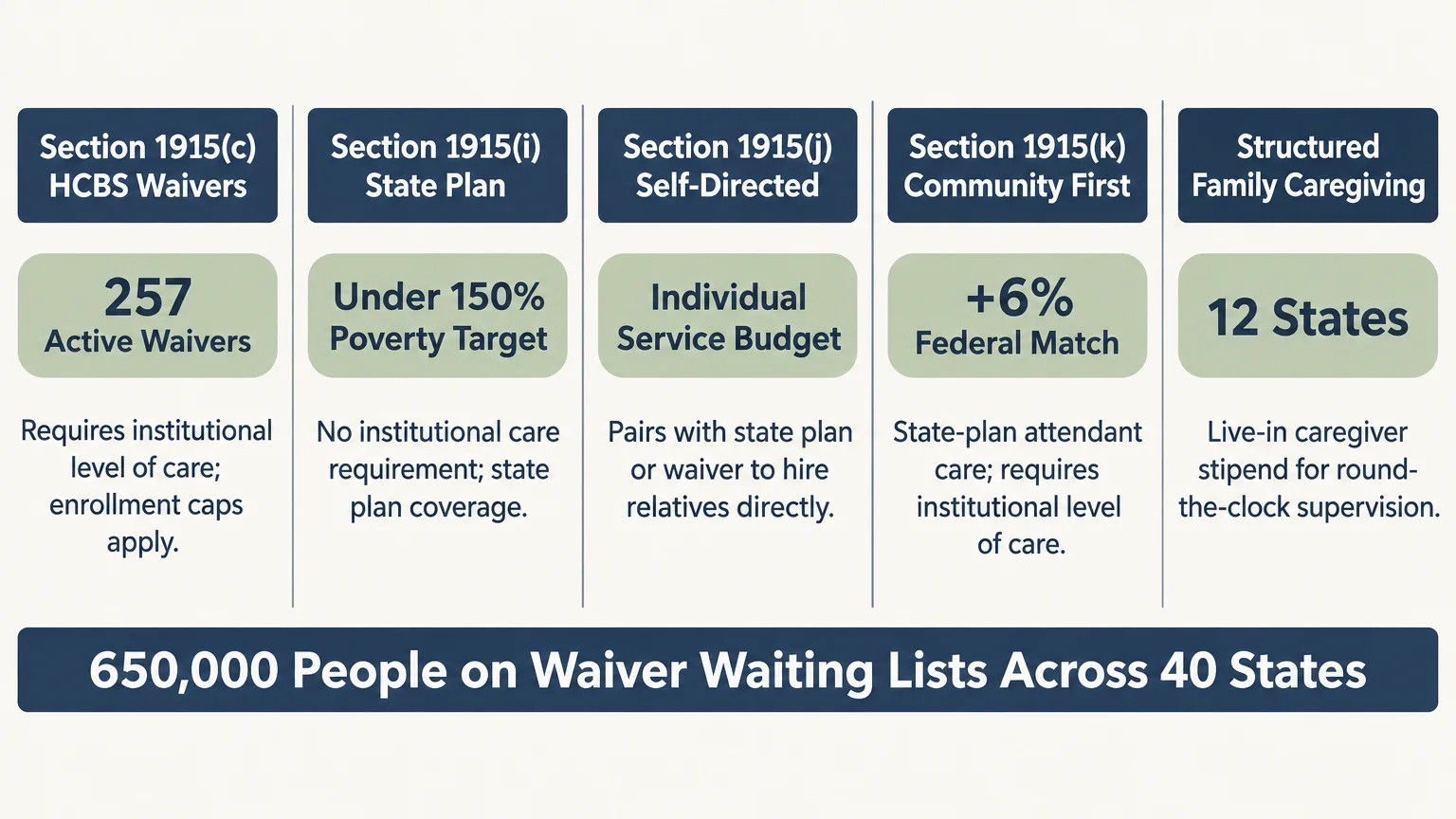
| Section 1915(c) HCBS Waivers | Funds home care instead of nursing home placement across roughly 257 active waivers. | Requires institutional level of care; enrollment caps apply. |
| Section 1915(i) State Plan | Covers home services directly under a state’s Medicaid plan. | No institutional care requirement; often targets under 150% of poverty. |
| Section 1915(j) Self-Directed | Provides an individual service budget to hire relatives directly. | Pairs with a state plan or waiver. |
| Section 1915(k) Community First | State-plan attendant care earning 6 extra federal match points. | Requires institutional level of care. |
| Structured Family Caregiving | Pays a live-in caregiver stipend for round-the-clock supervision. | Available in 12 states, including Georgia, Indiana, and Ohio. |
Section 1115 demonstration waivers also run managed long-term care programs in several states. Because states set their own waiver terms, covered hours and pay vary by zip code.
Waiting lists can delay when payments start. Across 40 states, nearly 650,000 people sit on home care waiver waiting lists in 2026, with older adults and people with physical disabilities making up a quarter of those waiting.

Who Qualifies as a Paid Family Caregiver—and Who Doesn’t
Most Medicaid waivers allow your loved one to hire adult children, siblings, grandchildren, nieces, nephews, or close friends. Caregivers typically pass a background check, meet minimum age rules, and complete basic orientation.
Paying a spouse or legal guardian is far more restricted under federal rules. Under Section 1905 state-plan personal care, federal law bars paying spouses and parents of minor children as legally responsible relatives.
Federal waiver rules allow states to pay a spouse for extraordinary care beyond normal marital duties to prevent institutionalization. Still, many states exclude spouses and Powers of Attorney, while Arizona, Illinois, New York, and Oregon allow spousal pay under specific programs.
Even where spouses cannot earn wages, Medicaid offers other family supports. Respite care is covered in 47 states, caregiver training in 33 states, and counseling or support groups in 23 states.
Explore local waiver programs through the Eldercare Locator or compare state rules via the Family Caregiver Alliance.

2026 Medicaid Income, Asset, and Spousal Eligibility Rules
Before Medicaid caregiver pay can begin, the care recipient must meet strict medical and financial criteria. Most states limit monthly income and countable assets, though a primary home, one vehicle, and modest burial funds are usually exempt.
For 2026, federal Supplemental Security Income standards anchor Medicaid long-term care limits nationwide. Review these key thresholds before applying:
- Monthly income cap: In the 41 states plus D.C. using the special income rule, a single applicant cannot exceed $2,982 per month, or $5,964 if both spouses apply.
- Standard asset limit: Most states cap countable assets at $2,000 for one person and $3,000 for a couple, with home equity caps between $752,000 and $1,130,000.
- Spousal protections: When one spouse needs care, the at-home spouse can keep up to $162,660 in assets and a monthly income allowance rising to $2,705 on July 1, 2026 (up to a $4,066.50 federal maximum).
- California’s 2026 limits: California reinstated Medi-Cal long-term care asset caps of $130,000 for one person and $195,000 for a couple on January 1, 2026, dropping to $21,000 and $31,000 on July 1, 2027.
Exceeding the monthly income cap does not automatically disqualify your loved one. Income-cap states often allow a Qualified Income Trust, while medically needy states let applicants spend down excess income on care.
Screen your parent or spouse for state benefits using BenefitsCheckUp. Checking early matters because 2025 federal budget legislation introduces Medicaid work requirements in 2027 that could pressure state waiver slots.

Caregiver Pay Rates, Tax Exemptions, and Electronic Visit Rules
Medicaid caregiver pay depends on your state, program, and approved weekly care hours. Nationally, family caregivers typically earn between $12 and $26 per hour, averaging about $18 per hour.
By comparison, median 2026 Medicaid payment rates to personal care agencies stand at $19 per hour. When a home care agency employs a live-in caregiver, federal labor rules require overtime pay after 40 hours per week.
Live-in caregivers often receive a major federal tax break under IRS Notice 2014-7. Qualified Medicaid waiver payments are excluded from federal gross income when you and the care recipient live in the same home.
This tax exclusion applies whether or not you are related, provided you care for no more than five adults in the household. Payments to non-live-in caregivers, vacation pay, and outside respite care remain taxable.
Eligible caregivers can still elect to count all excludable waiver income for the Earned Income Tax Credit or Additional Child Tax Credit. Verify with your payroll agency how Social Security and Medicare taxes apply.
Getting paid to care for someone you love does not diminish your devotion—it protects your own retirement savings so one generation’s health crisis does not drain the next generation’s future.
Most caregivers must also follow Electronic Visit Verification rules when logging shifts. Federal law requires recording six details—including service type, location, and start and end times—for in-home Medicaid personal care visits.
Although federal guidance exempts live-in caregivers from electronic tracking, states can set stricter standards. Texas and Arizona require it for live-in care, and Virginia ended its live-in exemption on October 1, 2026.

Errors That Cost Retirees Thousands
Applying for Medicaid support without checking transfer and tax rules can trigger months of unpaid delays. Avoid these expensive mistakes:
- Gifting assets before applying: Most states enforce a 60-month look-back period (30 months in California for transfers on or after January 1, 2026) that penalizes uncompensated transfers.
- Skipping a formal caregiver contract: Paying yourself from a parent’s savings without a written attorney-drafted agreement often counts as a disqualifying gift.
- Quitting work before approval: With 40 states holding waiver waiting lists, leaving your job too early can leave your household without income.
- Relying on Medicare.gov for daily care: Medicare covers short-term skilled health services, not ongoing custodial help with bathing or dressing.
- Mishandling live-in tax forms: Failing to document shared residency under IRS Notice 2014-7 can invite tax notices if your W-2 shows taxable wages.

When to Get Expert Help
Medicaid long-term care rules combine federal thresholds with state-level waiver restrictions. Work with an elder law attorney before transferring property, creating a Qualified Income Trust, or drafting a private family caregiver contract.
For free help comparing state waivers or navigating waiting lists, contact your local Area Agency on Aging or State Health Insurance Assistance Program counselor. A tax professional can also confirm how waiver wages affect your tax credits and Social Security earnings.
Frequently Asked Questions About Paid Family Caregivers
Can I get paid through Medicaid while keeping another job?
Yes, many self-directed programs allow part-time paid caregiving alongside outside employment. Roughly six in ten family caregivers hold outside jobs, though Medicaid only pays for approved care hours when you are actively assisting the recipient.
How long does it take to get approved for Medicaid caregiver pay?
Approval typically takes several weeks to a few months where waiver slots are open. If your state maintains a Section 1915(c) waiting list, ask about state-plan personal care options while you wait.
Can I be paid as a caregiver if my loved one is a veteran?
Yes, and veterans may access separate programs through the Department of Veterans Affairs, including Aid and Attendance or Veteran-Directed Care. Comparing options via AARP caregiving guides helps you pick the strongest benefit.
Call your state Medicaid office or local Area Agency on Aging today to ask which self-directed care waivers are open in your area. Gathering five years of financial statements and recent medical records now will streamline your application.
Information in this article reflects current rules as of the publication date and may change. Always confirm benefit details directly with Social Security Administration, Medicare.gov, or relevant government agencies before making decisions.
Last updated: November 2026. Medicare and Social Security rules change annually—always verify current details at official government sources.