Working past age 70 allows you to collect your maximum Social Security payout while earning an unlimited paycheck without benefit penalties. However, your monthly checks will never grow any larger simply by waiting longer to claim.
Continuing to work also creates unique tax ripples across your retirement income, from payroll withholdings to higher Medicare premiums. Knowing how these moving parts interact ensures you keep more of your hard-earned money.
Here is exactly what happens to your benefits, your taxes, and your bottom line when you stay on the job past 70.
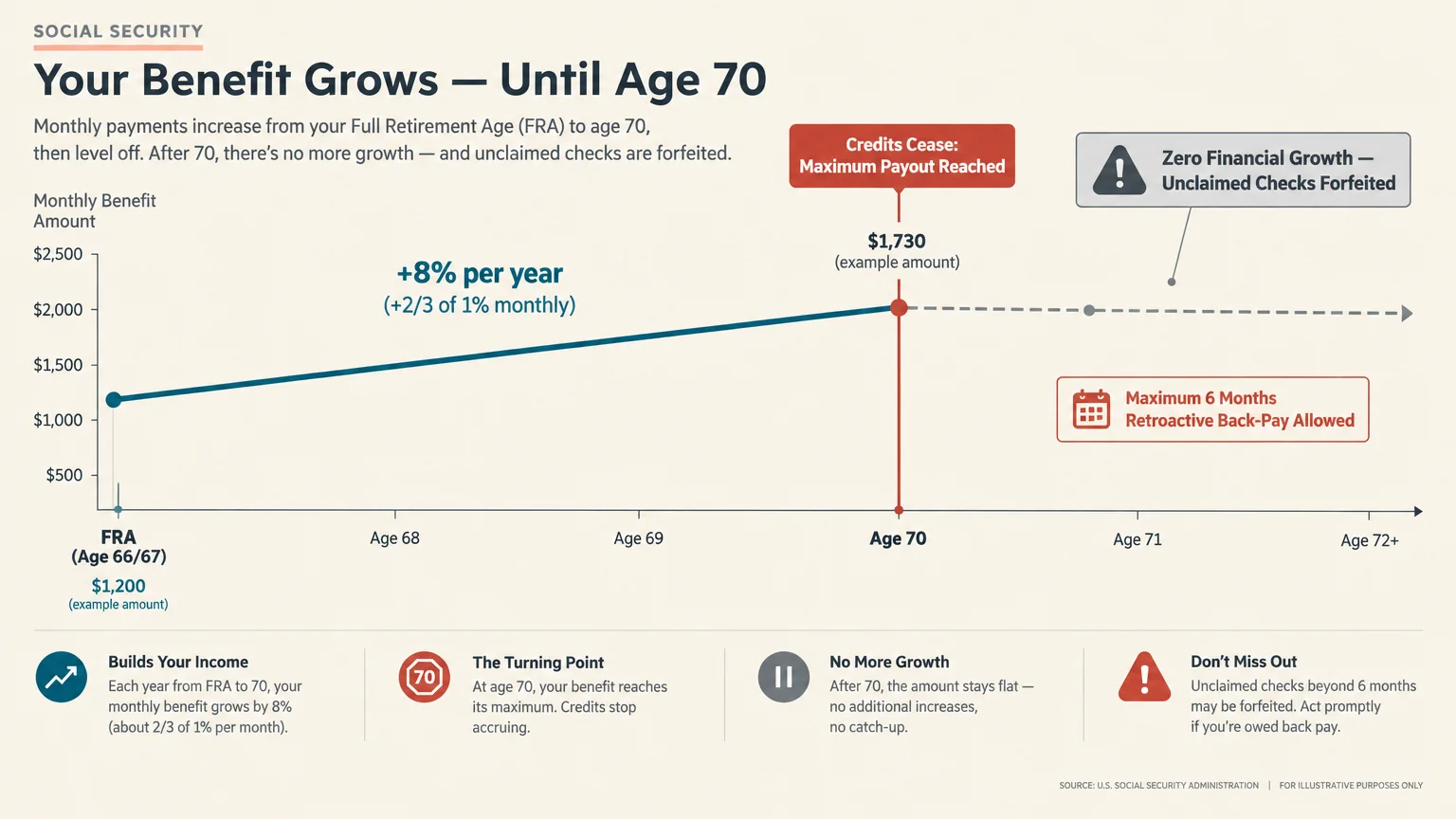
Delayed Retirement Credits Stop at Age 70
If you delay claiming Social Security past your Full Retirement Age (FRA), your monthly benefit grows through delayed retirement credits. These credits increase your eventual payout by 8% for every full year you wait—or two-thirds of 1% per month.
That growth ends permanently the month you reach age 70. There is zero financial incentive or bonus for delaying your application past your 70th birthday.
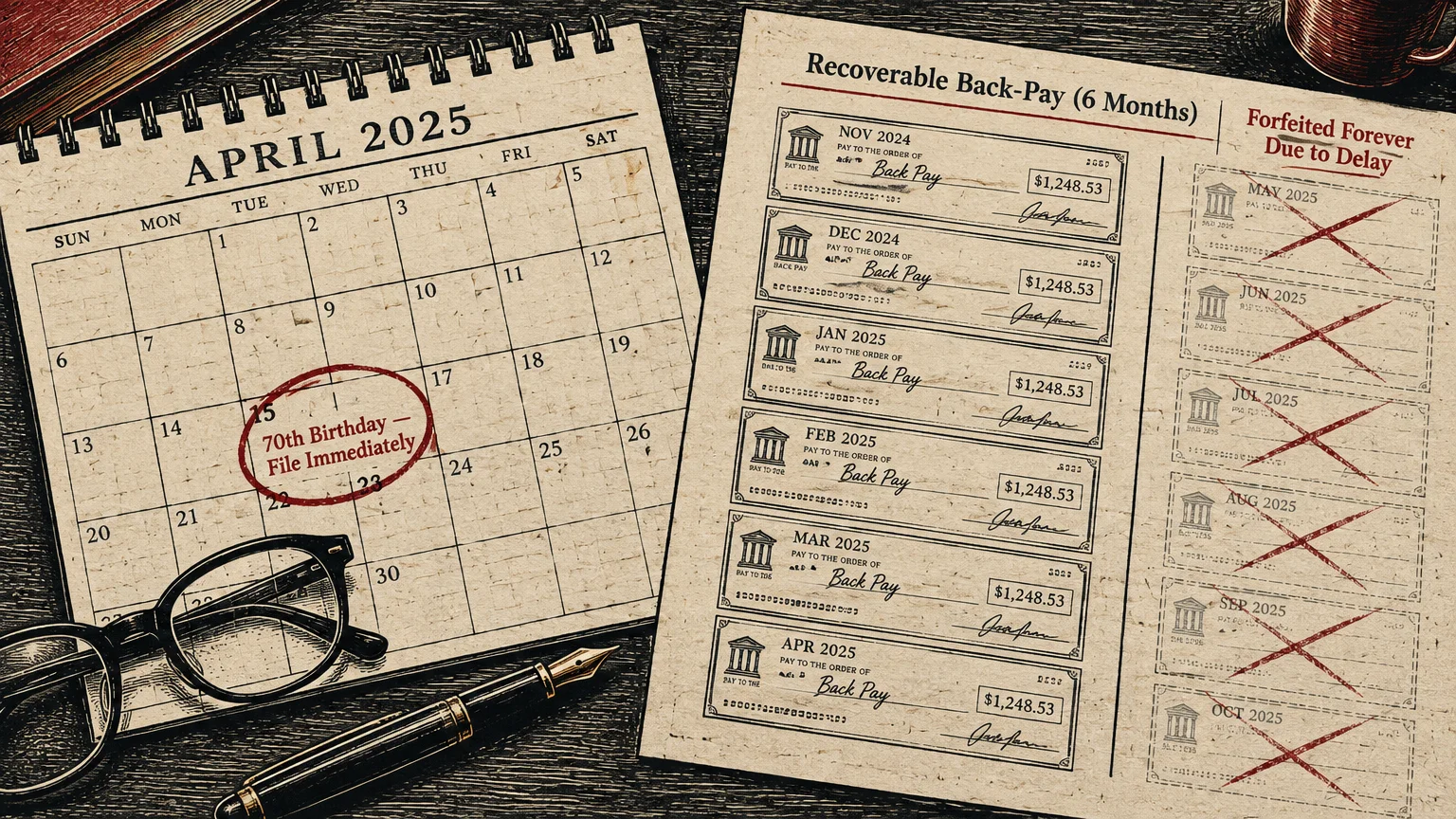
Every month you delay claiming past age 70 is simply money forfeited forever. Even if you plan to work full-time well into your seventies, file for your benefits immediately once you reach 70.
If you already passed age 70 without claiming, the Social Security Administration (SSA) allows a maximum of six months of retroactive payments. The agency issues these missed benefits as a single lump-sum payout.
Any delay beyond six months past age 70 causes permanent loss of monthly checks. For example, applying at age 71 means you can only recover six months of back pay, forfeiting the other six months completely.

No Earnings Limits: Keep Every Dollar of Your Check
One of the greatest financial advantages of working past age 70 is freedom from earnings caps. Early claimers—those collecting between age 62 and their FRA—face strict limits under the Retirement Earnings Test.
Before full retirement age, the government temporarily withholds benefits if your wages surpass annual earnings thresholds. That policy penalizes working retirees who choose to take benefits early.
Once you reach your Full Retirement Age, the Retirement Earnings Test disappears completely. You can earn an unlimited income from wages, bonuses, or business profits without sacrificing one cent of your Social Security.
Whether you earn $30,000 consulting or $300,000 running a business, you receive your full monthly benefit check on schedule. Working while collecting Social Security after age 70 allows you to maximize total cash flow without penalty.
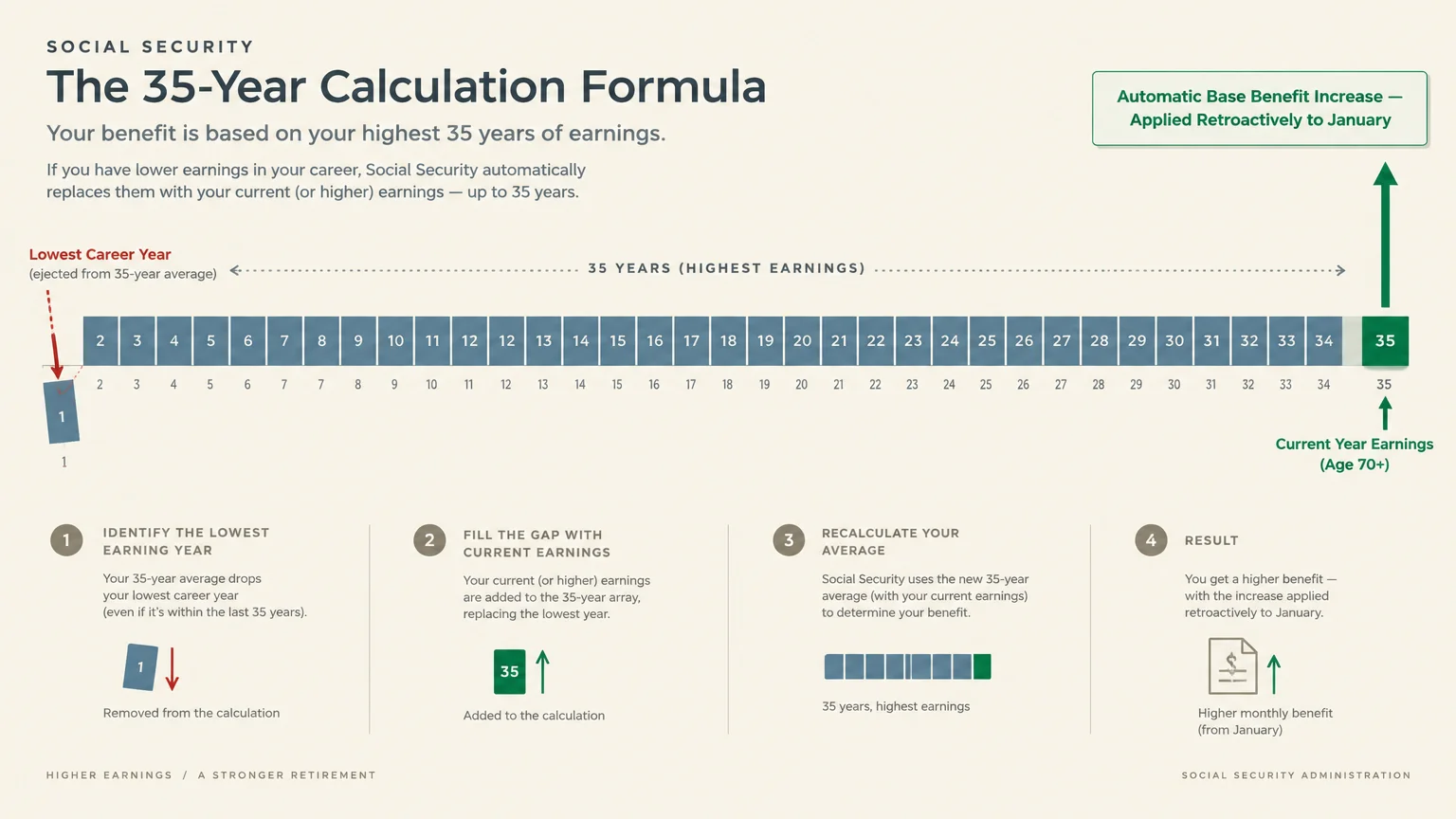
How Working Past 70 Can Still Increase Your Monthly Benefit
Your delayed retirement credits stop at 70, but your primary benefit formula never locks permanently. The government calculates your monthly retirement check based on your highest 35 years of indexed earnings.
If you earn more today than you did in one of your lowest-earning years, your new wages can boost your base benefit. This recalculation offers significant upside for professionals earning peak career wages in their seventies.
Many workers took time out of the workforce decades ago or earned modest wages early in their careers. Replacing a zero-earning year or a low-wage year with high current earnings directly lifts your average lifetime wage.
You do not need to call the SSA or submit extra paperwork to trigger this increase. The agency automatically scans your annual tax filings and recalculates your benefit amount every single year.
When current earnings push your 35-year average higher, the agency credits you with a larger monthly benefit. The SSA applies this adjustment retroactively to January of the year following your earnings.
You can track how your recent wages change your lifetime earnings record using the official Social Security Retirement Estimator.
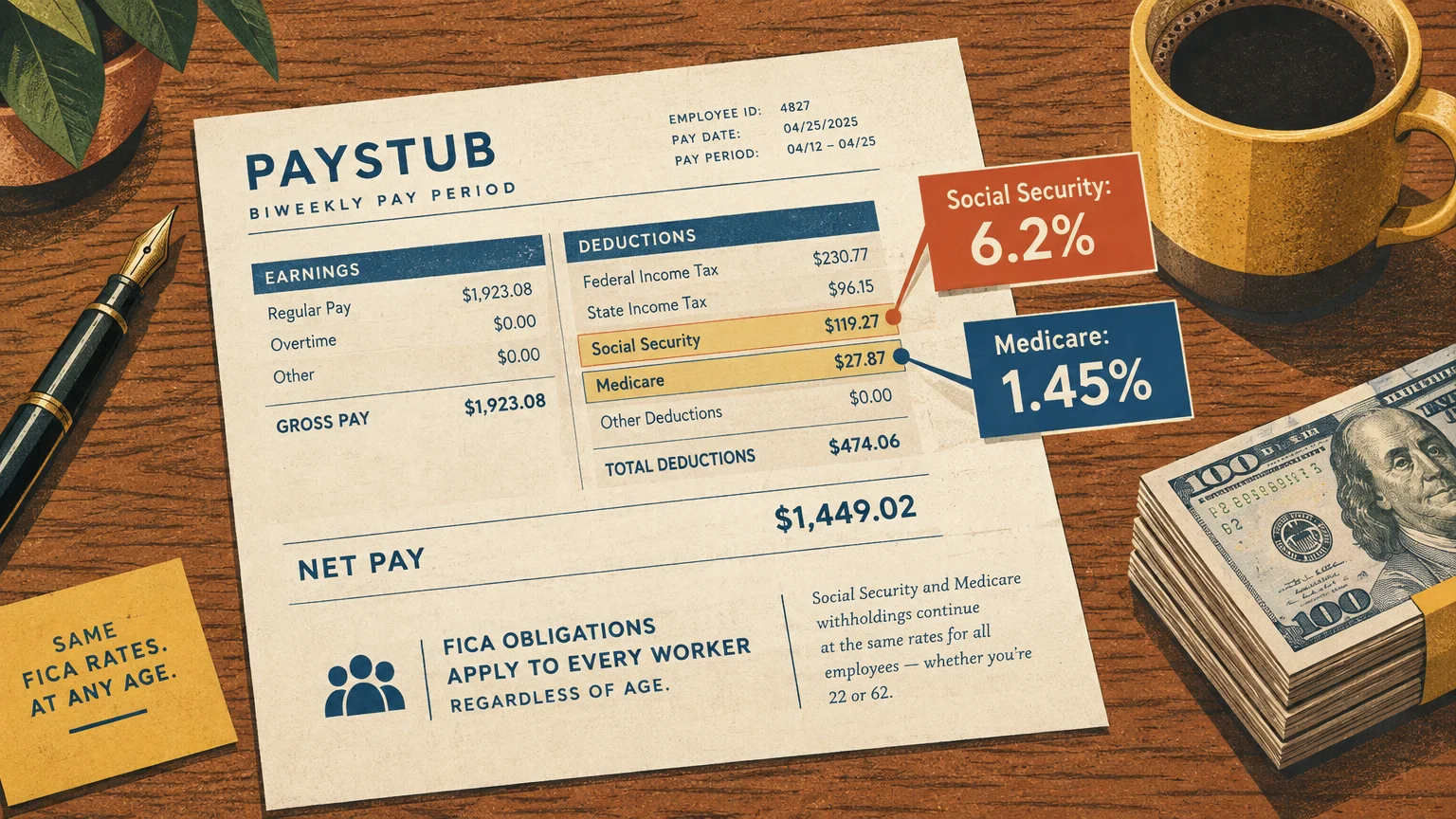
The FICA Tax Reality: Yes, You Still Pay Payroll Taxes
A common retirement myth suggests that once you collect Social Security, you no longer pay payroll taxes on your wages. In reality, federal payroll tax rules apply equally to all workers regardless of age.
Every paycheck you earn past age 70 remains subject to mandatory FICA withholdings. You must pay a 6.2% Social Security tax up to the annual wage cap.
For context, the Social Security wage base limit climbed to $168,600 in 2024, $176,100 in 2025, and reached $184,500 in 2026. Earnings above this annual threshold are exempt from the 6.2% Social Security portion.
However, the 1.45% Medicare tax applies to every single dollar you earn without any wage limit. High earners also face an additional 0.9% Medicare surtax once wages pass $200,000 for single filers or $250,000 for married couples.
If you operate as an independent contractor or business owner, you owe the full 15.3% self-employment tax. Review current tax obligations directly through IRS Retirement Plans guidelines.
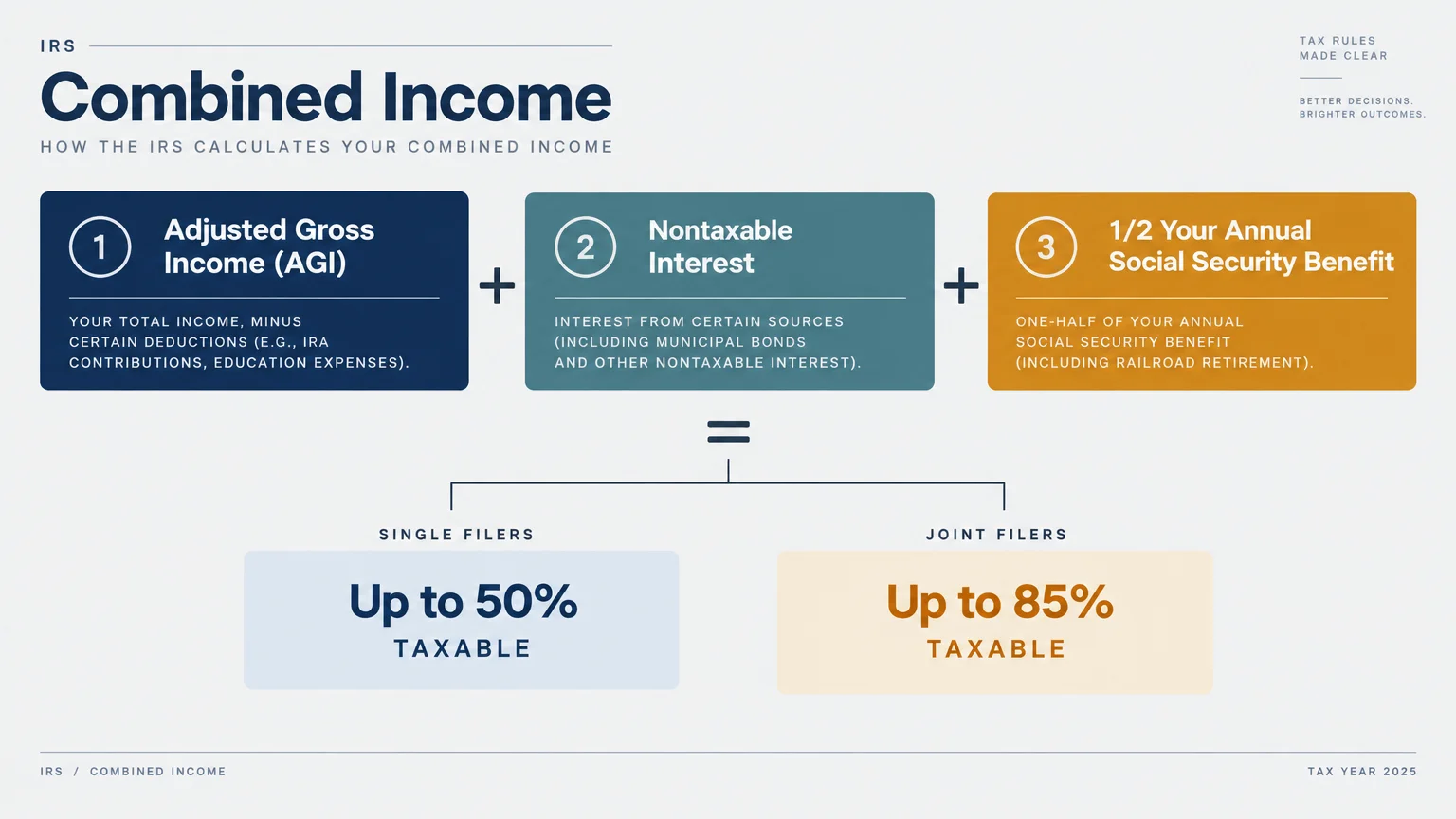
Taxes on Social Security: The Combined Income Formula
Working past age 70 often pushes a significant portion of your Social Security benefits into taxable territory. The IRS uses a specific metric known as combined income—or provisional income—to determine whether your benefits face federal taxes.
Your combined income equals your Adjusted Gross Income, plus any tax-exempt municipal bond interest, plus exactly half of your annual Social Security benefits. When this sum passes statutory limits, your benefits become subject to ordinary income tax.
For single filers, a combined income between $25,000 and $34,000 makes up to 50% of your Social Security benefits taxable. If your combined income surpasses $34,000, up to 85% of your benefits become taxable.
For married couples filing jointly, a combined income between $32,000 and $44,000 triggers taxation on up to 50% of benefits. Any joint combined income above $44,000 subjects up to 85% of your benefits to federal tax.
Congress established these thresholds decades ago and never adjusted them for inflation. Because wages past age 70 easily exceed these modest levels, most working seniors pay federal tax on 85% of their benefits.
“It’s not how much money you make, but how much money you keep, how hard it works for you, and how many generations you keep it for.” — Robert Kiyosaki
You can prevent surprise tax bills at filing time by requesting voluntary tax withholding directly from your monthly benefit. Submit IRS Form W-4V to the SSA to withhold 7%, 10%, 12%, or 22% from each payment.
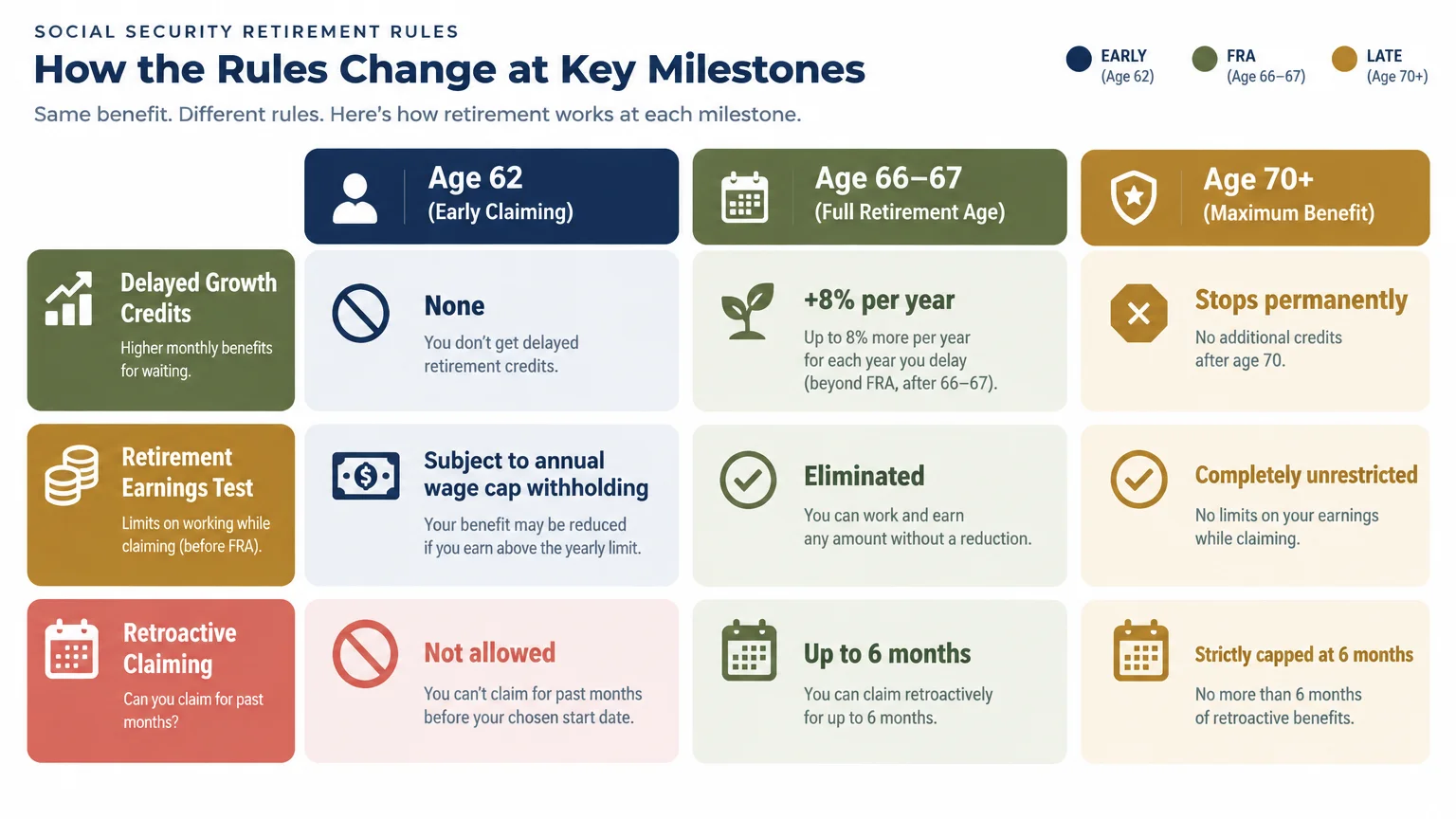
Comparing Your Benefit Rules Across Retirement Milestones
Social Security rules shift dramatically as you pass through different retirement ages. The following comparison illustrates how working influences your benefits before Full Retirement Age, between FRA and 69, and after age 70.
| Rule or Feature | Ages 62 to Full Retirement Age | FRA to Age 69 | Age 70 and Beyond |
|---|---|---|---|
| Retirement Earnings Test | Applies; benefits withheld if wages pass annual limits | None; earn unlimited wages with zero benefit withholding | None; earn unlimited wages with zero benefit withholding |
| Delayed Retirement Credits | Not available; permanent early claiming reduction applies | Earns 8% per year (two-thirds of 1% monthly) | Credits end completely; monthly check reaches maximum |
| Payroll Taxes (FICA) Owed | Yes; standard 7.65% employee tax or 15.3% self-employed | Yes; standard 7.65% employee tax or 15.3% self-employed | Yes; standard 7.65% employee tax or 15.3% self-employed |
| Benefit Recalculation | Yes; new earnings can replace lower past years in top 35 | Yes; new earnings can replace lower past years in top 35 | Yes; new earnings can replace lower past years in top 35 |
| Retroactive Claiming Window | Zero retroactive months allowed | Up to 6 months (cannot backdate before FRA month) | Strict 6-month maximum lump-sum retroactive window |
| Optimal Action Strategy | Delay claiming if earning significant wages | Delay claiming toward 70 to accumulate 8% yearly credits | Claim immediately; do not wait another month |
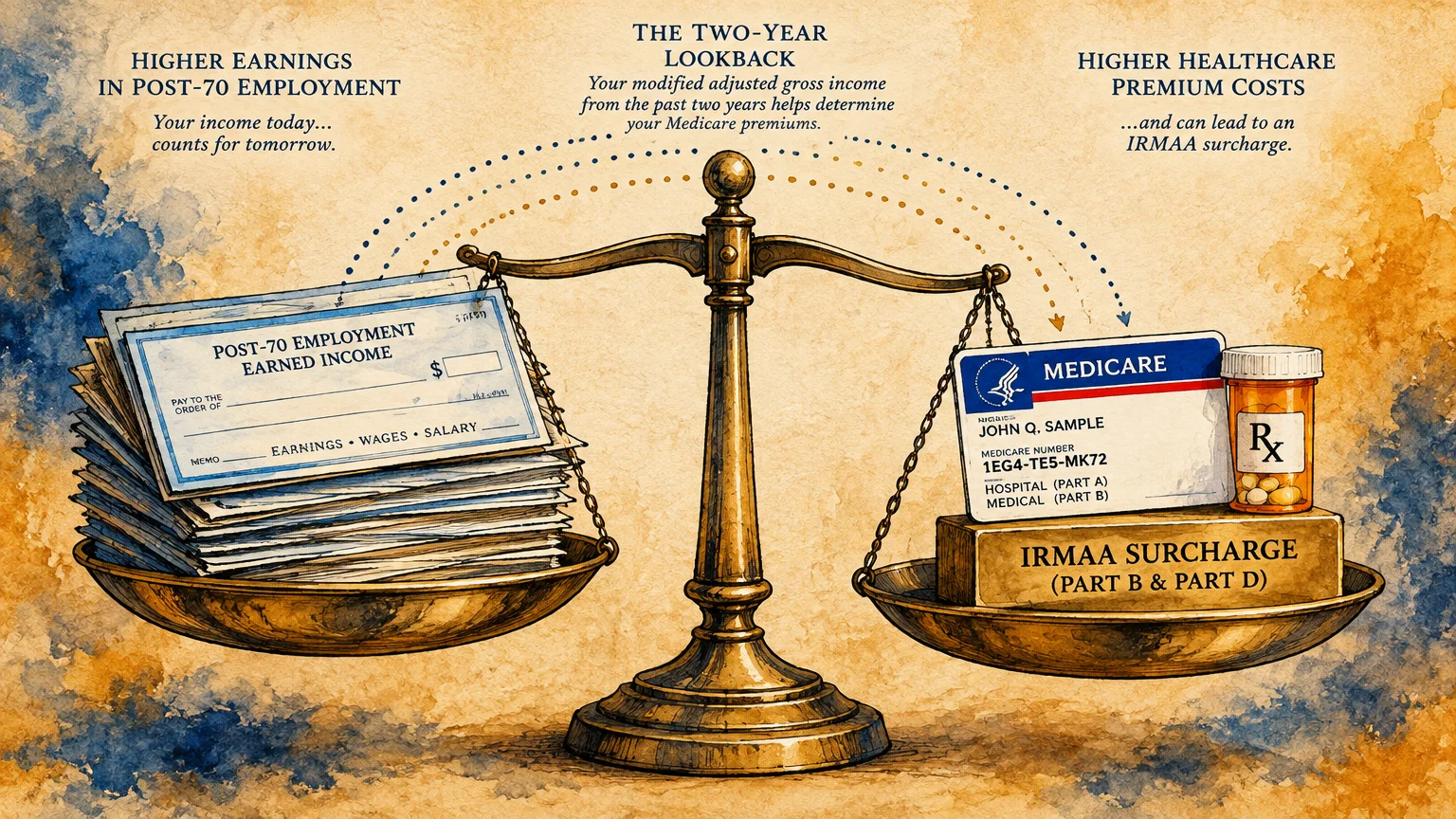
The Hidden Impact on Medicare Part B and Part D Premiums
Wages earned past age 70 can unintentionally drive up your healthcare expenses through Medicare surcharges. Standard Medicare Part B and Part D premiums assume your income stays below set thresholds.
If your Modified Adjusted Gross Income (MAGI) climbs above specific limits, the government assesses an Income-Related Monthly Adjustment Amount (IRMAA). This surcharge significantly increases your monthly Medicare deductions.
Medicare uses a two-year lookback period to establish your premium adjustments. Your earnings from age 70 dictate your Part B and Part D premiums when you reach age 72.
In 2025, IRMAA surcharges kicked in when MAGI exceeded $106,000 for individuals and $212,000 for married couples. In 2026, baseline surcharge tiers moved to $109,000 for single filers and $218,000 for joint returns.
Review comprehensive tier structures and baseline premium standards through Medicare.gov before planning your annual wage targets. High earnings can easily push your monthly Part B payment from standard levels to several hundred dollars extra per person.
When you eventually stop working or reduce your hours, you can appeal an IRMAA surcharge using Form SSA-44. A permanent drop in work hours qualifies as a recognized Life-Changing Event that allows Medicare to recalculate premiums immediately.
Errors That Cost Retirees Thousands
Navigating benefits past age 70 involves subtle rules that catch even seasoned professionals off guard. Avoiding common operational mistakes protects your lifetime income from permanent losses.
- Waiting past age 70 to claim benefits: Believing monthly checks continue growing after 70 is a severe mistake. Delaying past age 70 and six months permanently forfeits uncollected benefits.
- Assuming payroll taxes stop after retirement: Many working seniors budget without accounting for FICA withholdings. You must always account for the 7.65% payroll deduction on every earned paycheck.
- Ignoring the Medicare IRMAA two-year lookback: Earning an extra $2,000 at age 70 could cross an IRMAA bracket. That minor raise might cost you thousands in higher Medicare Part B and Part D premiums two years later.
- Failing to request retroactive benefits when claiming late: If you file at age 70 and four months, request your retroactive lump sum. Otherwise, you forfeit months of checks you rightfully earned.
- Neglecting estimated quarterly tax payments: Combining wages with taxable Social Security checks can produce an underpayment penalty. Set up withholding using Form W-4V or send quarterly estimated payments to the IRS.
“The goal of retirement is to live off your assets—not live off your regrets.”
Carefully mapping your wage income against these common friction points keeps your wealth intact. Strategic timing prevents unexpected tax penalties from eroding your paycheck.

When to Get Expert Help
Coordinating wage income, Social Security, and healthcare premiums requires careful tax forecasting. Professional advisors can model scenarios that maximize your take-home pay while keeping benefits efficient.
Schedule a consultation with a Certified Financial Planner (CFP) or CPA if your annual wages exceed the single or joint IRMAA brackets. An accountant can suggest pretax retirement contributions to keep your MAGI under key surcharge thresholds.
Contact a claiming specialist or visit your local SSA office if you are approaching age 70. They can verify your maximum benefit date and ensure your retroactive claiming window remains completely intact.
If you transition from employer health coverage to Medicare while continuing to work, consult your State Health Insurance Assistance Program (SHIP). SHIP counselors provide free, unbiased guidance on coordinating employer group health plans with Medicare Part B.
Frequently Asked Questions About Working Past 70
Do I have to start collecting Social Security at age 70 if I am still working?
You are not legally forced to claim benefits, but delaying past 70 offers zero financial advantage. Your benefits stop growing at 70, meaning further delay simply throws away earned money.
Will working past 70 ever lower my Social Security monthly benefit?
No, working will never decrease your Social Security benefit check. New earnings only replace lower historical years if they are higher, which either increases your benefit or leaves it unchanged.
Can I collect a retroactive payout if I waited until 71 to apply?
The SSA limits retroactive payments to a strict maximum of six months. If you apply at 71, you receive six months of back pay, but the remaining six months are permanently lost.
Do I still have to pay Social Security taxes if I am already receiving my maximum benefit?
Yes, federal law requires FICA tax withholdings on all earned employment wages regardless of your age or benefit status. Employers must withhold 6.2% for Social Security and 1.45% for Medicare.
Does earning a paycheck past 70 impact my spouse’s benefits?
Your ongoing wages do not reduce your spouse’s benefits because the earnings penalty ends at Full Retirement Age. Furthermore, if your earnings increase your primary benefit through recalculation, your spouse’s survivor benefit potential also rises.
Action Steps for Working Past 70
If you are approaching age 70 or currently working past this milestone, log into your personal Social Security account today. Confirm your earnings history, calculate your maximum benefit payout, and file your claim no later than your 70th birthday month.
Coordinate your total expected wages with a tax advisor to prepare for benefit taxation and Medicare IRMAA tiers. Taking proactive control of these rules ensures you reap the full financial rewards of staying active in the workforce.
Information in this article reflects current rules as of the publication date and may change. Always confirm benefit details directly with Social Security Administration, Medicare.gov, or relevant government agencies before making decisions.
Last updated: February 2026. Medicare and Social Security rules change annually—always verify current details at official government sources.