Your Social Security earnings history provides far more than just a personal monthly retirement check; it serves as a foundational financial safety net for your entire household. Millions of Americans miss out on thousands of dollars each year simply because they do not realize which relatives qualify for auxiliary payments based on their work record. By understanding family members eligible for Social Security benefits, you can unlock critical financial support for your spouse, children, former partners, and even dependent parents. Whether you are currently collecting retirement benefits or preparing your future claiming strategy, reviewing these nine eligible relative categories ensures your family receives every dollar you earned through decades of hard work.

1. Your Current Spouse
Your current spouse can collect monthly benefits based on your earning history once you apply for your own retirement benefits. Under standard rules, a spouse can receive up to 50% of your Primary Insurance Amount (PIA)—the benefit you qualify for at your Full Retirement Age (FRA). For instance, if your full retirement benefit equals $2,800 per month, your spouse could collect up to $1,400 per month on your record.
To qualify for spousal Social Security benefits, your spouse must be at least 62 years old, and your marriage must have lasted for at least one continuous year prior to applying. If your spouse claims benefits before reaching their own Full Retirement Age, the Social Security Administration reduces their monthly payment permanently. Furthermore, spousal benefits do not earn delayed retirement credits; they max out once your spouse reaches Full Retirement Age.

2. Your Divorced Spouse
Many retirees feel surprised to learn that an ex-spouse can collect benefits based on their employment record without affecting anyone else’s monthly payout. If you were married to your former spouse for at least 10 consecutive years, your ex-spouse may qualify for up to 50% of your primary insurance amount.
To claim dependent Social Security benefits as a divorced spouse, your ex-partner must meet the following criteria:
- They must be at least 62 years old.
- They must remain currently unmarried (remarrying generally terminates eligibility for benefits on your record).
- Their own earned Social Security benefit must be lower than the benefit available on your record.
Additionally, if you have been divorced for at least two continuous years, your ex-spouse can claim benefits on your record even if you have not claimed your own retirement benefits yet, provided you are at least 62 years old. Any benefit paid to a divorced spouse operates independently and will never reduce your monthly payment or the benefits payable to your current spouse.

3. Your Minor Children
If you collect retirement or disability benefits, your unmarried minor children can receive monthly auxiliary payments based on your earning record. A minor child can collect up to 50% of your full retirement benefit while you are alive, or up to 75% if you pass away.
To receive payments, your child must meet basic age and status requirements:
- Be under age 18.
- Be up to age 19 if they remain enrolled full-time in an elementary or secondary school (high school).
- Be biological, legally adopted, or an eligible stepchild who relies on you for financial support.

4. Your Disabled Adult Child (DAC)
Social Security provides specialized financial assistance to adult children who developed a severe, disabling condition early in life. If you have an unmarried child aged 18 or older whose qualifying disability began before age 22, they can collect Disabled Adult Child (DAC) benefits on your earnings record.
An eligible adult child can receive up to 50% of your full retirement benefit while you live, and up to 75% as a survivor benefit after your death. These payments do not require the child to have a personal work history. Instead, the Social Security Administration evaluates the child’s medical documentation and bases the benefit entirely on your covered earnings. Securing DAC status also often provides a crucial pathway to Medicare coverage for your child.

5. A Young Spouse Caring for Your Dependent Child
Age requirements change dramatically when minor or disabled children are involved. If you are collecting retirement or disability benefits, your spouse can receive spousal benefits at any age if they care for your child who is under age 16 or disabled.
This “caring spouse” benefit pays up to 50% of your Primary Insurance Amount while you are living, and up to 75% if you pass away. The age-62 minimum requirement is completely waived in this scenario. However, once the child turns 16 (unless the child is disabled), the caring spouse benefit pauses until the spouse reaches age 62 and qualifies for standard spousal payments.

6. Your Surviving Spouse (Widow or Widower)
When you pass away, your surviving spouse can transition from standard spousal benefits to survivor benefits, which offer significantly higher monthly payouts. A surviving spouse can claim up to 100% of the benefit you were receiving—or were entitled to receive—at the time of your death, including any delayed retirement credits you accrued by waiting past Full Retirement Age to file.
Surviving spouses can claim reduced survivor benefits starting as early as age 60, or as early as age 50 if the surviving spouse has a qualifying disability. If your spouse waits until their own Full Retirement Age to claim survivor benefits, they receive the full 100% survivor payout. You can review your projected survivor payouts by logging into your account on the Social Security Administration (SSA) website.

7. Your Surviving Divorced Spouse
If you pass away, your former marriage partner may qualify for survivor benefits based on your work history. A surviving divorced spouse can collect up to 100% of your primary benefit, provided your marriage lasted at least 10 consecutive years.
Similar to surviving spouses, a surviving ex-spouse can begin collecting reduced survivor payments at age 60 (or age 50 if disabled). Remarrying after age 60 (or age 50 if disabled) does not impact their eligibility for survivor benefits on your record. Just like living divorced spouse benefits, survivor benefits paid to a former spouse do not decrease payments allocated to your surviving current spouse or children.

8. Your Dependent Parents
One of the most overlooked aspects of Social Security family eligibility is the dependent parent benefit. If you pass away, your elderly parents may qualify for monthly survivor payments based on your lifetime work record if they depended on you for their livelihood.
To qualify for dependent parent survivor benefits, your parents must meet strict financial and age criteria:
- They must be at least 62 years old.
- They must prove they received at least half (50%) of their financial support from you at the time of your death.
- They must not be entitled to a personal retirement benefit that equals or exceeds your benefit amount.
If one parent qualifies, they can receive up to 82.5% of your Primary Insurance Amount. If both of your surviving parents qualify, each parent can receive up to 75% of your primary insurance amount.

9. Your Dependent Grandchildren and Stepchildren
Under specific family circumstances, your grandchildren or step-grandchildren can collect benefits on your Social Security record. Generally, grandchildren qualify for dependent Social Security benefits only if their biological parents are deceased or disabled, and the grandparent provides primary care.
To establish eligibility, the grandchild must have lived with you for at least one full year before you became entitled to retirement or disability benefits, and you must have provided at least 50% of the child’s financial support during that timeframe. Legally adopting your grandchild simplifies this process and automatically qualifies them under standard child benefit rules.
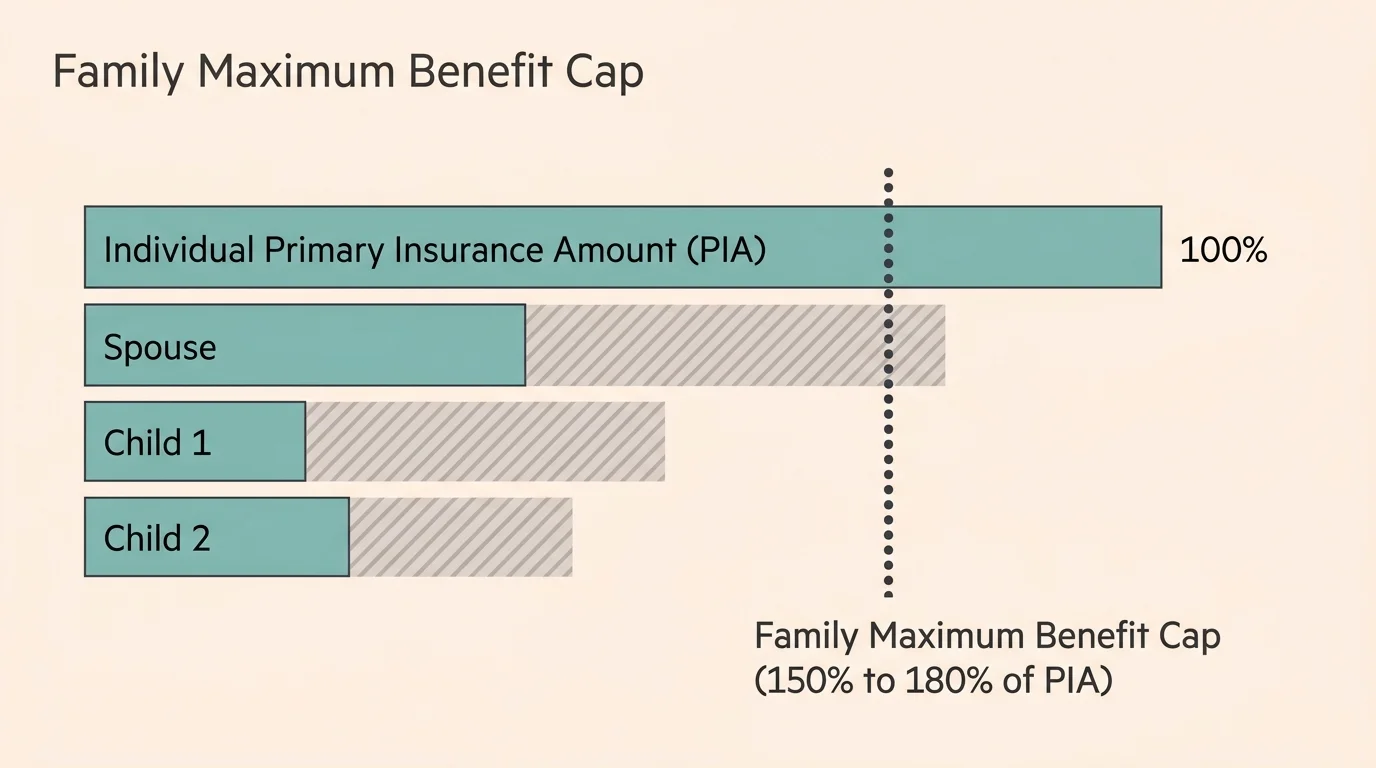
Understanding the Family Maximum Benefit Cap
While multiple family members can collect payments on your record, the Social Security Administration enforces a hard limit on total monthly family payouts. This limit is known as the Family Maximum Benefit cap. The cap typically ranges between 150% and 188% of your Primary Insurance Amount.
If the combined total of auxiliary benefits payable to your spouse and children exceeds this family maximum, Social Security proportionally reduces the benefits paid to your dependents. Your personal retirement check is never reduced; the limit applies strictly to the secondary payments distributed to your family members. Crucially, benefits paid to a divorced spouse do not count toward your Family Maximum Benefit cap.
“It’s not how much money you make, but how much money you keep, how hard it works for you, and how many generations you keep it for.” — Robert Kiyosaki

Comparing Social Security Family Benefits
Understanding who qualifies for benefits on your record requires comparing age thresholds, support rules, and potential monthly percentages. The table below outlines how benefits break down across eligible family members.
| Family Member Category | Minimum Age Threshold | Max Benefit % (Living Worker) | Max Benefit % (Deceased Worker) | Key Eligibility Condition |
|---|---|---|---|---|
| Current Spouse | 62 (or any age if caring for child) | 50% of PIA | 100% of earned benefit | Married for at least 1 year. |
| Divorced Spouse | 62 (60 for survivor benefits) | 50% of PIA | 100% of earned benefit | Married for 10+ consecutive years; currently unmarried. |
| Minor Child | None (under 18, or 19 in high school) | 50% of PIA | 75% of PIA | Unmarried child or eligible stepchild. |
| Disabled Adult Child | 18 or older | 50% of PIA | 75% of PIA | Disability began prior to age 22; unmarried. |
| Caring Young Spouse | Any age | 50% of PIA | 75% of PIA | Caring for worker’s child under 16 or disabled. |
| Dependent Parent | 62 | N/A | 82.5% (1 parent) / 75% each (2 parents) | Worker provided 50%+ of parent’s financial support. |
| Dependent Grandchild | Under 18 (or 19 in high school) | 50% of PIA | 75% of PIA | Parents disabled/deceased; lived with grandparent. |

Errors That Cost Retirees Thousands
Navigating Social Security family eligibility requires precision. Simple misunderstandings of government rules frequently result in thousands of dollars in lost household income. To protect your family’s earnings, avoid these costly errors:
- Failing to report divorced marriages: Many retirees assume that a past divorce erases benefit entitlement. If your marriage lasted 10 years, your ex-spouse should evaluate claiming options using your record—it will not lower your current spouse’s payments.
- Stopping minor child benefits early: Benefits do not automatically terminate on a teenager’s 18th birthday if they remain enrolled full-time in high school. Filing secondary school attendance forms with SSA extends benefits until graduation or age 19.
- Ignoring the Earnings Test: If you or your dependents claim benefits before reaching Full Retirement Age while continuing to work, SSA applies an earnings limit test. Exceeding this annual threshold reduces monthly payouts across dependent benefits.
- Overlooking adult disabled children: Families often forget to transition a disabled adult child onto a retired parent’s work record. Claiming DAC benefits often yields a significantly higher payout than SSI (Supplemental Security Income) and preserves lifetime medical coverage.
- Claiming retirement benefits too early: Because spousal and survivor benefits base their limits on your underlying primary insurance amount, claiming your retirement benefits early permanently lowers the baseline maximums available to your surviving spouse.

When to Get Expert Help
Determining spousal and child Social Security benefits can get complex, especially when blending family structures, disability claims, and past divorces. Knowing when to engage professional resources prevents costly claiming mistakes.
Consider seeking external advice under the following scenarios:
- Contacting the Social Security Administration: Use the official Social Security Retirement Estimator tool or schedule an appointment with your local SSA office to verify exact primary insurance amounts.
- Working with a Fee-Only Financial Planner: Consult an accredited financial advisor to run timing simulations when coordinating spousal benefits, pension offset rules, and tax strategies.
- Consulting an Elder Law Attorney: If you care for an adult child with special needs or provide full care for aging parents, an elder law specialist can structure trusts and verify eligibility under dependent parent or DAC regulations.
- Utilizing Community Support: Connect with government-backed navigation assistance through the Eldercare Locator or explore low-income family benefit programs via the National Council on Aging (NCOA).
Frequently Asked Questions About Family Social Security Benefits
Does my ex-spouse claiming benefits on my record reduce my current spouse’s benefit?
No. Payments awarded to a divorced spouse operate independently under federal law. Claiming benefits as an ex-spouse does not impact your monthly retirement check, nor does it lower the monthly payments available to your current spouse or dependent children.
Can my minor child collect benefits if I claim my retirement benefit at age 62?
Yes. Once you officially claim your monthly retirement benefits, your eligible minor children can receive auxiliary payments. However, claiming your retirement benefit at age 62 permanently reduces your Primary Insurance Amount, which subsequently lowers the 50% auxiliary check calculated for your child.
What happens to family benefits if I return to work before my Full Retirement Age?
If you collect retirement benefits before reaching Full Retirement Age and earn income above the annual earnings limit, the Social Security Administration temporarily withhold benefits. This withholding applies not only to your personal check but also to the auxiliary benefits paid to your dependents based on your work record.
Do spousal benefits earn Delayed Retirement Credits after Full Retirement Age?
No. Unlike primary worker retirement benefits—which increase by 8% per year for every year delayed past Full Retirement Age up to age 70—spousal benefits max out completely when your spouse reaches their Full Retirement Age. Spouses gain no financial advantage by delaying a spousal claim past their FRA.
Taking the Next Step for Your Family’s Security
Unlocking the full value of your Social Security record requires looking beyond your individual retirement check. By identifying every relative who qualifies for auxiliary or survivor benefits, you ensure that your decades of contributions support your household across generations. Take time this week to gather birth certificates, marriage licenses, and past marriage documentation, then run updated financial projections to confirm your family claims every dollar earned.
Retirement rules and benefit amounts vary based on individual work history, income, and circumstances. This article provides general guidance only. Consult a SHIP counselor, financial advisor, or elder law attorney for advice specific to your situation.
Last updated: February 2026. Medicare and Social Security rules change annually—always verify current details at official government sources.