Women receive an average Social Security check of $1,872.43 per month, which trails the average payment for men by nearly $410. Knowing how your monthly benefit changes at each claiming age helps you secure the largest possible payout for your retirement.
Your claiming age directly controls whether you face a permanent 30 percent reduction or gain an 8 percent annual boost. Understanding these official benchmarks gives you the power to protect your long-term financial security.
This comprehensive guide breaks down the latest payment data across every retirement age and outlines actionable claiming strategies for women.
The Current Landscape of Social Security Benefits for Women
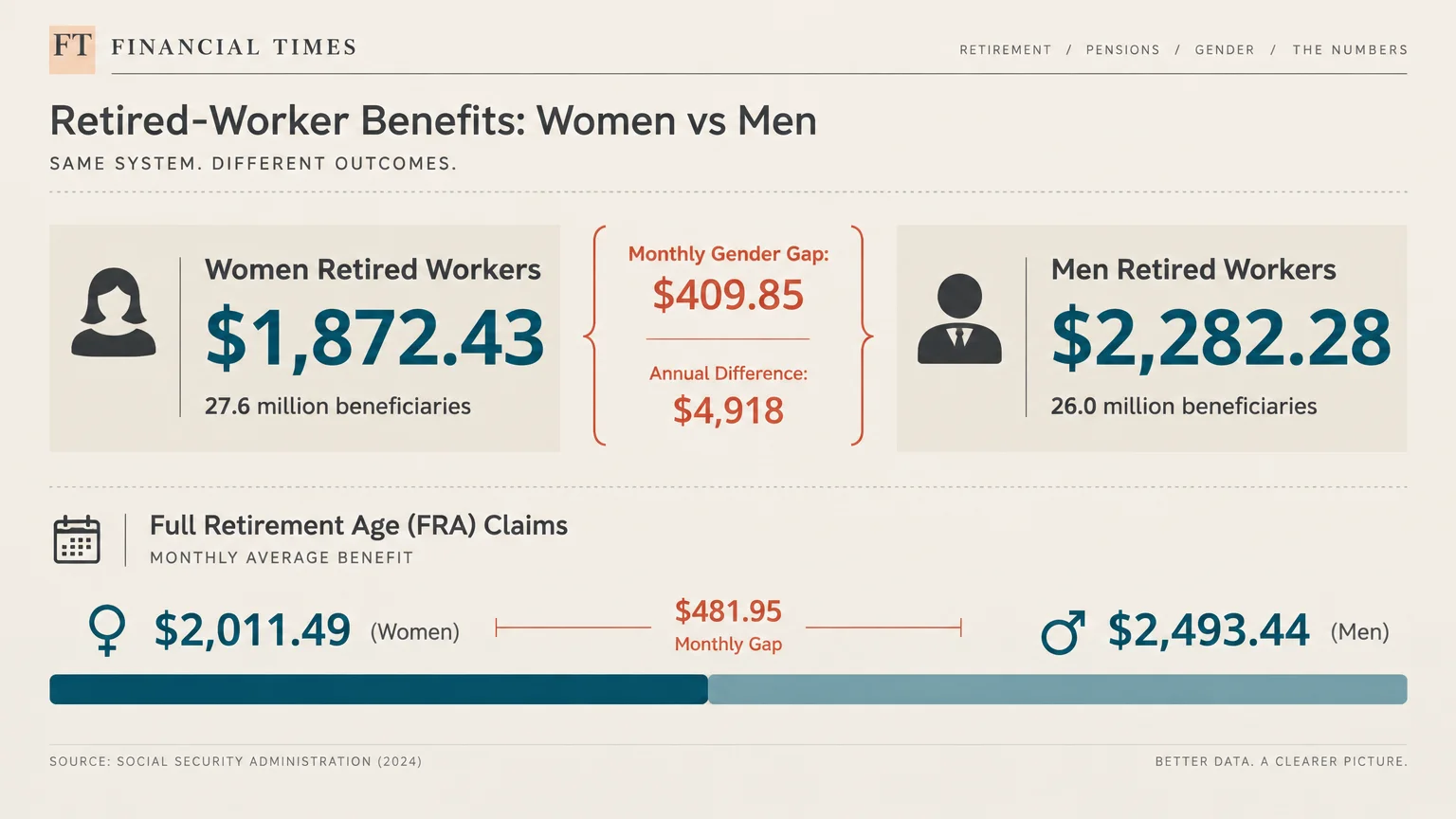
According to official data from the Social Security Administration, roughly 27.6 million women receive retired-worker benefits. Their monthly checks average $1,872.43 across all ages combined.
In contrast, 26.0 million male retired workers collect an average monthly benefit of $2,282.28. This creates an ongoing gender gap of $409.85 per month.
Over a full calendar year, that difference adds up to roughly $4,918 less income for female retirees. This disparity occurs despite decades of workforce gains.
Even among beneficiaries who claimed their benefits at their exact Full Retirement Age, the gap remains wide. Women claiming at full retirement age average $2,011.49 per month compared to $2,493.44 for men.
That leaves a monthly shortfall of $481.95 between men and women who claim at the standard benchmark. Across all retired workers, the overall average check sits at $2,071.30, climbing toward $2,089.
Cost-of-living adjustments continue to alter these figures year over year. The 2026 adjustment delivered a 2.8 percent increase, which added roughly $56 each month to the typical retiree payment.
A 3.6 percent cost-of-living adjustment takes effect for 2027 payments. That boost will add an average of $75 per month across all retired workers.
For a female retiree collecting an average age-70 payment of $2,024.08, the 3.6 percent increase adds approximately $73 each month. That raises her monthly check to nearly $2,097.
Meanwhile, the maximum taxable earnings limit expands from $184,500 to $192,300. This adjustment increases the amount of income subject to payroll taxes for high-earning workers.
Average Social Security Benefit for Women by Age
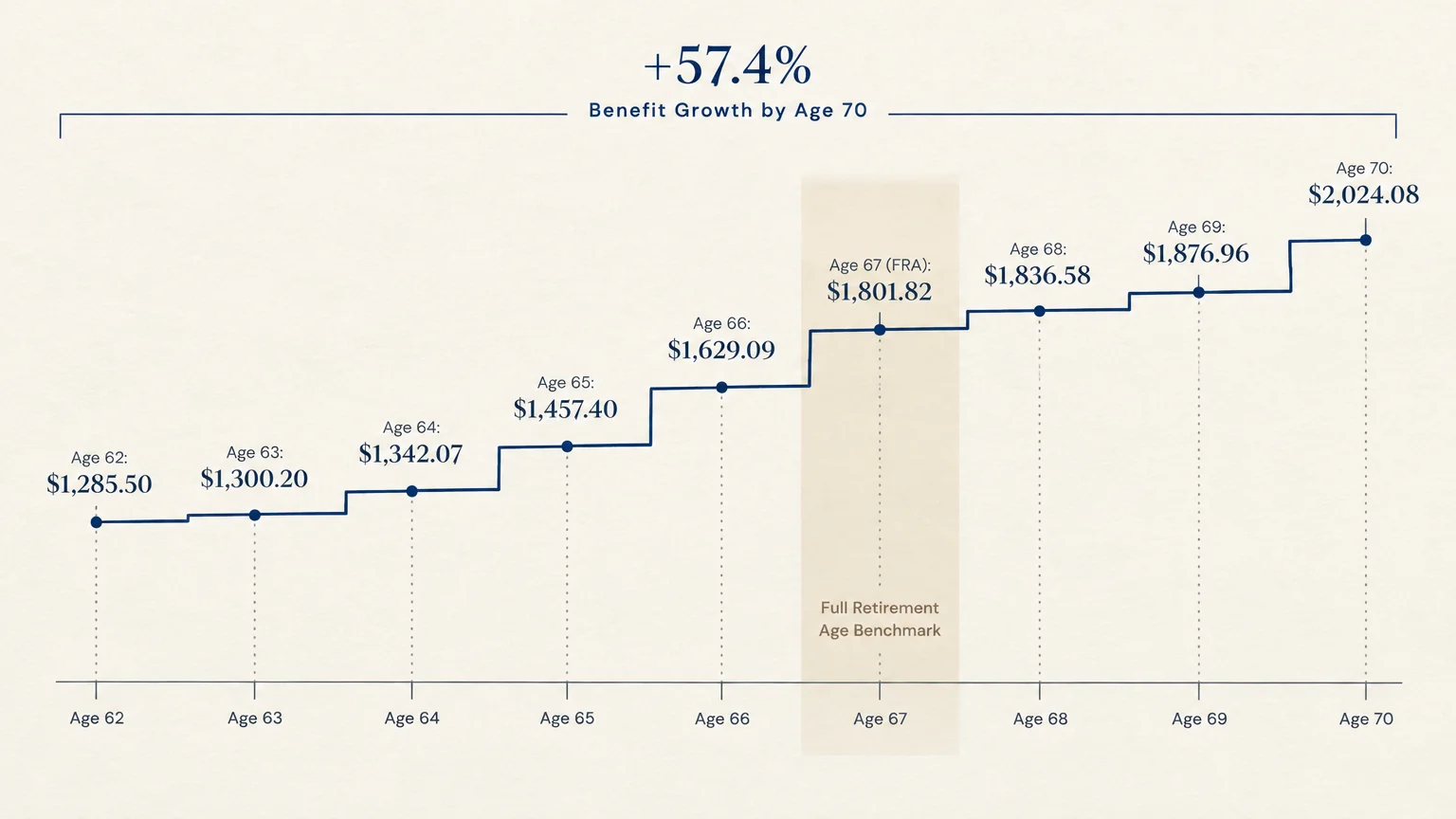
Your claiming age remains the single most influential factor determining your monthly check amount. Benefits follow a distinct upward trajectory between age 62 and age 70.
Women who claim at age 62 receive an average payment of just $1,285.50 per month. Men claiming at the same age average $1,572.83, creating a monthly gap of $287.33.
By age 63, the average check for women rises slightly to $1,300.20 per month. Men at 63 collect an average of $1,580.81.
At age 64, women receive an average monthly payment of $1,342.07. That compares to $1,624.93 for men, leaving an overall average benefit of $1,478.00 across both genders.
Women claiming at age 65 collect an average check of $1,457.40 each month. Their male counterparts average $1,772.00 at that exact milestone.
At age 66, average female benefits climb to $1,629.09 per month. Men at age 66 receive an average check of $1,998.75.
When women reach age 67, which serves as the Full Retirement Age for anyone born in 1960 or later, payments average $1,801.82 per month. Men at 67 receive an average of $2,234.41.
Waiting an additional year produces notable growth. At age 68, women average $1,836.58 per month, while men receive $2,272.40.
At age 69, average payments for women rise to $1,876.96 per month. Male beneficiaries at age 69 collect an average check of $2,321.96.
Payments reach their absolute peak for women claiming at age 70, where checks average $2,024.08 each month. Men at age 70 average $2,529.62 per month.
Benefits plateau and gradually decline for cohorts older than 70. Women at age 71 receive an average check of $2,006.83, while those at age 72 receive $1,981.87.
At age 73, women collect an average of $1,983.67 per month. Payments decline slightly to $1,962.42 at age 74 and $1,937.42 at age 75.
Female retirees at age 76 average $1,949.26 per month, followed by $1,959.06 at age 77 and $1,936.04 at age 78. By age 79, checks average $1,947.29.
Women aged 80 receive an average monthly check of $1,912.67. Those in the 85 to 89 age bracket collect an average of $1,877.27 per month.
These older cohorts average lower monthly payments because their peak career earnings were lower decades ago. Their checks reflect historical wage levels rather than lower claiming ages.

Comparison of Monthly Benefits by Age and Gender
Reviewing exact monthly numbers reveals how filing ages alter lifetime income. The following table displays average monthly benefits across key retirement ages.
| Beneficiary Age | Women Average | Men Average | Overall Average | Gender Difference |
|---|---|---|---|---|
| Age 62 | $1,285.50 | $1,572.83 | $1,424.40 | -$287.33 |
| Age 63 | $1,300.20 | $1,580.81 | $1,435.81 | -$280.61 |
| Age 64 | $1,342.07 | $1,624.93 | $1,478.00 | -$282.86 |
| Age 65 | $1,457.40 | $1,772.00 | $1,607.27 | -$314.60 |
| Age 66 | $1,629.09 | $1,998.75 | $1,807.28 | -$369.66 |
| Age 67 (FRA) | $1,801.82 | $2,234.41 | $2,016.48 | -$432.59 |
| Age 68 | $1,836.58 | $2,272.40 | $2,052.64 | -$435.82 |
| Age 69 | $1,876.96 | $2,321.96 | $2,096.95 | -$445.00 |
| Age 70 | $2,024.08 | $2,529.62 | $2,274.68 | -$505.54 |
| Age 75 | $1,937.42 | $2,358.96 | $2,144.88 | -$421.54 |
| Age 80 | $1,912.67 | $2,309.85 | $2,106.29 | -$397.18 |
| Ages 85–89 | $1,877.27 | $2,182.80 | $2,018.02 | -$305.53 |
The data demonstrates that waiting from age 62 to age 70 increases a woman’s average benefit by $738.58 each month. That represents an income surge of more than 57 percent.

Why the Gender Benefit Gap Persists
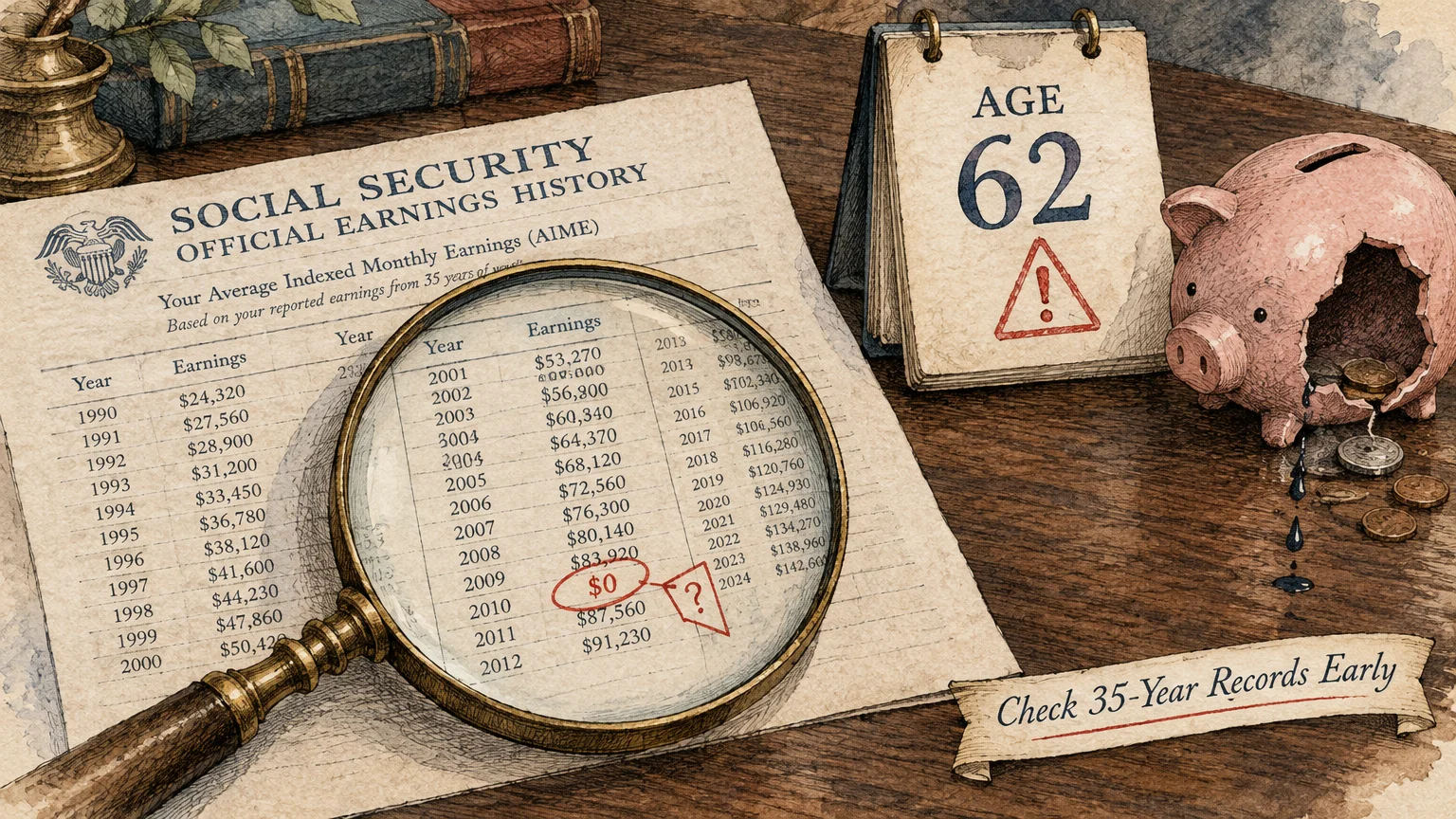
The gap between male and female Social Security checks stems directly from the program’s calculation formula. Your primary insurance amount depends on your highest 35 years of wage-indexed earnings.
If you worked fewer than 35 years, the government records a zero for every missing year. Those zero-earning years drag down your average indexed monthly earnings.
Women are significantly more likely than men to leave the workforce or reduce hours to care for children or aging parents. Each year spent caregiving outside the paid labor force lowers lifetime benefit calculations.
Historical wage differences also compound this benefit shortfall over time. Even women with complete 35-year careers frequently earned less than men in comparable roles.
Longevity factors make this payment disparity particularly urgent for female retirees. Government projections indicate that a 65-year-old woman will live an average of 21 additional years, reaching age 86.
A 65-year-old man lives an average of 18 more years, reaching age 83. Women must stretch smaller monthly checks across three more years of retirement living costs.
“The goal of retirement is to live off your assets—not live off your regrets.”
Longer life expectancies also expose women to higher cumulative healthcare expenses and nursing care costs. A smaller base benefit leaves little cushion against rising medical bills late in life.

Spousal, Survivor, and Divorced Benefit Rules
Many women do not rely solely on their own earnings history for Social Security benefits. Understanding how entitlement categories operate helps you claim every dollar available to you.
Currently, roughly 60.8 percent of retired women aged 65 and older collect benefits based entirely on their own work record. Another 24.0 percent are classified as dually entitled.
Dual entitlement means your personal retirement benefit is smaller than the spousal or survivor benefit you qualify for. In these cases, the government pays your worker benefit first, then tops it off with an auxiliary payment.
Approximately 15.2 percent of women receive spousal or widow benefits exclusively without claiming on their own record. These family-based provisions provide essential protection for lifelong homemakers and primary caregivers.
A spousal benefit can provide up to 50 percent of your partner’s Full Retirement Age benefit. To qualify, your spouse must already be collecting their own retirement check.
The average spousal check sits at $987 per month. The 3.6 percent cost-of-living adjustment will push that average above $1,000 for the first time, reaching roughly $1,022.
Unlike personal worker benefits, spousal benefits do not earn delayed retirement credits if you wait past full retirement age. Claiming spousal benefits after your full retirement age produces no extra monthly income.
Survivor benefits provide even stronger protections if your spouse passes away first. A widow can claim up to 100 percent of the deceased spouse’s actual monthly benefit, including any delayed credits earned.
Non-disabled widows receive an average monthly survivor benefit exceeding $1,832. This provides crucial income replacement when household expenses remain high after losing a partner.
Divorced women can also collect spousal or survivor benefits based on an ex-spouse’s work history. Your marriage must have lasted at least 10 consecutive years to qualify for these divorced benefits.
You must remain currently unmarried to receive divorced spousal benefits, and you must be at least 62 years old. If your ex-spouse has reached age 62 but has not yet claimed, you can still collect if you have been divorced for two full years.
Collecting benefits on your ex-partner’s record does not reduce their payout or impact their current spouse’s payments. The agency processes your claim completely independently without notifying your former spouse.
How Claiming Age Changes Your Monthly Check
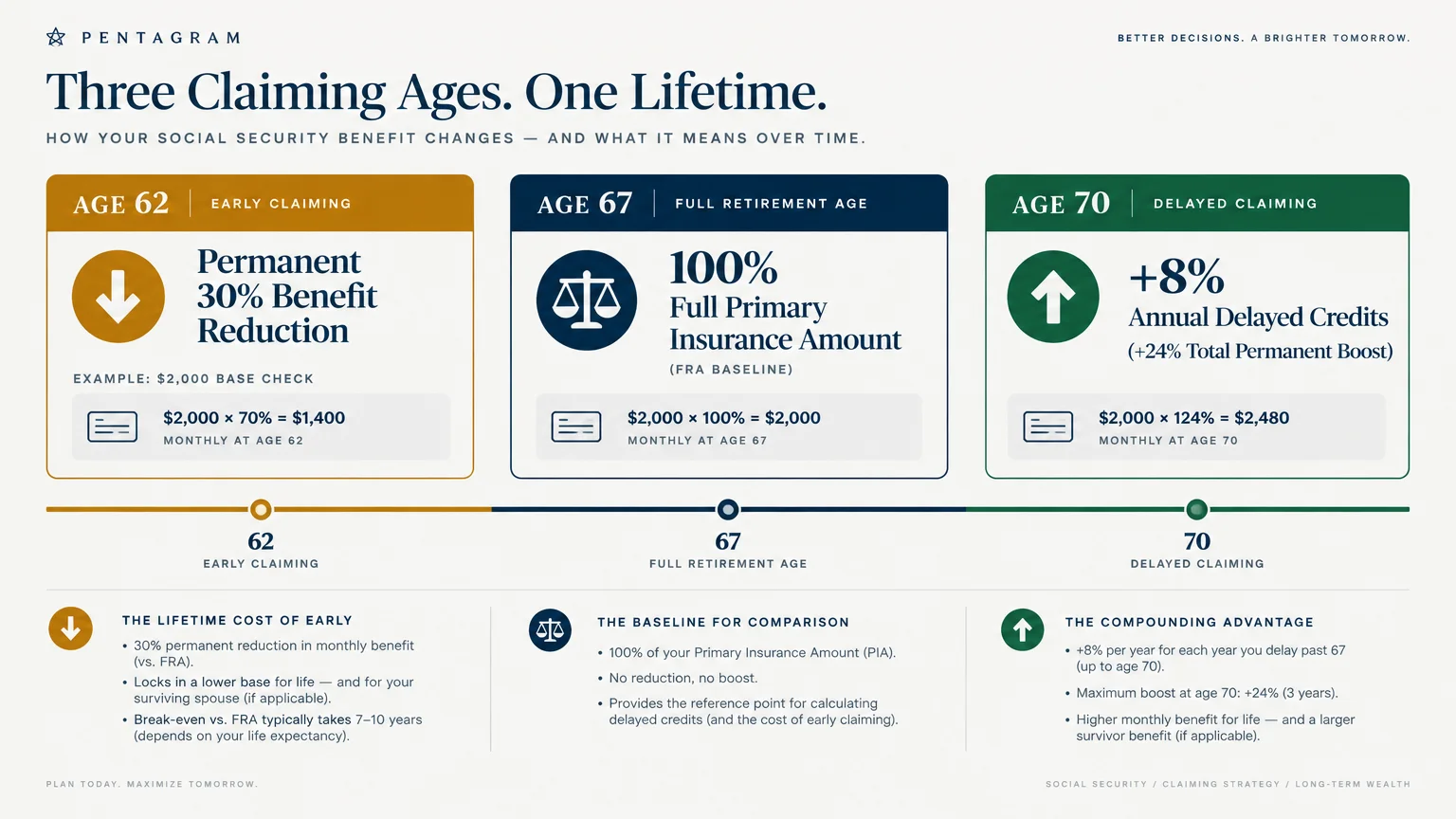
The age at which you file locks in your monthly payout rate for the rest of your life. Workers born in 1960 or later have a Full Retirement Age of exactly 67.
Filing at age 62 triggers a permanent 30 percent reduction in your personal monthly benefit. A monthly baseline of $2,000 at full retirement drops down to $1,400 if claimed at 62.
Despite this steep haircut, 64.9 percent of women claim before reaching their full retirement age. In contrast, 59.1 percent of men claim benefits early.
Taking spousal benefits early results in an even larger cut. Claiming spousal benefits at age 62 reduces your payment by 35 percent instead of 30 percent.
Delaying benefits beyond your full retirement age yields substantial rewards. The program awards delayed retirement credits of 8 percent per year for each year you wait between age 67 and age 70.
Waiting until age 70 locks in a permanent 24 percent increase over your standard full retirement age benefit. That same $2,000 baseline benefit expands into $2,480 per month for life.
Maximum possible payouts highlight the immense impact of filing age. In 2026, the maximum possible monthly benefit at age 62 is $2,969, while the maximum at age 70 reaches $5,181.
Delaying does not make sense for everyone, especially if you face severe health challenges or immediate cash shortfalls. However, for women in good health with alternative savings, waiting generates guaranteed, inflation-protected lifetime income.
“The best time to plan for retirement was 20 years ago. The second best time is today.”
Running personalized estimates on official agency platforms allows you to see the exact numbers before you submit an application. You can review your verified history using the Social Security Retirement Estimator.
Errors That Cost Retirees Thousands
Claiming mistakes can permanently diminish your retirement income and leave surviving spouses vulnerable. Steering clear of common traps preserves your household wealth over decades.
- Filing too early without analyzing spousal options: Locking in a 30 percent reduction at age 62 permanently limits your base. This decision also caps the lifetime auxiliary benefits you can collect while your spouse remains living.
- Violating the retirement earnings test: If you collect benefits before your full retirement age while continuing to work, the government withholds benefits once earnings exceed annual limits. Working full-time while claiming early frequently creates unnecessary tax and cash-flow friction.
- Overlooking divorced spousal rights: Many divorced women fail to claim on an ex-spouse’s record because they assume they need permission or contact with their former partner. The agency requires no cooperation from your former spouse to establish eligibility.
- Failing to sequence survivor and retirement benefits: Widows can claim a survivor benefit early while allowing their own worker benefit to grow until age 70. Conversely, a widow can claim her own benefit first and switch to a larger survivor benefit later.
- Ignoring the tax consequences of Social Security income: Up to 85 percent of your Social Security benefits become subject to federal income taxes if combined income exceeds standard limits. Failing to plan withdrawals from retirement accounts can trigger unexpected tax bills on your benefits.
Avoiding these costly missteps ensures that you preserve every dollar earned through decades of labor. Strategic coordination between household accounts produces the highest net income.

Actionable Steps to Maximize Your Social Security Payments
You can take proactive steps right now to increase your future Social Security payments, even if retirement is just around the corner. Focusing on work history and claiming coordination pays substantial dividends.
First, review your official earnings record for reporting mistakes. Employers occasionally misreport annual wages, and correcting those errors before you claim directly increases your calculated average earnings.
Second, work extra years to replace zero-earning or low-earning years on your 35-year work history. Even part-time work late in your career can replace a zero from a previous caregiving year.
Because benefits rely on your highest 35 inflation-adjusted years, replacing a single zero can boost your monthly check permanently. Earning solid wages in your early sixties creates immediate upward pressure on your calculation.
Third, coordinate filing dates with your spouse to maximize survivor protections. Having the higher-earning spouse delay claiming until age 70 guarantees the largest possible survivor benefit for the surviving partner.
Because women outlive men on average, a husband’s decision to delay claiming until 70 serves as a powerful insurance policy for his wife. That choice locks in maximum inflation-adjusted monthly income for her remaining years.
Fourth, investigate state and local assistance programs if your monthly benefit leaves you struggling with essential expenses. Organizations like the National Council on Aging help older adults access critical community support.
You can search for public benefits and healthcare savings programs directly through BenefitsCheckUp. These resources help bridge budget shortfalls without depleting your remaining emergency savings.

When to Get Expert Help
Navigating Social Security rules can become complex when juggling divorces, widowhood, pensions, and medical considerations. Seeking qualified professional guidance protects you from irreversible financial errors.
Consult a specialized Social Security claiming analyst if your household involves complex age gaps or multiple marriages. These professionals model different claiming timelines to pinpoint your optimal lifetime payout.
Work with a fee-only certified financial planner to coordinate Social Security with your other investment portfolios. An advisor helps balance taxable withdrawals, Roth conversions, and guaranteed government income streams.
Reach out to an elder law attorney if you anticipate long-term care needs or require estate restructuring. Legal specialists ensure that spousal benefits and Medicaid rules work harmoniously without jeopardizing care.
You can also connect with free counselors through the State Health Insurance Assistance Program to align Social Security choices with Medicare enrollment. Coordinated planning prevents late-enrollment penalties and income-related monthly premium surcharges.
Frequently Asked Questions About Women’s Social Security
Why is the average Social Security benefit lower for women than men?
The gap stems primarily from the 35-year calculation formula. Women frequently take time out of the paid workforce to provide caregiving, which results in zero-earning years that drag down their average.
Historical wage differences between men and women also reduce lifetime average earnings. In addition, a higher percentage of women claim their benefits prior to reaching Full Retirement Age.
Can a woman collect on her ex-husband’s Social Security record?
Yes, provided the marriage lasted at least 10 years and she remains currently unmarried. She must also be at least 62 years of age to submit a divorced spousal claim.
Collecting on a former spouse does not reduce the ex-partner’s check or affect their current spouse’s payments. The administration handles the application privately without informing the former spouse.
What happens to a woman’s benefit if her spouse passes away?
A widow is entitled to step up to 100 percent of her deceased spouse’s actual benefit amount if she has reached full retirement age. She receives the higher of her own benefit or her deceased spouse’s check.
The household loses the smaller of the two original Social Security checks. A surviving spouse cannot continue collecting both full payments simultaneously.
Does a woman’s spousal benefit increase if she waits until age 70?
No, spousal benefits do not earn delayed retirement credits past Full Retirement Age. A spousal benefit reaches its maximum value of 50 percent of the partner’s primary insurance amount at full retirement age.
Waiting past full retirement age to claim a spousal benefit simply forfeits monthly checks without increasing the payment. Only your own worker benefit earns delayed retirement credits up to age 70.
Take Control of Your Retirement Income
Take time today to log into your personal Social Security account and review your official earnings statement. Verifying your historical wages and comparing your projected payouts at age 62, 67, and 70 puts you in control.
Small adjustments in your claiming timeline can add hundreds of dollars to your monthly budget for life. Treat this decision as a cornerstone of your long-term independence and financial security.
This article is for informational purposes only and does not constitute financial, legal, or medical advice. Medicare rules, Social Security benefits, and tax laws change regularly—verify current details at Medicare.gov, SSA.gov, or with a licensed professional.
Last updated: November 2026. Medicare and Social Security rules change annually—always verify current details at official government sources.