Male retired workers in the United States collect an average Social Security benefit of $2,282.28 each month. Your exact monthly payment will depend heavily on the specific age you choose to file.
Filing at age 62 locks in a permanent monthly reduction, whereas waiting until age 70 dramatically expands your guaranteed income. Knowing these government figures helps you protect your long-term household budget.
This detailed guide outlines the verified Social Security payments for men across every age bracket; it also delivers actionable claiming strategies to optimize your financial security.
Current Social Security Benchmarks for Men
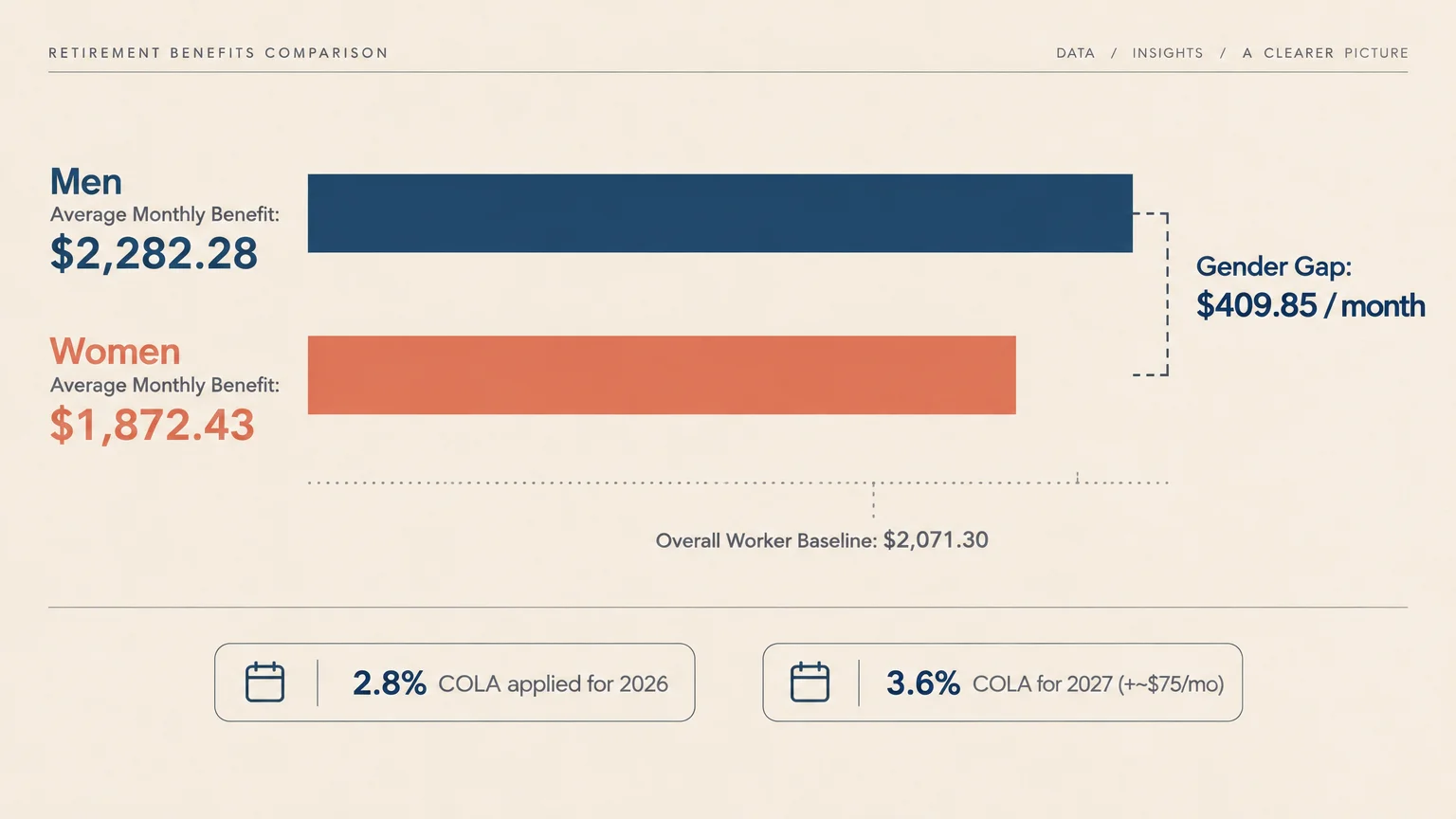
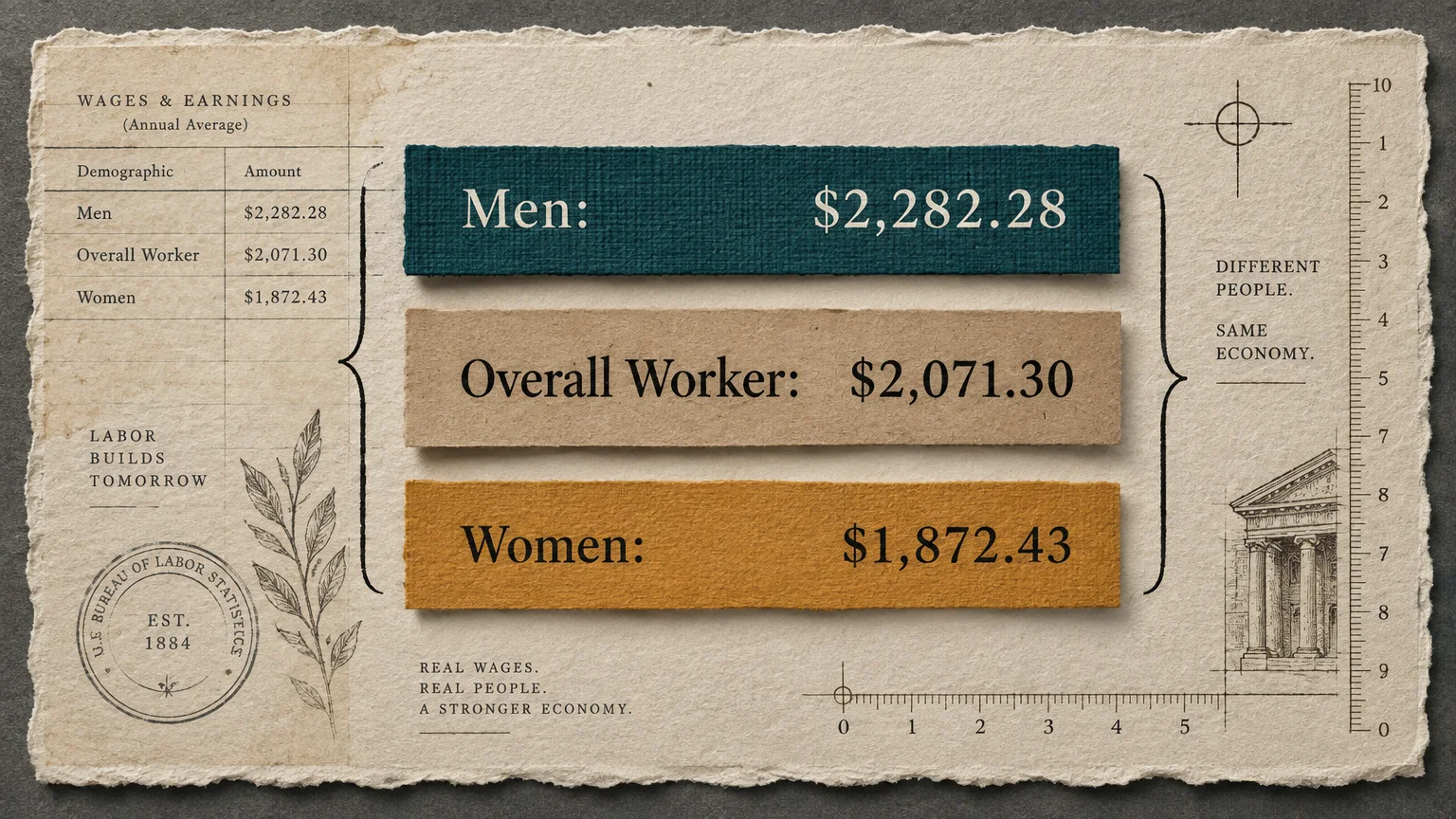
According to official Social Security Administration records, male retired workers receive an average monthly benefit of $2,282.28. This figure incorporates the 2.8% cost-of-living adjustment applied for 2026.
Female retirees receive an average monthly benefit of $1,872.43. This creates a persistent average gender gap of $409.85 per month across American households.
The overall average monthly check across all retired workers stands at $2,071.30. Monthly tracking throughout fall 2026 shows that overall baseline inching closer to $2,095.
Upcoming adjustments will boost these numbers even further. The Social Security Administration announced a 3.6% COLA for 2027, which will add roughly $75 per month to the overall worker average.
Remember that headline averages do not reflect take-home cash. The federal government automatically deducts Medicare Part B premiums directly from your monthly Social Security check.
Average Social Security Benefit for Men by Age Breakdown
Your filing age serves as the single most powerful lever over your monthly payment amount. Claiming early cuts your check, while waiting builds substantial monthly growth.
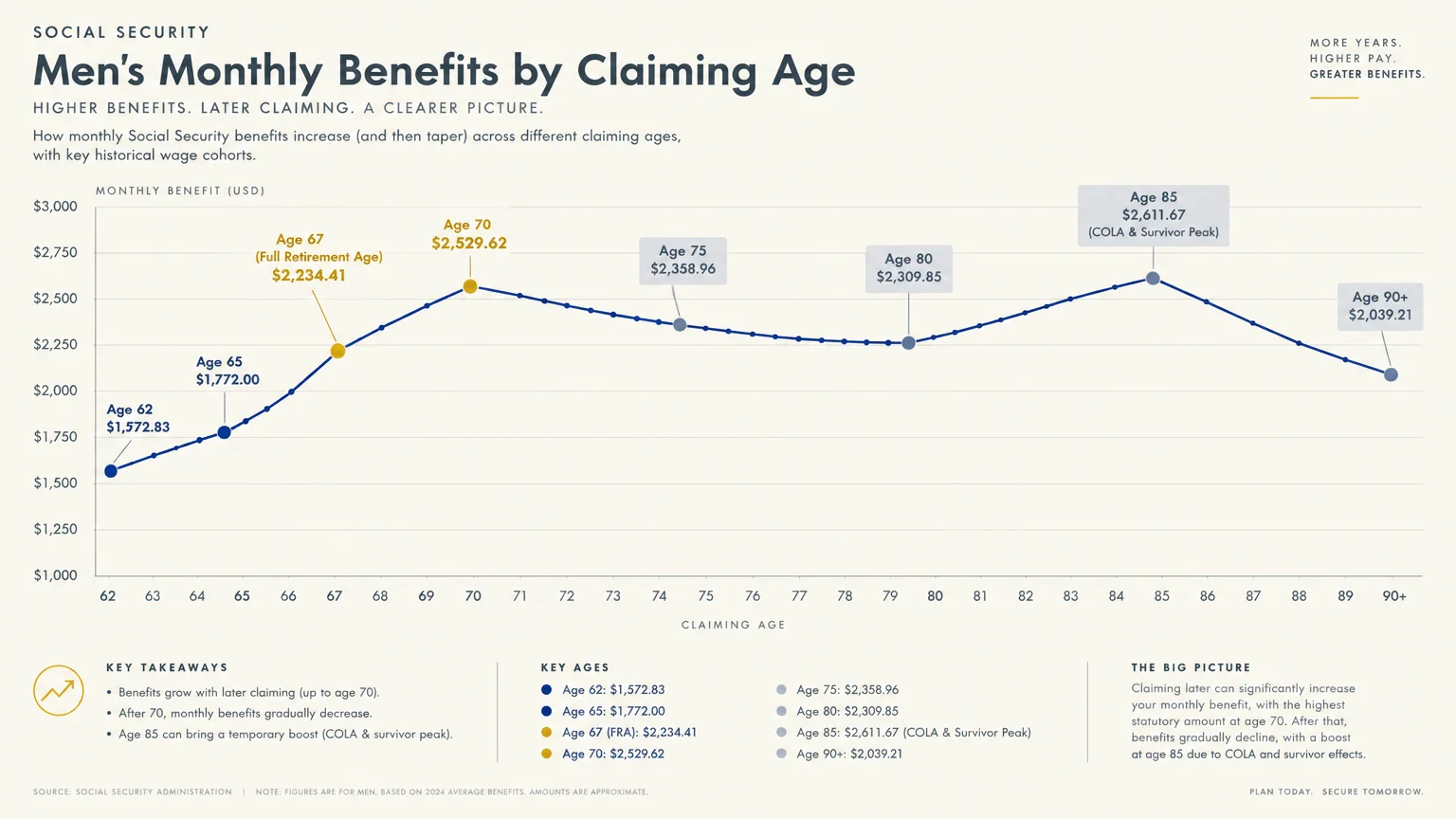
At age 62, men collect an average benefit of only $1,572.83 per month. This lower baseline reflects the permanent early claiming reduction enforced by federal law.
As men progress through their early sixties, the monthly average edges upward. Men filing at age 63 receive an average of $1,580.81, while 64-year-olds average $1,624.93 monthly.
By age 65, the average male benefit reaches $1,772.00 per month. Men claiming at age 66 collect an average of $1,998.75 as they approach full retirement age.
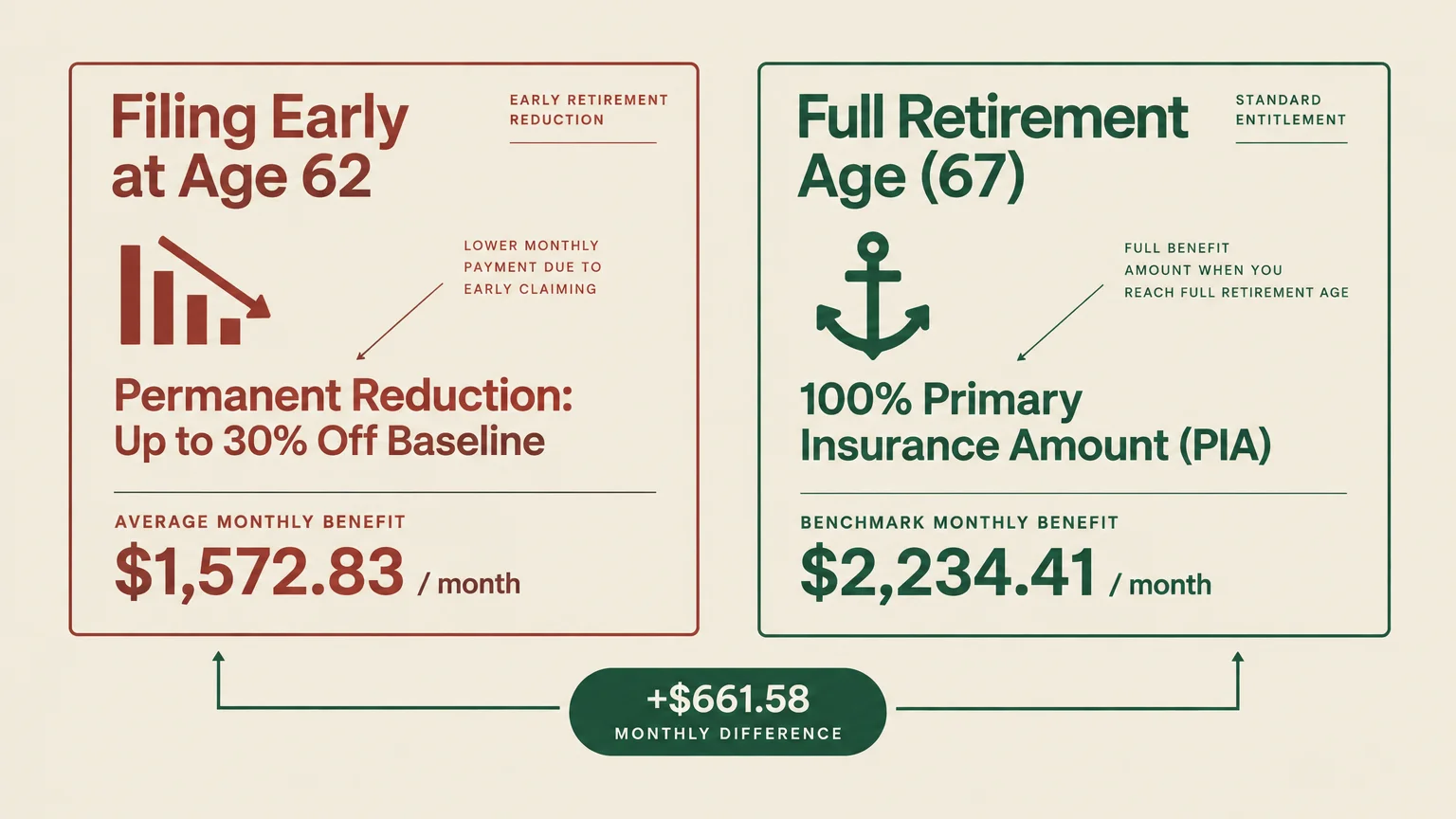
At age 67, which represents Full Retirement Age for anyone born in 1960 or later, the average male check rises to $2,234.41. This is over $660 higher than the age 62 baseline.
Men who delay into their late sixties capture even higher monthly payments. Average benefits reach $2,272.40 at age 68 and climb to $2,321.96 at age 69.
At age 70, the average male benefit hits $2,529.62 per month. Delaying until this final statutory cap provides the highest average monthly check among all recent claiming groups.
Beneficiaries in older age cohorts display varied averages due to historical wage structures. Men aged 75 collect an average of $2,358.96, while 80-year-old men average $2,309.85 each month.
Interestingly, 85-year-old men receive the highest overall average check at $2,611.67 per month. This reflects decades of compounding cost-of-living adjustments and survivor benefit conversions.
For men aged 90 and above, the average monthly benefit drops back to $2,039.21. Lower nominal wages from several decades ago establish a lower historical baseline for this group.
Data Comparison: Social Security Payments Across Ages
Comparing men’s benefits alongside women’s and overall national averages highlights distinct patterns across age brackets. These verified numbers reflect official Social Security data tables.
| Claiming Age | Men’s Average Monthly Benefit | Women’s Average Monthly Benefit | Overall Worker Average |
|---|---|---|---|
| Age 62 | $1,572.83 | $1,285.50 | $1,424.40 |
| Age 63 | $1,580.81 | $1,300.20 | $1,435.81 |
| Age 64 | $1,624.93 | $1,342.07 | $1,478.00 |
| Age 65 | $1,772.00 | $1,457.40 | $1,607.27 |
| Age 66 | $1,998.75 | $1,629.09 | $1,807.28 |
| Age 67 | $2,234.41 | $1,801.82 | $2,016.48 |
| Age 68 | $2,272.40 | $1,836.58 | $2,052.64 |
| Age 69 | $2,321.96 | $1,876.96 | $2,096.95 |
| Age 70 | $2,529.62 | $2,024.08 | $2,274.68 |
| Age 75 | $2,358.96 | $1,937.42 | $2,144.88 |
| Age 80 | $2,309.85 | $1,912.67 | $2,106.29 |
| Age 85 | $2,611.67 | $2,039.13 | $2,353.96 |
| Age 90+ | $2,039.21 | $1,771.87 | $1,895.76 |
Notice the sharp contrast between filing at age 62 and waiting until age 70. Men who delay receive an average of $956.79 more each month than those filing early.
Factoring in the upcoming 3.6% COLA for 2027 shifts these payment tiers upward. Multiplying these amounts by 1.036 provides an accurate forecast for your upcoming 2027 checks.
The Mechanics of Early Claiming: Age 62 vs. Full Retirement Age
The Social Security Administration defines your Full Retirement Age according to the year you were born. Your FRA represents the moment you qualify for 100% of your primary insurance amount.
If you were born in 1959, you attain full retirement age at 66 years and 10 months during 2026. If you were born in 1960 or later, your FRA is exactly 67.
Claiming earlier than your designated FRA triggers a permanent, non-negotiable haircut to your monthly benefit. Filing right at age 62 cuts your payment by up to 30% if your FRA is 67.
This substantial reduction remains in place for every remaining year of your retirement life. While you receive checks sooner, each individual payment carries substantially less purchasing power.
A 30% reduction reduces an expected $2,000 monthly benefit down to just $1,400. Over a 25-year retirement, that monthly deficit adds up to tens of thousands of lost dollars.

Delayed Retirement Credits: Why Men Benefit From Waiting Until 70
You do not have to stop at Full Retirement Age when planning your Social Security claim. Every month you delay claiming past your FRA earns you valuable Delayed Retirement Credits.
The federal government increases your benefit by two-thirds of 1% for each month you delay. This equals an 8% simple annual increase for every full year you wait past FRA.
For workers whose FRA is 67, waiting until age 70 yields a permanent 24% boost above their baseline payment. That guaranteed expansion permanently raises your income ceiling for life.
No safe commercial investment product can match an 8% annual government-guaranteed rate of return. Delaying your claim functions as an ironclad hedge against prolonged longevity and market turbulence.
“The goal of retirement is to live off your assets—not live off your regrets.”
If you remain healthy and have other savings to bridge the gap, delaying delivers maximum financial resilience. You lock in higher cash flow for your later decades when medical bills often peak.
Maximum Social Security Benefits for High Earners
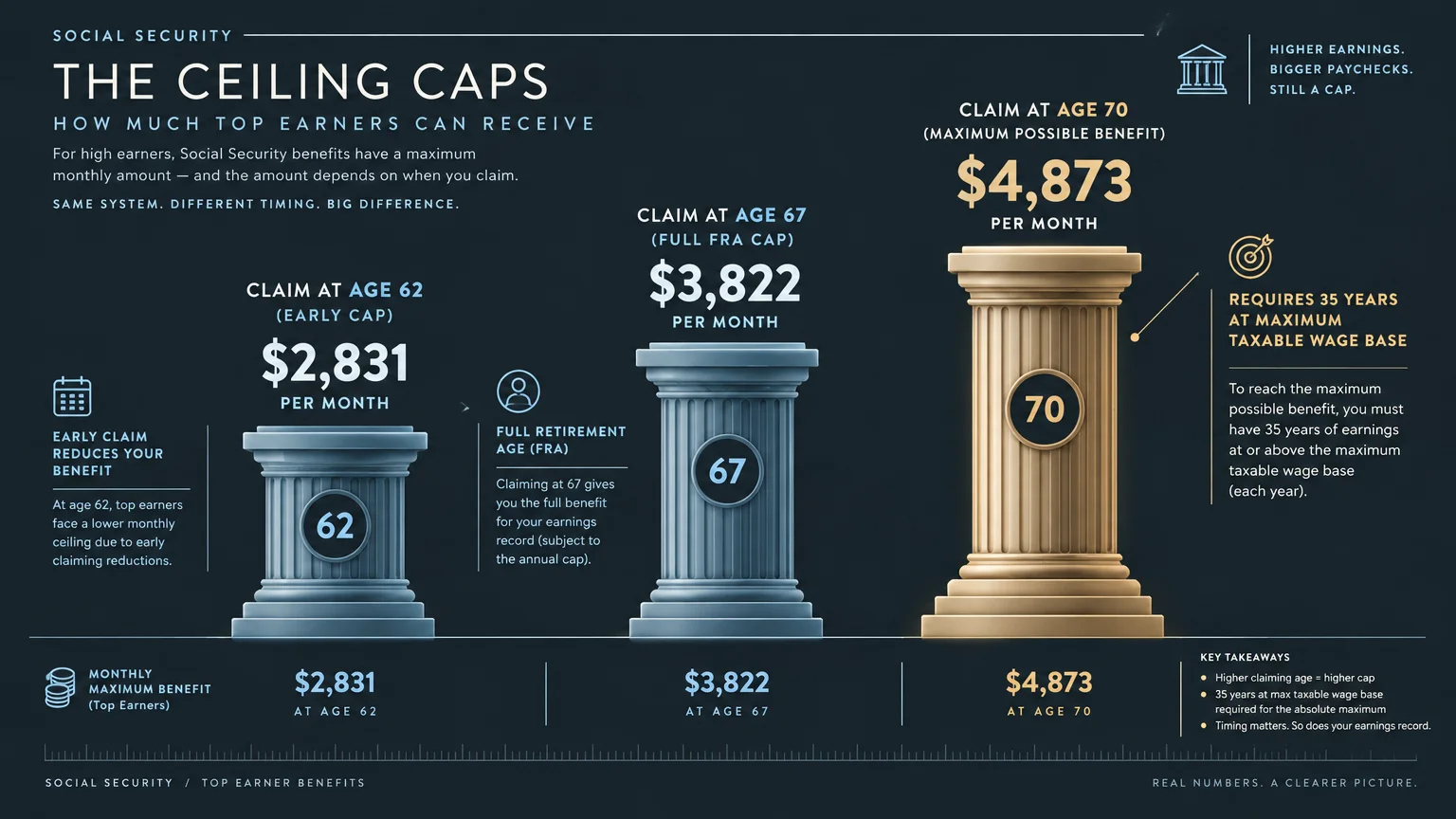
Men with consistent high-earning careers often aim for the absolute maximum Social Security payout. The federal government sets a strict ceiling on monthly benefits regardless of your career earnings.
In 2026, the maximum monthly payment for a worker claiming at age 62 is $2,969. In 2027, that early filing ceiling rises to $3,094 per month.
Claiming at Full Retirement Age unlocks a substantially larger cap for high earners. The maximum FRA benefit is $4,152 monthly in 2026 and increases to $4,188 per month in 2027.
Maximizing your check until age 70 produces the absolute pinnacle of federal retirement income. High earners can receive up to $5,181 per month in 2026, rising to $5,358 in 2027.
Securing these peak checks requires earning at or above the taxable wage base for at least 35 working years. The taxable wage base is $184,500 in 2026 and rises to $192,300 in 2027.
How the Benefit Formula Works: Credits, Indexing, and the 35-Year Rule
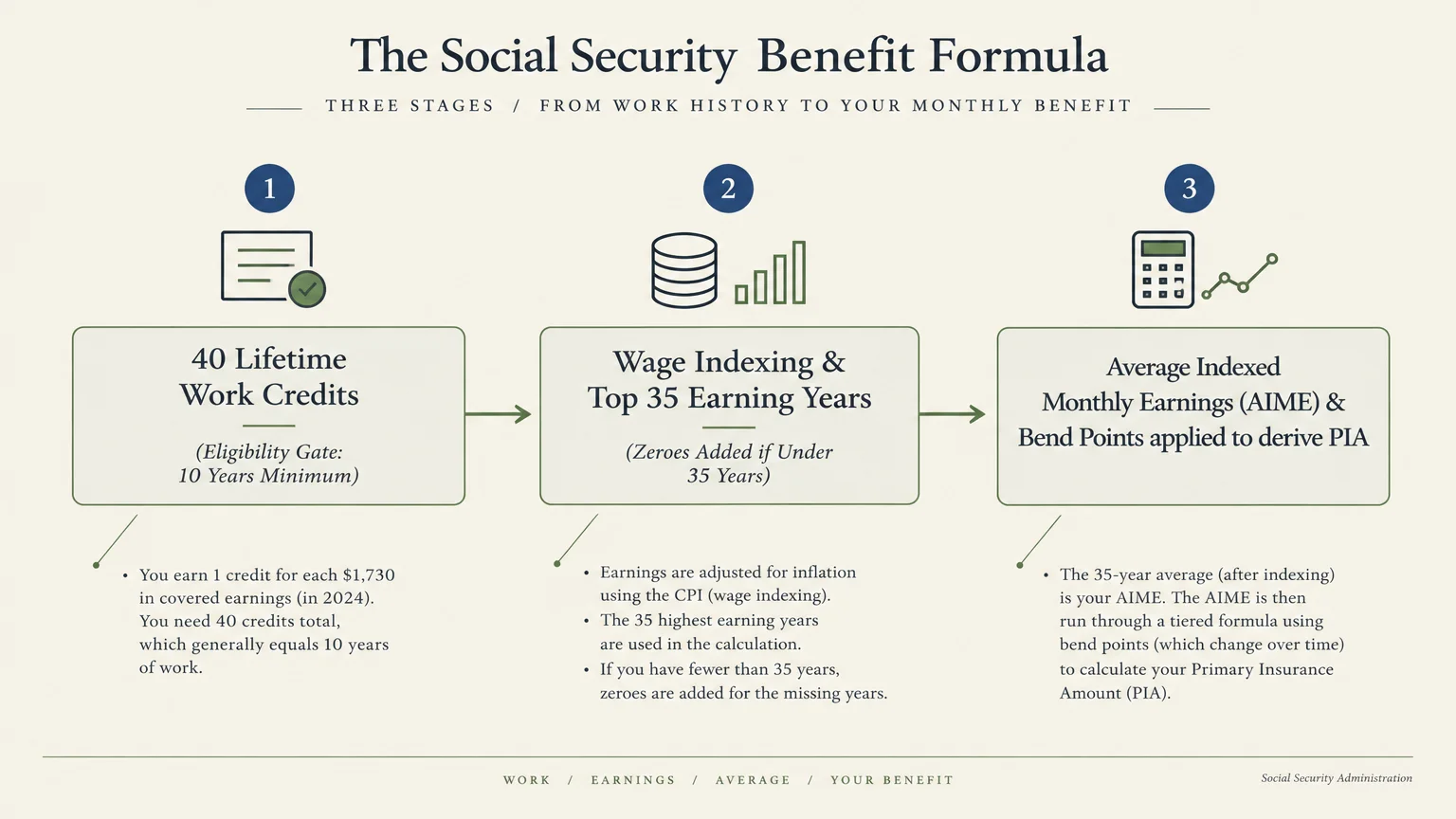
Your monthly Social Security check does not rely on guesswork or luck. The Social Security Administration uses a rigorous multi-step calculation to establish your Primary Insurance Amount.
To qualify for any retired-worker benefit, you must first earn at least 40 Social Security work credits. You earn one credit for every $1,890 earned in 2026, adjusting to $1,970 in 2027.
Workers can earn a maximum of four credits per calendar year. Once you complete 10 full years of covered employment, you secure your lifetime eligibility for retirement benefits.
The agency then indexes your historical earnings to match modern wage growth across the national economy. It selects your highest 35 earning years to calculate your Average Indexed Monthly Earnings.
Having fewer than 35 recorded work years severely depresses your final benefit figure. The agency inserts a zero for every missing year, dragging down your career average.
Replacing an early low-earning year with a robust late-career salary boosts your monthly check for life. Continuing to work in your sixties can directly elevate your underlying Primary Insurance Amount.
Check your official work record by setting up a personal profile at the Social Security Administration website. Verifying reported wages guarantees that clerical errors do not reduce your earned benefits.

Working While Receiving Benefits: The Retirement Earnings Test
Many men choose to transition into semi-retirement rather than leaving the workforce entirely. If you claim benefits before Full Retirement Age while working, you must monitor the earnings test.
For beneficiaries under FRA for the entire year, the 2026 annual earnings limit is $24,480 ($2,040 monthly). In 2027, that threshold increases to $25,560 per year ($2,130 monthly).
The agency withholds $1 in benefits for every $2 you earn above these established limits. Exceeding the cap unexpectedly can cause the government to suspend multiple monthly checks.
Different rules apply during the specific calendar year you reach your Full Retirement Age. In 2026, that higher limit is $65,160 ($5,430 monthly), climbing to $67,920 ($5,660 monthly) in 2027.
In your FRA year, the agency withholds $1 for every $3 earned above the limit before your birthday month. Once you officially reach your FRA, all earnings limits disappear permanently.
Do not view withheld benefits as money lost forever to the government. At Full Retirement Age, the agency recalculates your monthly payment upward to credit you for every withheld dollar.
How Income Taxes Reduce Your Take-Home Benefit
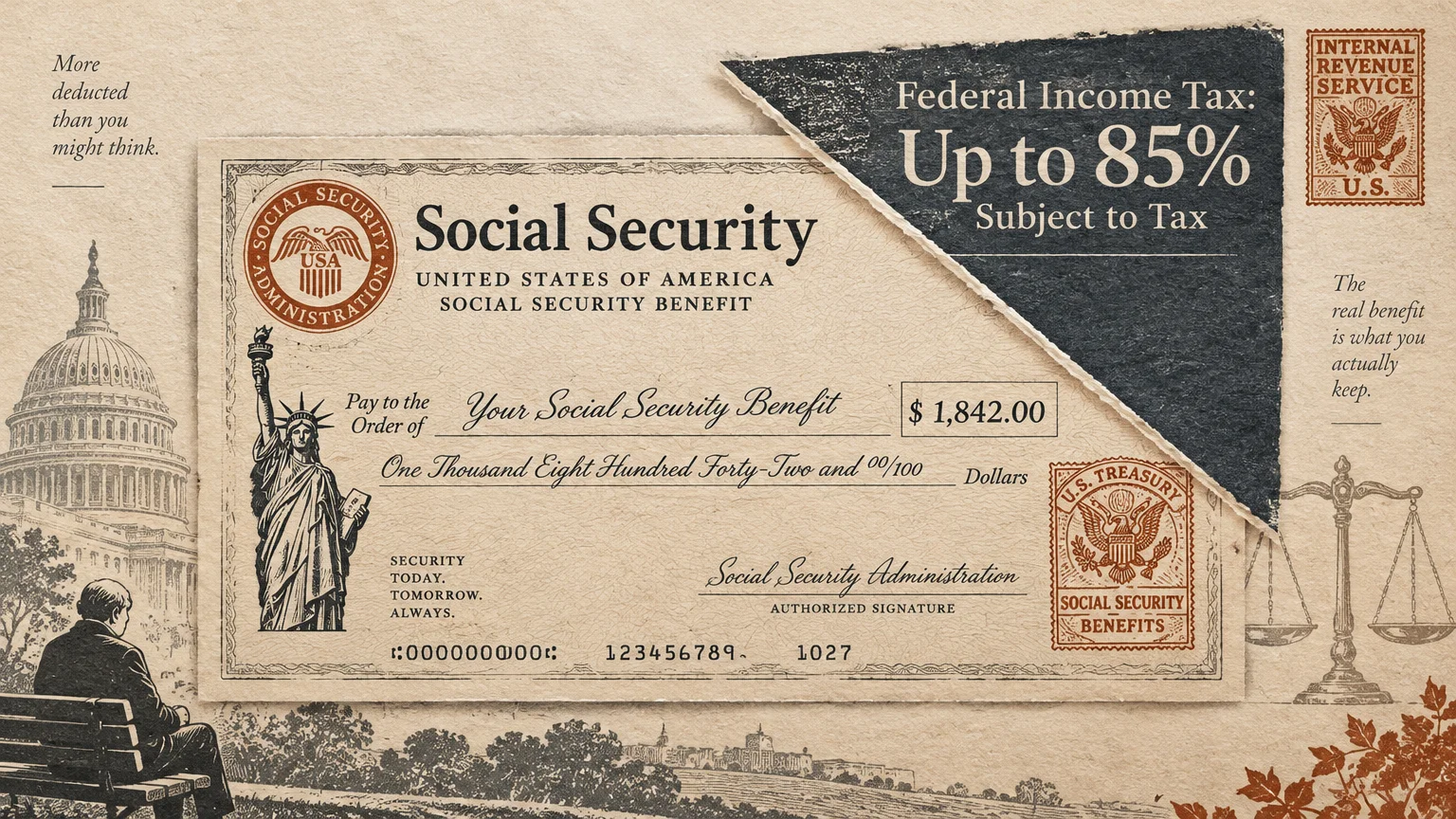
Many retirees assume their Social Security benefits will arrive completely free of income taxes. In reality, federal taxes erode the monthly payments of millions of retired men every year.
The IRS uses your combined income to determine whether your benefits are subject to federal taxes. Combined income equals your adjusted gross income, nontaxable interest, plus half your Social Security benefit.
If you file as an individual and your combined income falls between $25,000 and $34,000, up to 50% of your benefits become taxable. Above $34,000, up to 85% of your benefits face income taxes.
For married couples filing jointly, combined income between $32,000 and $44,000 makes up to 50% of benefits taxable. If your joint income exceeds $44,000, up to 85% becomes subject to taxation.
These tax brackets have remained frozen since their introduction decades ago without inflation indexing. As cost-of-living adjustments increase your nominal checks, more of your benefit crosses into taxable territory.
You can ask the Social Security Administration to withhold federal income taxes directly from your checks. Using Form W-4V prevents unpleasant tax bills and penalties when you file your annual return.

Strategic Planning for Couples: Spousal and Survivor Protections
Social Security decisions carry profound consequences for your spouse that extend far beyond your own life. Because men often accumulate higher career earnings, their claiming age determines the household’s survivor safety net.
When you pass away, your surviving spouse becomes eligible to inherit your full monthly Social Security payment. If you claimed early at age 62, your widow receives that permanently reduced amount for life.
Conversely, delaying your claim until age 70 locks in the highest possible monthly survivor benefit. This extra income provides crucial protection against poverty for a surviving wife in her advanced years.
When one spouse dies, the smaller of the couple’s two Social Security checks disappears completely. Maximizing the larger check ensures the surviving partner retains the strongest possible financial baseline.
You can evaluate diverse claiming options using interactive planning resources from the Consumer Financial Protection Bureau retirement tools. Testing these scenarios helps protect both partners against unforeseen longevity risks.

Costly Mistakes to Avoid
Avoiding costly errors requires understanding how Social Security intersects with your overall financial picture. Review these critical pitfalls before submitting your formal retirement application.
- Claiming early while still working full-time: Exceeding the retirement earnings test triggers heavy benefit withholdings before you reach Full Retirement Age.
- Underestimating the value of delayed credits: Forfeiting the 8% annual guaranteed increase past FRA deprives your household of optimal inflation-protected income.
- Overlooking the impact on your surviving spouse: Claiming at 62 permanently shrinks the survivor benefit your partner relies on after your passing.
- Ignoring federal income taxes on benefits: Failing to plan for the 50% and 85% taxation thresholds can create surprise liabilities at tax time.
- Assuming Social Security rules remain static: Neglecting annual adjustments in earnings caps, work credit values, and COLAs weakens your long-range budget.
Analyze your personal health, family history, and liquid retirement savings before locking in a date. A disciplined, informed approach ensures you do not leave thousands of earned dollars on the table.

Don’t DIY These Decisions
Coordinating Social Security with private pensions, 401(k) accounts, and Medicare requires comprehensive financial expertise. A misstep in claiming sequence can trigger higher Medicare premiums and unnecessary tax penalties.
Consult a fee-only fiduciary financial advisor who specializes in modern retirement decumulation strategies. A fiduciary evaluates your entire portfolio and designs a tax-efficient withdrawal schedule tailored to your goals.
If your retirement involves complex estate considerations or special needs dependents, engage an experienced elder law attorney. Legal counsel safeguards your family’s assets while maintaining eligibility for vital public programs.
Run your personalized figures through the official Social Security Retirement Estimator prior to meeting with your advisory team. Bringing accurate government projections ensures your professional advisors build realistic, data-driven retirement models.
“The best time to plan for retirement was 20 years ago. The second best time is today.”
Frequently Asked Questions About Men’s Social Security Benefits
Review these practical answers to common questions about men’s Social Security benefits, claiming ages, and benefit rules.
Why do men receive higher average Social Security benefits than women?
Men currently average $2,282.28 per month compared to $1,872.43 for women, creating a $409.85 monthly difference. This divide stems primarily from historical wage disparities and career interruptions related to family caregiving.
Because the formula averages your top 35 earning years, continuous careers with higher wages naturally yield larger Primary Insurance Amounts.
Can I collect benefits at 62 and switch to my full benefit at age 67?
No, you cannot simply exchange an early discounted benefit for an unreduced payment once you reach FRA. Claiming at age 62 locks in a permanent monthly reduction for the rest of your life.
Your only remedy is withdrawing your application within 12 months of filing and repaying all received benefits. This statutory reset option is strictly limited to once in your lifetime.
How will the 2027 COLA change monthly payments for men?
The Social Security Administration announced a 3.6% cost-of-living adjustment taking effect in January 2027. This increase will add roughly $75 per month to the overall retired worker average.
For a man collecting the current male average of $2,282.28, the 3.6% raise adds approximately $82 each month. That adjustment lifts the average male payment above $2,364 starting in January 2027.
What happens to my Social Security benefit if I pass away before my wife?
Your surviving spouse can receive up to 100% of your monthly benefit amount, including any delayed credits. If she has reached her full retirement age, she steps into your higher payment tier.
However, your household will no longer receive her smaller benefit check, as dual entitlement rules prevent combining payments. Maximizing your own benefit ensures your surviving spouse retains the highest possible income.
Will my benefit increase if I work after Full Retirement Age?
Yes, continuing to work can increase your benefit if your current annual earnings exceed one of your past 35 years. The agency automatically recalculates your Primary Insurance Amount whenever you replace a lower-earning year.
Furthermore, you can earn unlimited income after reaching Full Retirement Age without facing any benefit withholdings. Working in your late sixties offers an effective way to enhance your lifetime cash flow.
Securing Your Retirement Future
Take proactive ownership of your retirement by examining your complete earnings record on the official Social Security portal. Verifying your wage history today eliminates costly discrepancies before you file your formal claim.
Weigh your claiming timeline carefully against your personal health, lifestyle aspirations, and household financial resources. Making an informed choice ensures you maximize the monthly checks you spent a lifetime earning.
This article is for informational purposes only and does not constitute financial, legal, or medical advice. Medicare rules, Social Security benefits, and tax laws change regularly—verify current details at Medicare.gov, SSA.gov, or with a licensed professional.
Last updated: November 2026. Medicare and Social Security rules change annually—always verify current details at official government sources.