High earners and active seniors planning their financial future need to prepare for another upward shift in the Social Security taxable income cap. Based on intermediate estimates from the Social Security Board of Trustees, the maximum taxable earnings for 2027 will likely land between $188,100 and $188,700—up from $184,500 in 2026. This potential rise increases the maximum annual tax burden for top earners by hundreds of dollars while directly influencing your future retirement benefit formulas. Understanding how this ceiling moves empowers you to adjust payroll withholdings, optimize tax-deferred accounts, and refine your broader retirement cash flow strategies well in advance.
Key Takeaways: What You Need to Know
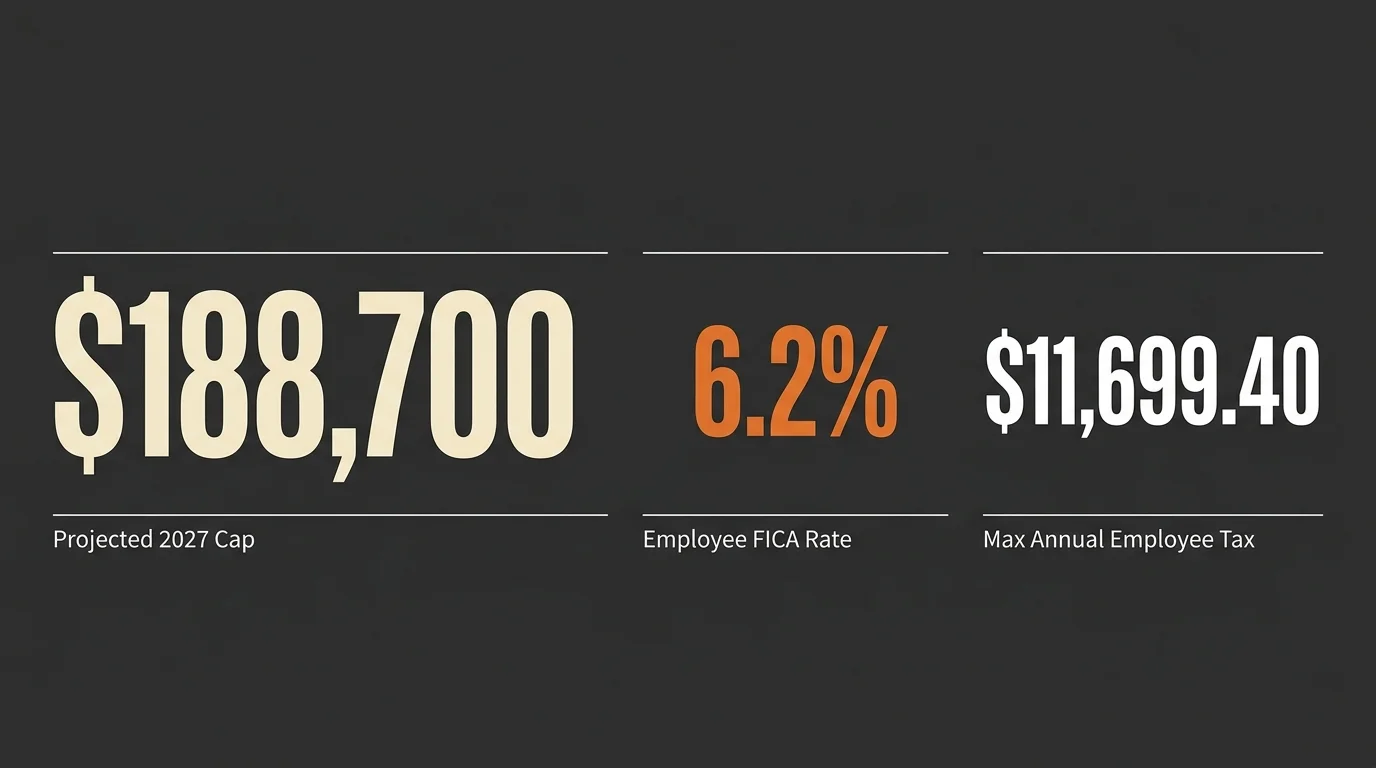
- 2027 Projection: The Social Security wage base cap is expected to reach between $188,100 and $188,700 in 2027, based on intermediate projections from the Social Security Board of Trustees.
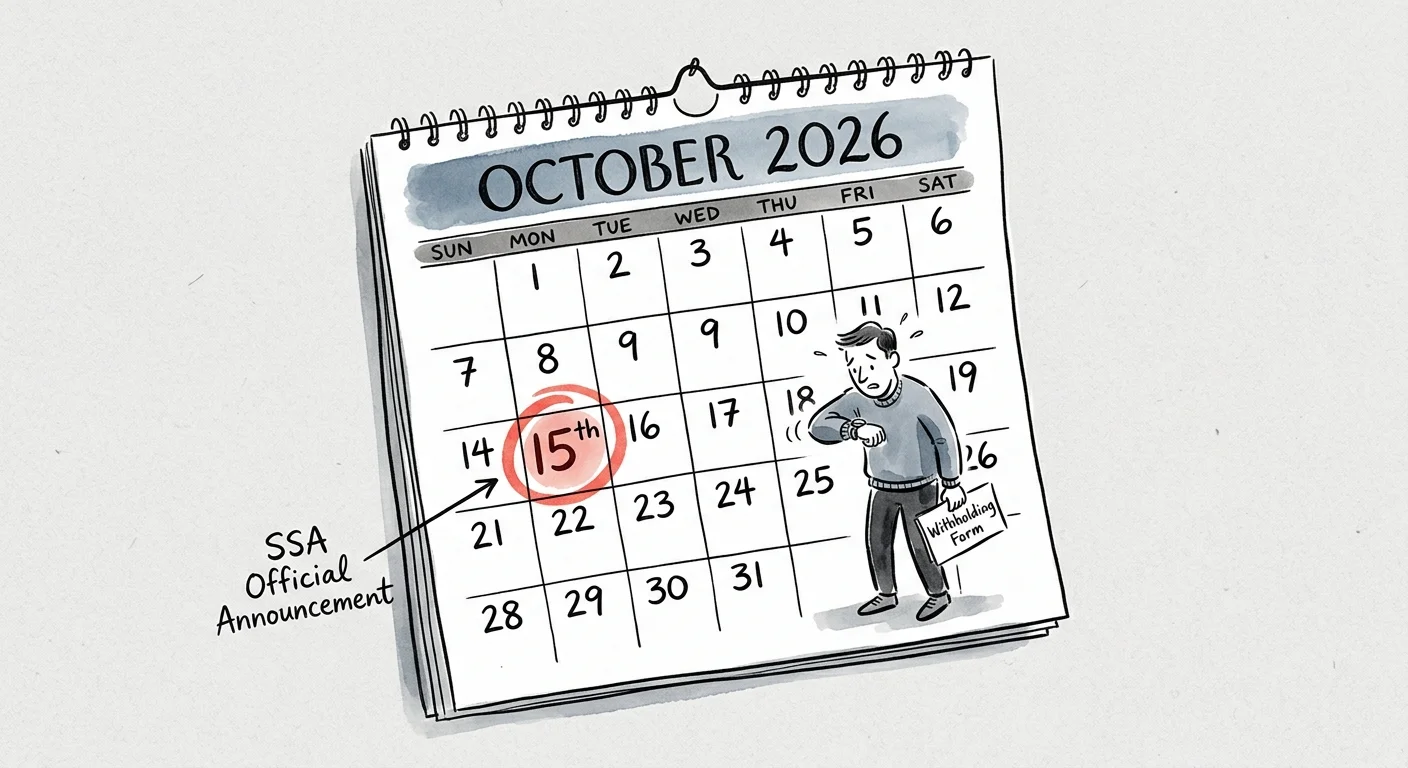
- Official Announcement Date: The Social Security Administration (SSA) will officially confirm the finalized 2027 wage base cap in mid-October 2026.
- Tax Rates Remain Fixed: Employees pay 6.2% on earnings up to the cap, while self-employed individuals pay the full 12.4% rate. Earnings above the cap are exempt from Social Security payroll taxes.
- Maximum Tax Burden: At an estimated cap of $188,700, the maximum annual Social Security tax per employee would be approximately $11,699.40 ($23,398.80 for the self-employed).
- Medicare Taxes Are Uncapped: Unlike Social Security, Medicare payroll taxes (1.45% base plus an optional 0.9% Additional Medicare Tax for higher incomes) apply to all earned income without a wage limit.
Projecting the 2027 Social Security Wage Base
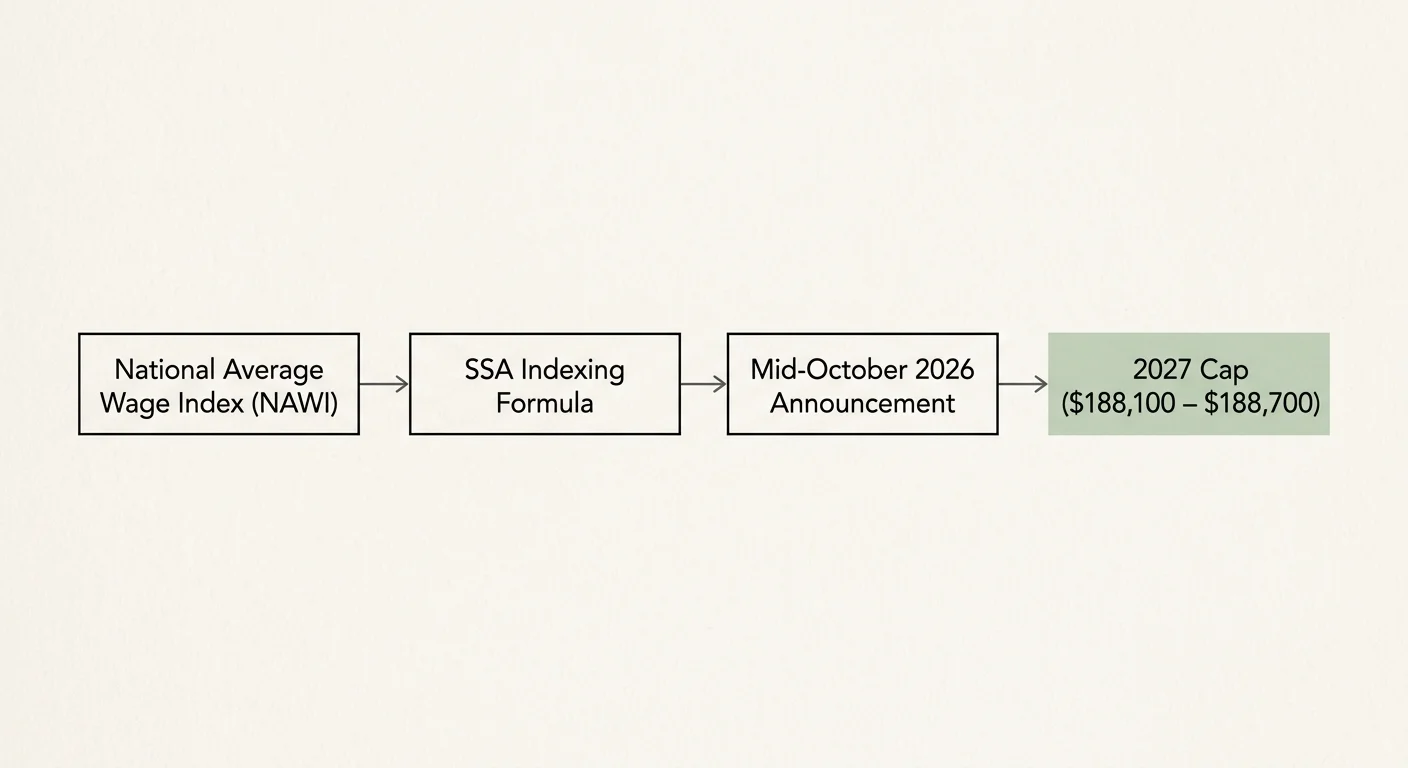
Every autumn, the federal government updates the maximum amount of earnings subject to the Social Security payroll tax. The Social Security Administration calculates this limit automatically using the National Average Wage Index (NAWI). Because the indexing formula relies on economic data from two years prior, wage growth trends occurring today directly shape the 2027 cap.
According to the most recent intermediate projections released by the Social Security Board of Trustees, the 2027 maximum taxable earnings figure is expected to settle between $188,100 and $188,700. This estimate represents a steady increase over the 2026 wage base cap of $184,500, which itself jumped $8,400 from the 2025 cap of $176,100.
Strong national wage growth pushes the index higher; conversely, periods of economic stagnation slow its rise. The SSA will publish the official, binding limit in mid-October 2026 alongside the annual Cost-of-Living Adjustment (COLA) announcement. Keeping an eye on these projections allows pre-retirees and working seniors to anticipate changes in their take-home pay and tax exposure long before the new tax year begins.
How the Social Security Tax Limit Works
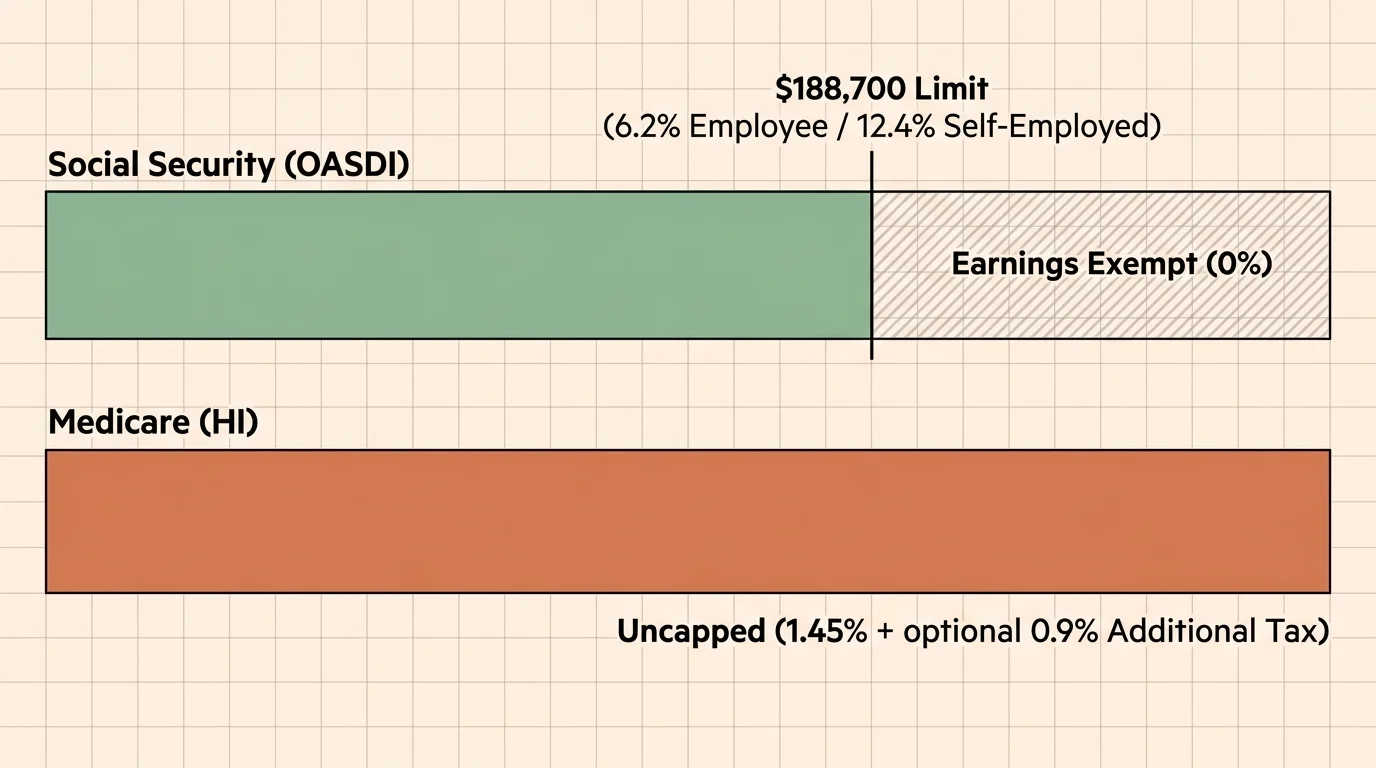
The Old-Age, Survivors, and Disability Insurance (OASDI) program relies on a specific payroll tax structure defined by the Federal Insurance Contributions Act (FICA). As an employee, you pay a 6.2% tax on your gross wages up to the annual limit, while your employer matches that 6.2% contribution. If you are self-employed, the Self-Employed Contributions Act (SECA) requires you to pay both portions—a combined rate of 12.4%—up to the wage cap.
Once your earned income crosses the annual threshold, payroll systems automatically stop collecting the 6.2% Social Security tax for the remainder of the calendar year. This mechanism creates a natural cap on individual contributions:
- 2026 Baseline: On the $184,500 limit, the maximum employee tax is $11,439.00 (6.2%), and the maximum self-employed tax is $22,878.00 (12.4%).
- 2027 Forecast (High Estimate): If the cap rises to $188,700, the maximum employee tax will reach approximately $11,699.40, while self-employed individuals will cap out at $23,398.80.
It is crucial to distinguish the Social Security tax cap from Medicare payroll taxes. Medicare taxes have no income ceiling whatsoever. All gross wages are subject to the standard 1.45% Medicare tax (2.9% for self-employed individuals). Furthermore, the Affordable Care Act established an Additional Medicare Tax of 0.9% on earned income exceeding $200,000 for single filers or $250,000 for married couples filing jointly; this supplemental tax applies regardless of the Social Security wage cap.
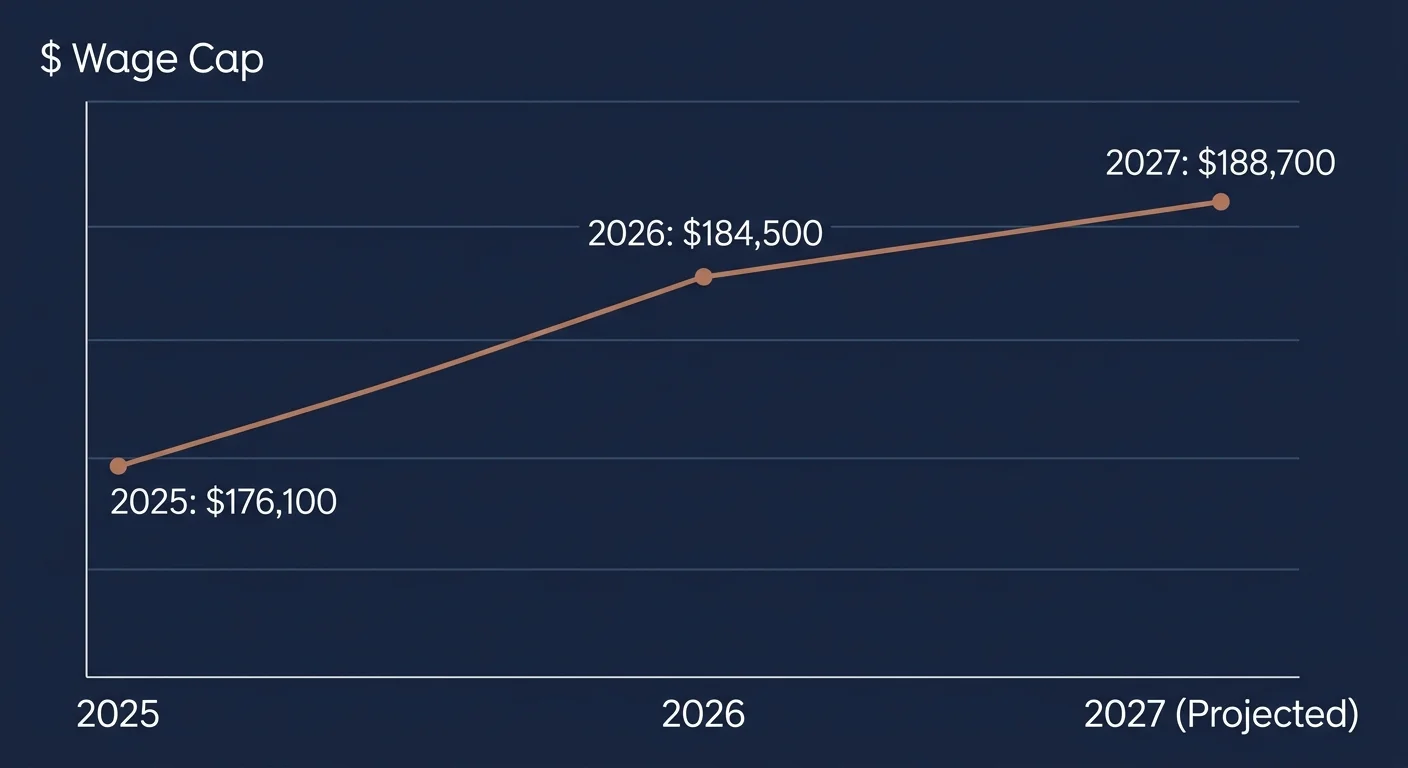
Historical Trend: Social Security Taxable Income Cap (2023–2027 Forecast)
Examining how the wage base cap has evolved over recent years highlights the trajectory of wage indexing. High inflation and wage adjustments in recent years led to notable bumps in the taxable ceiling, creating a higher foundation for future increases.
| Tax Year | Social Security Wage Base Cap | Max Employee Tax (6.2%) | Max Self-Employed Tax (12.4%) | Year-over-Year Increase |
|---|---|---|---|---|
| 2023 | $160,200 | $9,932.40 | $19,864.80 | +$13,200 (+9.0%) |
| 2024 | $168,600 | $10,453.20 | $20,906.40 | +$8,400 (+5.2%) |
| 2025 | $176,100 | $10,918.20 | $21,836.40 | +$7,500 (+4.5%) |
| 2026 | $184,500 | $11,439.00 | $22,878.00 | +$8,400 (+4.8%) |
| 2027 (Forecast) | $188,100 – $188,700 | ~$11,662.20 – $11,699.40 | ~$23,324.40 – $23,398.80 | +$3,600 – $4,200 (Est.) |
“It’s not how much money you make, but how much money you keep, how hard it works for you, and how many generations you keep it for.” — Robert Kiyosaki

How the Wage Base Cap Directly Impacts Your Retirement Benefit
The Social Security tax cap is a double-edged sword. While it limits the maximum payroll tax collected from high earners each year, it also serves as the maximum earnings figure used to compute future monthly benefits. The SSA calculates your primary retirement benefit using your highest 35 years of indexed earnings.
When the SSA computes your Average Indexed Monthly Earnings (AIME), any wages you earned above the tax cap in a given year are excluded from the formula. Consequently, earning at or above the wage cap for 35 or more years entitles you to the absolute maximum Social Security monthly payout available at Full Retirement Age (FRA) or at age 70.
To put this into context, reaching the maximum taxable cap in 2027 helps secure top-tier earning credit for that calendar year. If you are approaching retirement and evaluating your overall benefit potential, utilizing tools like the official Social Security Retirement Estimator can show you how continuous earnings near the wage cap affect your projected monthly income stream.

Strategic Tax and Financial Planning for Working Seniors
If your annual earnings approach or exceed the Social Security wage limit, proactive planning helps maximize cash flow while minimizing overall tax liabilities. Workers aged 55 to 75 who remain active in the workforce have several practical levers to pull:
1. Utilize Health Savings Accounts (HSAs) for FICA Savings
While traditional 401(k) contributions lower your federal and state income taxes, they do not reduce your Social Security or Medicare payroll taxes. Health Savings Accounts are a notable exception. When you contribute to an HSA through payroll salary reductions (under a Section 125 cafeteria plan), those contributions are exempt from federal income tax, state income tax, and FICA payroll taxes. This delivers an immediate 6.2% savings on Social Security tax for earnings below the cap, alongside a 1.45% Medicare tax savings.
2. Optimize Retirement Account Catch-Up Contributions
Taxpayers aged 50 and older can make additional catch-up contributions to qualified retirement plans. Review IRS Retirement Plans guidance to stay informed on annual elective deferral limits for 401(k), 403(b), and Traditional or Roth IRAs. Lowering your overall adjusted gross income (AGI) via tax-deferred savings helps offset higher payroll taxes incurred early in the calendar year.
3. Manage Self-Employed Business Structures
If you run your own consulting firm or small business in retirement, operating as a sole proprietor exposes your entire net profit (up to the cap) to the 12.4% SECA tax. Electing S-Corporation tax status may allow you to divide earnings between a reasonable salary (subject to FICA taxes) and shareholder distributions (exempt from FICA taxes, though subject to income tax). Consult a qualified CPA to ensure your salary structure aligns with IRS reasonable compensation rules.
4. Plan Around Non-Qualified Deferred Compensation (NQDC)
High-earning executives near retirement often utilize deferred compensation arrangements. Be aware that FICA taxes on NQDC plans are generally due at the time services are performed or when the deferred income vests—not when you actually receive the distributions in retirement. Understanding these timing rules prevents unexpected payroll tax bills during your final working years.

Legislative Reforms: Will Congress Remove the Social Security Tax Cap?
The future of the Social Security tax cap remains a central topic in Washington. The Social Security Trust Funds are currently projected to face insolvency within the next decade if lawmakers do not intervene. Under current law, depletion of the reserves would force an across-the-board benefit reduction of roughly 17% to 20%.
To prevent this scenario, several legislative proposals focus directly on altering or eliminating the taxable wage limit. Prominent reform concepts include:
- Creating a “Donut Hole”: Proposals such as the Social Security Expansion Act suggest applying the 6.2% payroll tax to earnings above a certain threshold (such as $400,000) while leaving earnings between the annual cap and $400,000 untaxed. Over time, as the annual cap rises, the donut hole would close completely.
- Phasing Out the Wage Cap Entirely: Eliminating the taxable ceiling completely would subject all earned income to the 6.2% employee and employer tax, mirroring the current Medicare tax structure.
- Modifying Benefit Calculations for Top Earners: Some lawmakers propose taxing earnings above the current cap without extending additional retirement benefit credits for those extra contributions, effectively converting the payroll tax into a pure revenue-generation mechanism for the Trust Fund.
While Congress has not yet passed major overhaul legislation, pre-retirees should monitor these proposals closely. Any major legislative changes would alter cash-flow projections for high-earning households leading into retirement.
Don’t Make These Mistakes
Navigating payroll taxes and retirement rules requires precision. Avoid these common missteps when managing income near the Social Security wage cap:
- Failing to Claim Credit for Overpaid Social Security Tax: If you work for two or more employers in a single year and your total combined earnings exceed the annual cap, each employer will withhold the 6.2% tax until your pay at that specific company reaches the limit. As a result, you may overpay Social Security taxes. You must claim this excess withholding as a refundable credit on line 11 of Schedule 3 on your IRS Form 1040.
- Confusing the Tax Cap with the Retirement Earnings Test: The Social Security taxable maximum is completely different from the Social Security Retirement Earnings Test (RET). The wage cap limits the payroll tax you pay on high earnings. The RET temporarily reduces benefit payouts if you claim Social Security prior to Full Retirement Age while earning income above a separate annual threshold.
- Assuming 401(k) Deferrals Reduce Payroll Tax: Many workers assume that placing $23,000 or more into a pre-tax 401(k) drops their payroll tax obligation. In reality, FICA taxes apply to your taxable wage base *before* elective deferrals are deducted from your paycheck.
- Miscalculating Quarterly Estimated Taxes for Business Income: Self-employed individuals who reach the wage cap mid-year often forget to adjust their quarterly estimated payments for Q3 and Q4. Once you hit the maximum taxable limit, your SECA tax liability drops by 12.4% on subsequent earnings, which impacts your required quarterly payments.

When Professional Advice Is Worth It
Managing payroll taxes, business entity selection, and retirement timing involves intersecting tax codes and federal regulations. Working with certified experts ensures you protect your hard-earned assets while staying fully compliant:
- Certified Public Accountant (CPA) or Tax Attorney: Essential for self-employed individuals structuring S-Corp compensation or claiming excess FICA tax credits from multiple employers.
- Certified Financial Planner (CFP): Valuable for coordinating deferred compensation payouts, estimating future pension/Social Security income, and reviewing resources from the Consumer Financial Protection Bureau retirement tools to build a comprehensive cash-flow model.
- Social Security Claiming Specialist: Helpful if you have a complex earnings history near the wage cap and need to coordinate claiming timing with a spouse to maximize cumulative lifetime benefits.
Frequently Asked Questions
When will the Social Security Administration officially announce the 2027 tax cap?
The Social Security Administration will officially announce the finalized 2027 taxable maximum in mid-October 2026. This announcement occurs simultaneously with the publication of the annual Cost-of-Living Adjustment (COLA) figure for the upcoming calendar year.
What is the projected Social Security tax cap for 2027?
Intermediate forecasts from the Social Security Board of Trustees estimate that the 2027 maximum taxable earnings ceiling will land between $188,100 and $188,700. The final figure depends on growth in the National Average Wage Index (NAWI).
Do pre-tax 401(k) contributions reduce my Social Security payroll tax?
No. Pre-tax contributions to traditional 401(k) or 403(b) accounts reduce your federal and state income taxes, but they do not reduce your Social Security (FICA) taxes. Payroll taxes are calculated based on your gross wages before elective retirement deferrals are subtracted.
What happens if I overpay Social Security tax by working two jobs in one year?
If you work for multiple employers and your combined income exceeds the annual wage base cap, you will likely overpay Social Security taxes because each employer is required to withhold taxes up to the limit. You can claim a refund for the excess tax paid as a credit when filing your federal tax return (IRS Form 1040, Schedule 3).
Anticipating changes to the Social Security wage base cap allows high earners and pre-retirees to maintain full control over their financial trajectory. By integrating projected payroll tax shifts into your tax withholding settings, retirement savings strategies, and business structures today, you safeguard your income and keep more of your money working for your future.
This article is for informational purposes only and does not constitute financial, legal, or medical advice. Medicare rules, Social Security benefits, and tax laws change regularly—verify current details at Medicare.gov, SSA.gov, or with a licensed professional.
Last updated: February 2026. Medicare and Social Security rules change annually—always verify current details at official government sources.