Gathering your Medicare paperwork before tax season can unlock thousands of dollars in medical expense deductions. Missing a single statement can mean overpaying the IRS or triggering an unnecessary audit.
Many retirees assume Medicare covers everything and leave health expenses off their tax returns entirely. Tracking your premiums and out-of-pocket clinical costs ensures you claim every tax break you earned.
Navigating these tax documents does not have to feel overwhelming. Having the right ten forms organized in your files puts you in full control of your retirement budget.

Why Your Medicare Paperwork Matters at Tax Time
Your Medicare premiums and copayments represent a substantial annual investment in your well-being. Keeping orderly medical expense records allows you to claim allowable tax breaks with total confidence.
The Internal Revenue Service allows you to deduct qualifying medical expenses that exceed 7.5% of your Adjusted Gross Income (AGI). You claim these itemized expenses on Schedule A of Form 1040.
For the 2026 tax year, the base standard deduction is $16,100 for single filers and $32,200 for married couples filing jointly. Heads of household receive a $24,150 base deduction.
Older adults also receive an additional standard deduction. Taxpayers age 65 and older receive an extra $2,050 if single, or $1,650 per spouse if married filing jointly.
Under the One, Big, Beautiful Bill Act, adults 65 and older can claim an enhanced senior deduction of $6,000 per person. Married couples where both spouses qualify receive $12,000.
This enhanced deduction applies to both itemizers and non-itemizers through 2028. It phases out at a 6% rate for modified adjusted gross incomes above $75,000 for single filers or $150,000 for couples.
If you run a small business or work as a consultant, your paperwork delivers even greater value. Self-employed retirees can deduct 100% of their Medicare premiums directly on Schedule 1.
This above-the-line deduction does not require itemizing on Schedule A. It directly reduces your adjusted gross income dollar for dollar regardless of the 7.5% threshold.
“It’s not how much money you make, but how much money you keep, how hard it works for you, and how many generations you keep it for.” — Robert Kiyosaki
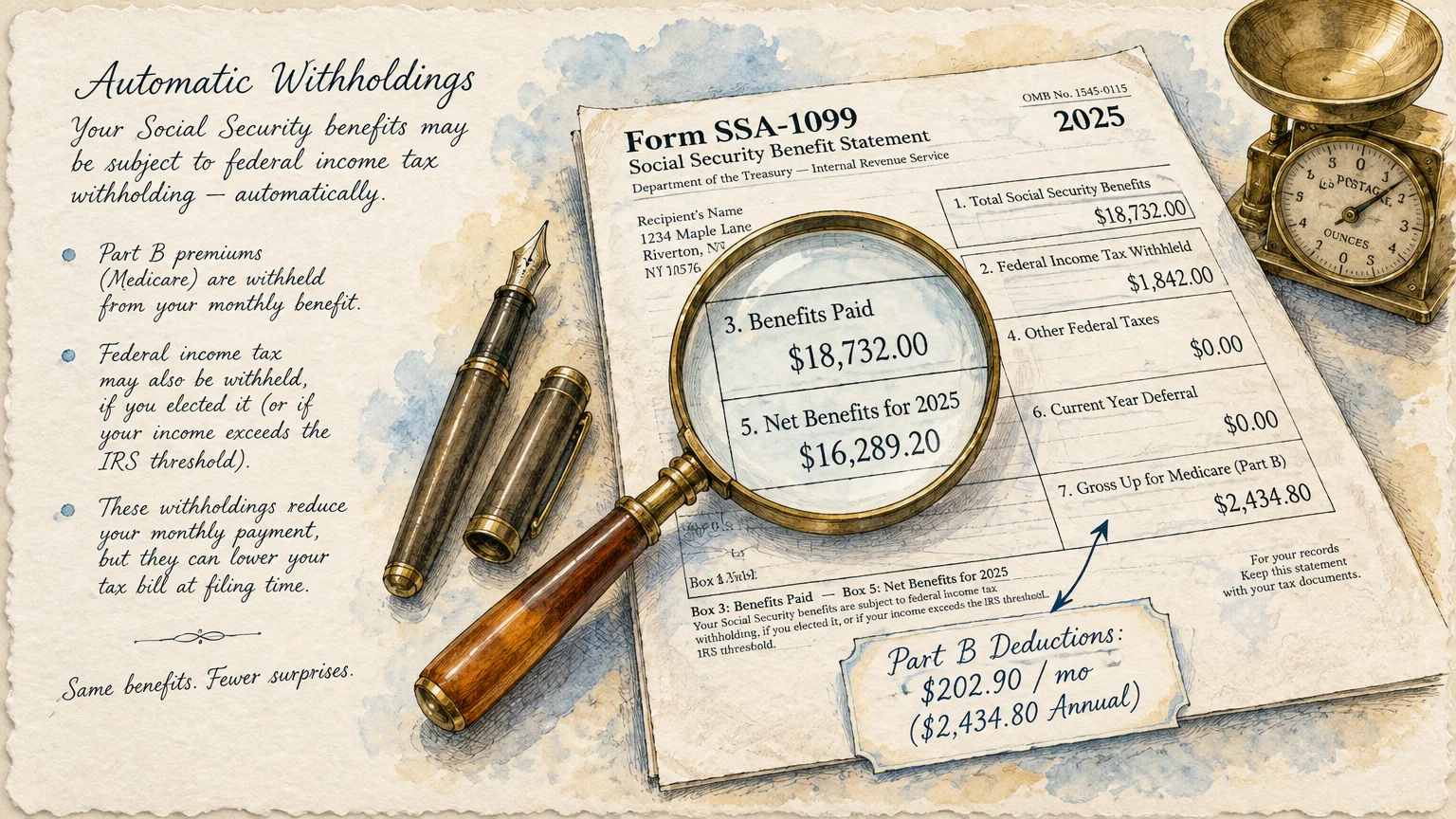
Document 1: Form SSA-1099 for Automatic Premium Deductions
The Social Security Administration mails Form SSA-1099 every January to anyone who received retirement benefits during the previous calendar year. You can also download it through your personal account on the Social Security Administration (SSA) website.
Review Box 3 and Box 5 carefully when your statement arrives. These boxes detail your total benefits and show Medicare premium amounts withheld directly from your checks.
In 2026, the standard monthly Medicare Part B premium is $202.90. This means you likely paid $2,434.80 across the full calendar year in Part B premiums alone.
If you enrolled in a Medicare Part D prescription plan and elected automatic payment, those deductions appear on this form too. Both Part B and Part D withholdings count as deductible medical expenses.
File this statement immediately in your primary tax folder. Your tax preparer relies on Form SSA-1099 to document your health insurance premium deductions accurately.
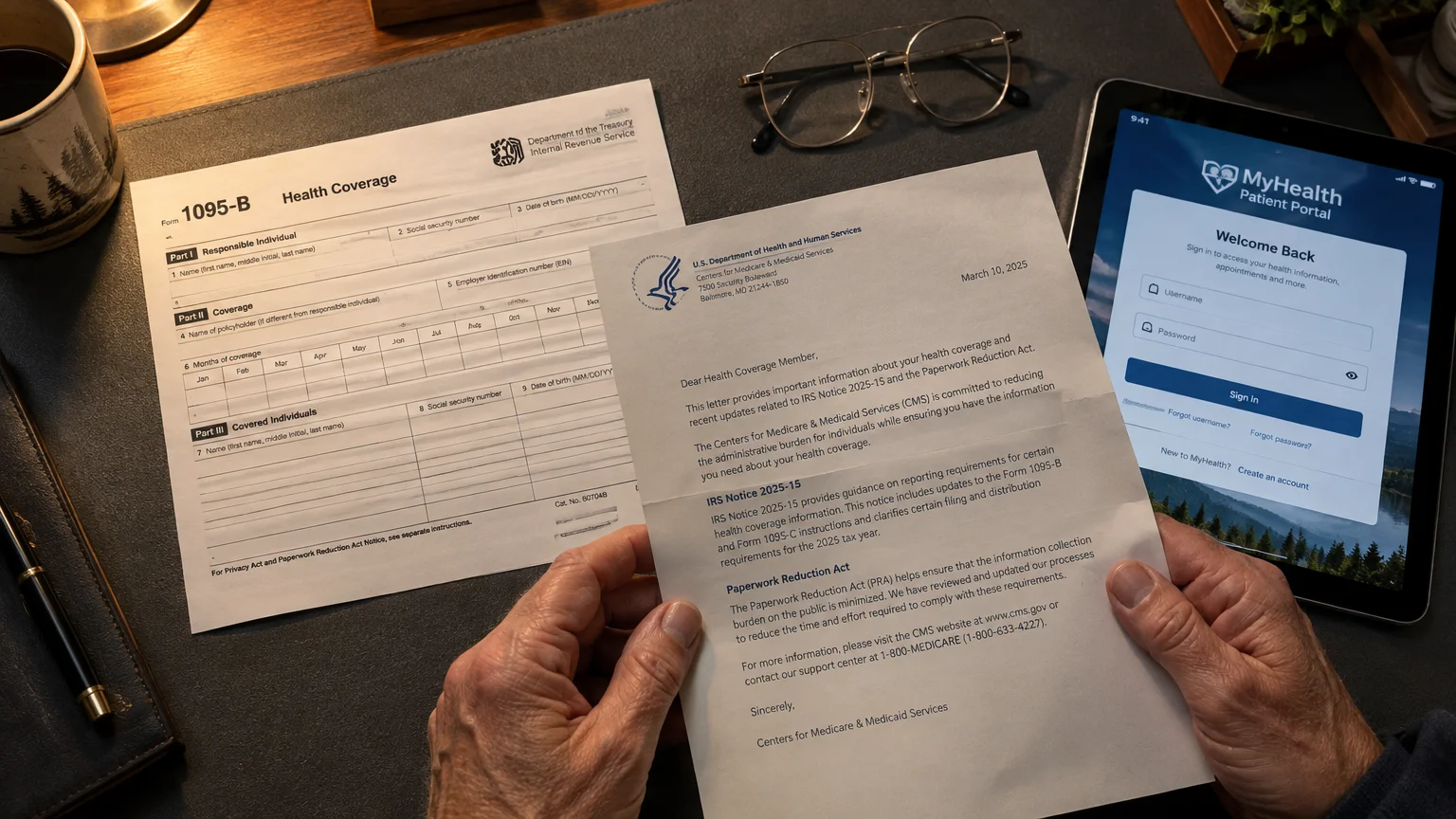
Document 2: Form 1095-B (Health Coverage Proof)
Form 1095-B serves as official verification that you maintained qualifying minimum essential health coverage during the tax year. The federal government uses this form to confirm your participation in Medicare Part A.
Under the Paperwork Burden Reduction Act and IRS Notice 2025-15, coverage providers are no longer required to mail this form automatically to every enrollee. Medicare posts a public notice explaining how to request a copy instead.
Medicare still automatically mails Form 1095-B if you had Part A coverage for only part of the year. Beneficiaries living in California, Massachusetts, New Jersey, Rhode Island, or Washington, D.C. also receive automatic mailings.
These individual jurisdictions enforce state-level health insurance mandates on resident tax returns. If you live elsewhere and need this form, you can request it through Medicare.gov or by calling Medicare directly.
Keep your Form 1095-B with your permanent files once received. Although you do not attach it to your federal return, it provides crucial backup documentation in case of state tax inquiries.

Document 3: Medicare Summary Notices (MSNs) for Parts A and B
Original Medicare enrollees receive a Medicare Summary Notice every three months if they received medical services or medical equipment during that quarter. These notices detail what your healthcare providers billed, what Medicare approved, and what you owe.
Your MSNs track your progress toward annual Medicare deductibles. In 2026, the Medicare Part B deductible is $283 for outpatient care and doctor visits.
For inpatient hospital stays, the 2026 Part A deductible is $1,736 per benefit period. MSNs confirm whether you met these initial costs out of your own pocket.
If you pay a monthly premium for Medicare Part A because you lack 40 work credits, save those billing statements too. In 2026, Part A premiums cost either $311 or $565 per month.
Highlight the patient responsibility column on each quarterly notice. Summing these figures provides verified proof of your deductible clinical expenses during an IRS review.

Document 4: Medicare Advantage Explanation of Benefits (EOB) Statements
If you enrolled in a Medicare Advantage (Part C) plan instead of Original Medicare, you will not receive quarterly MSNs. Your private health insurer sends you monthly Explanation of Benefits statements whenever you utilize medical services.
Your Part C EOB details your specific copayments, coinsurance charges, and payments applied toward your annual maximum out-of-pocket limit. Most insurers provide a consolidated year-end summary online every January.
Download and print this annual summary as soon as your plan publishes it. It lists every clinical visit, laboratory test, and diagnostic procedure you completed during the year.
Verify that your EOB reflects only eligible medical treatments. Qualified medical expenses include doctor office copays and emergency room fees, but exclude non-prescription toiletries or general gym memberships.
Pair your year-end EOB with your personal credit card receipts or canceled checks. Matching claim statements to actual bank debits establishes an unshakeable audit trail.

Document 5: Part D Annual Prescription Summaries and Pharmacy Receipts
Prescription medications represent one of the largest ongoing expenses for retirees managing chronic conditions. Proper recordkeeping ensures you capture every dollar spent on necessary prescription pharmaceuticals.
Under current Medicare rules for 2026, out-of-pocket spending on covered Part D prescription drugs is capped at $2,100 per beneficiary. The standard statutory Part D deductible is $615.
Log in to your Part D insurance portal in January to print your annual prescription drug spending summary. This document categorizes your total prescription costs, manufacturer discounts, and personal out-of-pocket copayments.
Ask your local retail or mail-order pharmacy for a consolidated annual customer payment report. Most major pharmacies generate this report on demand at no charge.
Compare the pharmacy payment report against your insurer’s Part D summary to confirm all purchases match. Only unreimbursed, out-of-pocket payments for eligible prescription drugs qualify for federal tax deductions.

Document 6: Medicare Prescription Payment Plan (M3P) Monthly Statements
The Medicare Prescription Payment Plan allows enrollees to spread their out-of-pocket prescription drug costs into manageable monthly installments throughout the calendar year. This program helps retirees avoid massive drug copayments at the pharmacy counter in January and February.
If you participate in this payment program, your Part D plan sponsor bills you monthly instead of collecting copays at the pharmacy counter. These monthly billing statements are critical medicare tax documents for your annual filing.
The IRS operates on a strict cash accounting basis for individual taxpayers claiming medical expense deductions. You may only deduct expenses you physically paid during the calendar year, regardless of when the pharmacy filled the prescription.
Retain every monthly M3P statement alongside your bank statements or canceled checks showing cleared payments. If your December bill is paid in January, you must claim that expense on the following year’s return.
Separating billed amounts from actual paid amounts prevents costly accounting mistakes. Your tax preparer must see the exact payment dates to calculate your medical deduction accurately.

Document 7: Medigap Premium Invoices and Year-End Statements
Retirees with Original Medicare frequently purchase private Medicare Supplement Insurance policies, commonly known as Medigap. These private plans cover out-of-pocket costs such as Part A hospital deductibles and Part B coinsurance.
Private insurance carriers bill Medigap premiums directly to policyholders through monthly bank drafts, credit card billings, or mailed paper invoices. These premiums are not deducted from your Social Security benefit check.
Because Medigap premiums are not listed on Form SSA-1099, you must maintain your own independent payment documentation. Every dollar you pay toward a qualifying Medigap policy counts toward your Schedule A medical deduction.
Self-employed individuals can include these supplemental insurance premiums under the self-employed health insurance deduction. You write off the entire cost directly against your net business profits on Schedule 1.
Request an annual payment certificate from your Medigap carrier every January. This single-page document certifies the total policy premiums you paid across the preceding twelve months.
“The goal of retirement is to live off your assets—not live off your regrets.”
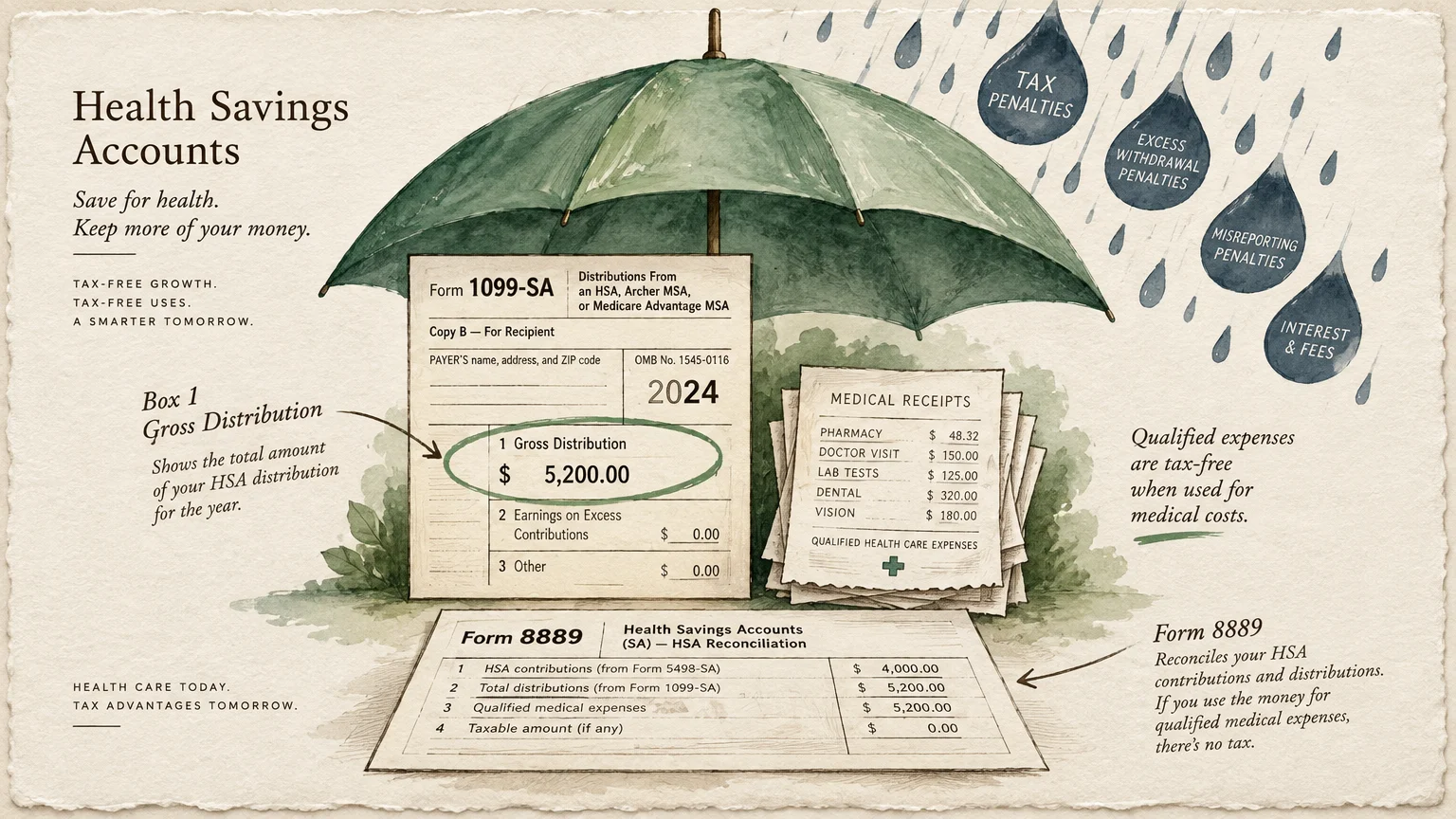
Document 8: Form 1099-SA and Form 8889 for HSA Distributions
Many individuals enter retirement with substantial balances remaining inside a Health Savings Account (HSA) established during their working careers. Navigating HSA rules alongside Medicare requires strict attention to documentation.
Once you enroll in any part of Medicare, federal law prohibits you from making new contributions to an HSA. Remember that enrolling in Medicare Part A after age 65 triggers up to six months of retroactive coverage.
You can still withdraw existing HSA funds tax-free to pay for qualified medical expenses after enrolling in Medicare. Qualified expenses include Medicare Part A, Part B, Medicare Advantage (Part C), and Part D prescription drug premiums.
Federal tax regulations specifically state that Medigap premiums do not qualify for tax-free HSA distributions. Paying Medigap premiums with HSA money exposes you to income taxes and penalties.
Your HSA custodian will issue Form 1099-SA showing your annual distributions. You must report these distributions on IRS Form 8889 to prove you used the funds exclusively for qualified medical care.
Check the rules published by the IRS Retirement Plans division if you have questions regarding account distributions. Maintaining your receipts guarantees that every distribution remains completely exempt from federal tax liability.

Document 9: Medical Mileage and Clinical Transportation Logs
Transportation expenses incurred while traveling to and from medical treatment qualify as deductible medical expenses under federal tax rules. This includes trips to doctors, physical therapists, dialysis centers, and pharmacies for prescription pickups.
Retirees tracking medical travel for the 2026 tax year must navigate a split standard mileage rate. The IRS adjusted medical travel rates mid-year, creating two distinct rates for your 2026 return.
From January 1 to June 30, 2026, the allowable medical mileage rate is 20.5 cents per mile. From July 1 to December 31, 2026, the allowable rate increases to 23.5 cents per mile.
Maintain a contemporaneous mileage log detailing every qualified medical trip. Record the specific date of travel, starting location, clinical destination, total round-trip mileage, and the medical purpose.
You can also deduct out-of-pocket parking fees, bridge tolls, and public transit fares associated with medical care. Staple your parking and toll receipts directly to your mileage logbook at the end of each month.
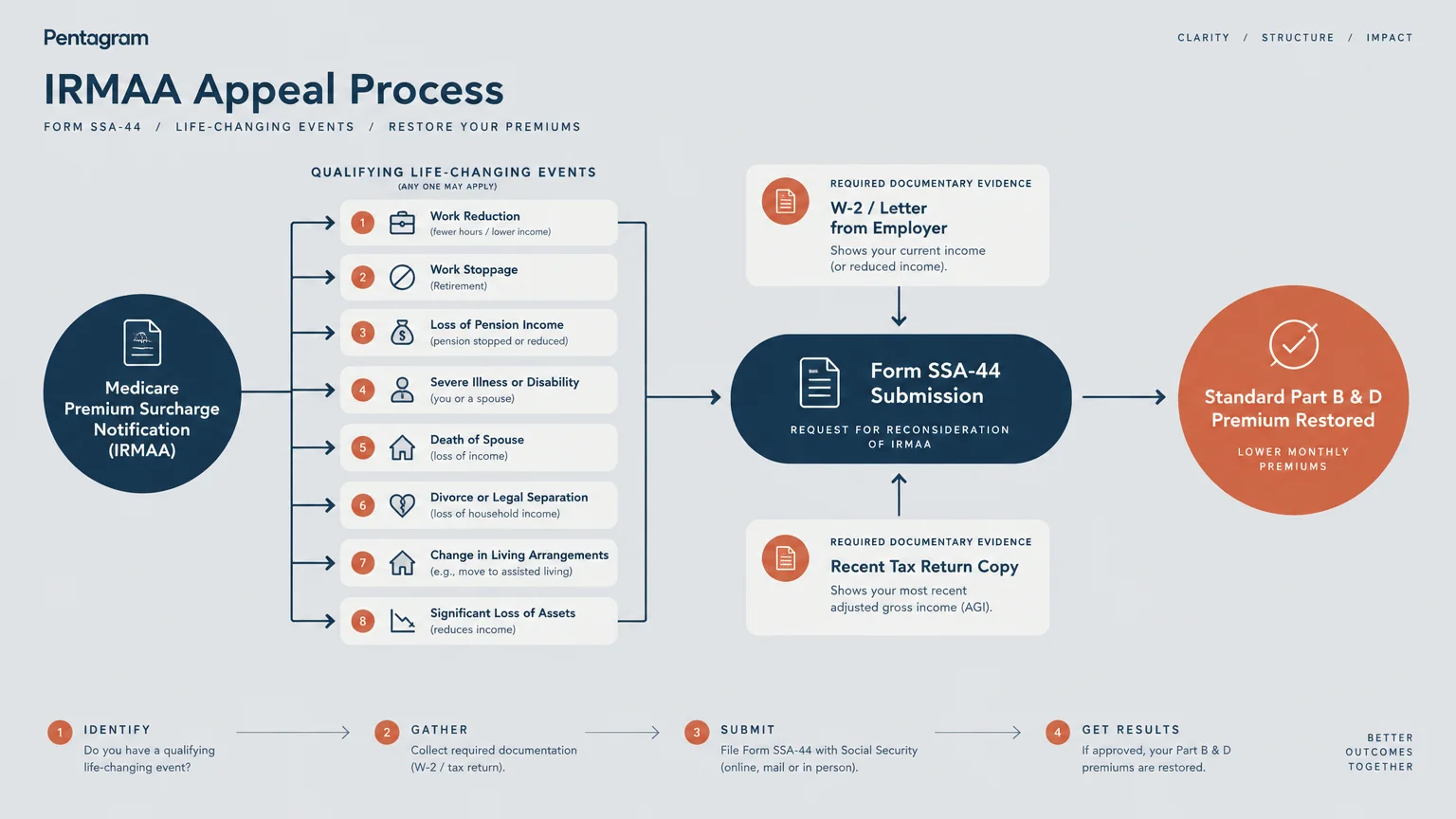
Document 10: Form SSA-44 and IRMAA Appeal Records
Higher-income retirees often pay an Income-Related Monthly Adjustment Amount (IRMAA) surcharge on their Part B and Part D premiums. The government calculates your 2026 IRMAA surcharge using the modified adjusted gross income reported on your 2024 tax return.
If your income dropped significantly due to a life-changing event, you can appeal this surcharge using Form SSA-44. Qualifying events include retirement, work reduction, loss of pension income, or the death of a spouse.
Keep signed copies of your filed Form SSA-44 and all accompanying evidence in your tax binder. Supporting documentation includes employer termination letters, signed retirement agreements, and recent tax transcripts.
If the Social Security Administration approves your appeal, they will recalculate your monthly Medicare premiums. The agency will refund any overpaid premiums or credit them against future benefit checks.
Match your revised SSA award letters against your year-end Form SSA-1099. Confirming that your premium deductions match your actual adjusted rates prevents filing inaccurate deduction figures with the IRS.
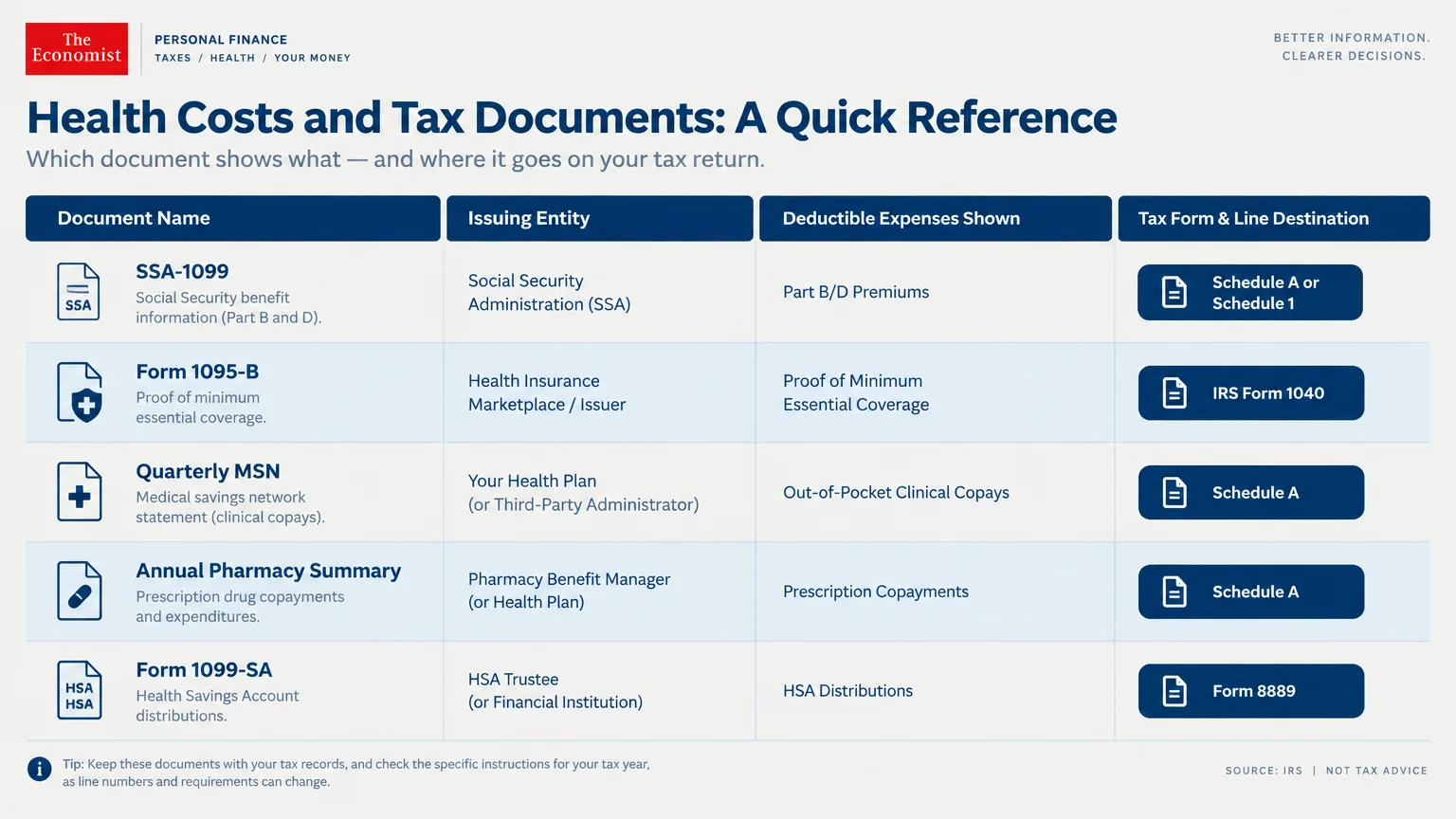
Comparing Medicare Tax Documents: What to Deduct and Where
Tracking multiple statements can feel confusing when tax season approaches. The following table illustrates which forms govern your healthcare deductions and how to handle them on your return.
| Medicare Document | Primary Purpose | Tax Form Used | Key 2026 Recordkeeping Rule |
|---|---|---|---|
| Form SSA-1099 | Part B and Part D premium deductions | Schedule A or Schedule 1 | Part B standard premium is $202.90 per month in 2026. |
| Form 1095-B | Proof of minimum essential coverage | Keep for personal records | Available upon request; mailed automatically in mandate states. |
| Medicare Summary Notice (MSN) | Tracks Parts A and B deductible expenses | Schedule A (Itemized) | Verifies out-of-pocket costs toward $283 Part B deductible. |
| Medicare Advantage EOB | Summarizes Part C copays and coinsurance | Schedule A (Itemized) | Deduct only unreimbursed payments for qualifying medical treatments. |
| Part D Drug Summary | Itemizes covered prescription spending | Schedule A (Itemized) | Aligns with the 2026 annual out-of-pocket cap of $2,100. |
| Monthly M3P Statements | Tracks monthly pharmacy installment payments | Schedule A (Itemized) | Deduct amounts physically paid during 2026, not just billed amounts. |
| Medigap Invoices | Verifies supplemental premium payments | Schedule A or Schedule 1 | Eligible for medical deduction; ineligible for tax-free HSA withdrawals. |
| Form 1099-SA | Reports annual HSA distributions | Form 8889 and Form 1040 | Covers Parts A, B, C, and D premiums, but never Medigap premiums. |
| Medical Mileage Log | Calculates clinical travel deductions | Schedule A (Itemized) | Apply 20.5 cents per mile before July 1; 23.5 cents after July 1. |
| Form SSA-44 & IRMAA Records | Documents appeals for premium surcharges | Keep for audit protection | Connects 2024 tax filings to life-changing events in 2026. |
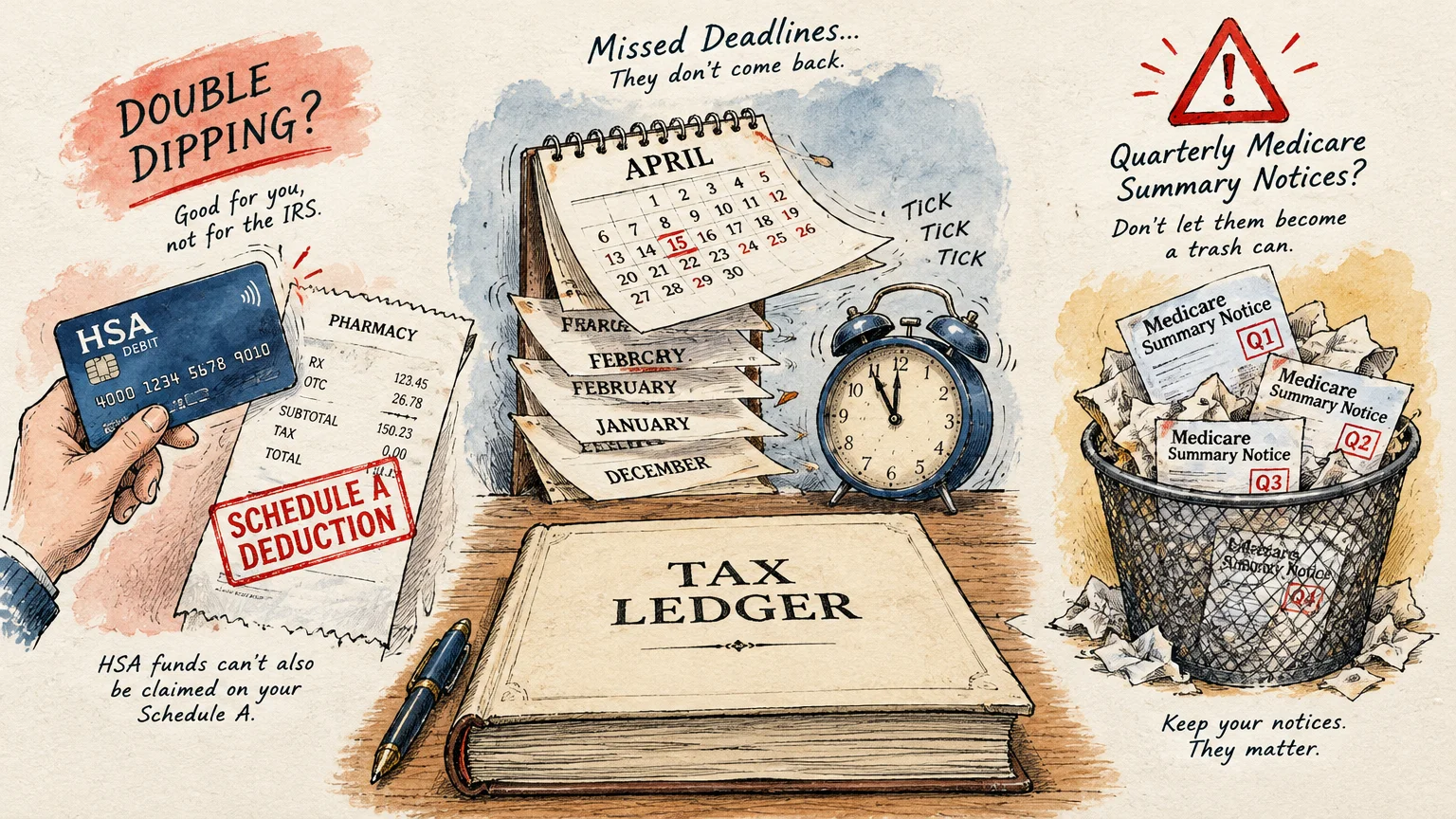
Costly Mistakes to Avoid
Overlooking automatic premium deductions on your Form SSA-1099 is an expensive oversight. Many retirees forget that their monthly Part B deductions total thousands of dollars in deductible expenses every year.
Using Health Savings Account funds to pay private Medigap premiums creates another serious tax problem. Medigap does not qualify as eligible coverage under federal HSA rules, making those withdrawals taxable and subject to penalties.
Assuming billed amounts equal paid expenses on Medicare Prescription Payment Plan statements can distort your deductions. Claiming drug expenses billed in December but paid in January violates IRS cash accounting rules.
Failing to claim the self-employed health insurance deduction costs consulting retirees substantial money. If you have net self-employment earnings, claim your Medicare premiums above the line rather than wrestling with the 7.5% AGI limit.
Using a single flat mileage rate across the entire year will miscalculate your travel deductions. You must separate your 2026 medical trips between the pre-July and post-July mileage rates to satisfy IRS scrutiny.
Discarding receipts for over-the-counter wellness supplies is another common trap. Over-the-counter medicines require a formal doctor prescription to qualify as deductible medical care on Schedule A.

Don’t DIY These Decisions
Navigating the intersection of Medicare rules and federal tax law can present unexpected complexities. Knowing when to solicit professional guidance protects your retirement nest egg from costly compliance penalties.
Trained counselors at the State Health Insurance Assistance Program (SHIP) provide free, unbiased guidance on Medicare options. You can locate your regional SHIP counselor through the Eldercare Locator supported by the federal government.
Certified Public Accountants (CPAs) and Enrolled Agents (EAs) specialize in evaluating whether itemizing your medical deductions beats taking the standard deduction. They assess your eligibility for the enhanced senior deduction and calculate self-employment adjustments accurately.
Elder law attorneys and financial planners help align your Medicare elections with long-term asset protection strategies. They provide crucial support when filing complex IRMAA appeals or managing retroactive Medicare Part A coverage lookback issues.

Record Retention: How Long Should You Keep Medicare Tax Records?
The Internal Revenue Service enforces clear statutory timelines for retaining supporting financial documents. You must keep all medicare paperwork taxes records for at least three years from your filing date.
If you filed your tax return late, retain your medical expense records for three years from the date you filed or two years from the date you paid the tax, whichever is later.
Store your quarterly MSNs, monthly EOBs, pharmacy receipts, and mileage logs together in an accessible physical or digital archive. Digitize your paper receipts to prevent thermal paper from fading over time.
Keep your Form SSA-44 documents and past tax returns for at least five years if you contested an IRMAA surcharge. Having an established historical record simplifies any future communications with the Social Security Administration.
Frequently Asked Questions
Are Medicare Part B and Part D premiums tax-deductible?
Yes, Medicare Part B and Part D premiums count as qualified medical expenses. You can deduct them on Schedule A if you itemize, or on Schedule 1 if you have eligible self-employment income.
Can I deduct Medicare premiums if I take the standard deduction?
You cannot deduct Medicare premiums on Schedule A if you take the standard deduction. However, self-employed retirees can claim 100% of their Medicare premiums as an above-the-line deduction on Schedule 1 regardless of whether they itemize.
Why didn’t I receive Form 1095-B in the mail this year?
Under IRS Notice 2025-15, coverage providers are no longer required to mail Form 1095-B automatically. You can obtain a copy by logging into your Medicare.gov account or by calling Medicare directly if you live outside states with individual mandates.
Can I use an HSA to pay my Medigap supplemental insurance premiums?
No, federal law prohibits using HSA funds tax-free for Medigap premiums. You can use HSA distributions for Parts A, B, C, and D premiums, but withdrawing HSA funds for Medigap creates taxable income and potential penalties.
Putting Your Tax Records into Action
Create a dedicated Medicare tax folder today, either in a filing cabinet or on a secure digital drive. Filing your Form SSA-1099, quarterly notices, and pharmacy receipts systematically ensures a stress-free tax season.
Retirement rules and benefit amounts vary based on individual work history, income, and circumstances. This article provides general guidance only. Consult a SHIP counselor, financial advisor, or elder law attorney for advice specific to your situation.
Last updated: October 2026. Medicare and Social Security rules change annually—always verify current details at official government sources.