Selling your family home to downsize provides extra cash and eliminates maintenance chores, but it often raises pressing questions about your monthly checks. The direct answer brings immediate relief: selling your home will never reduce your base Social Security retirement benefit.
The capital gains from your real estate transaction count strictly as unearned investment income. Because the federal retirement program evaluates only your active wages from ongoing employment, your regular monthly checks remain completely protected.
However, cashing out significant home equity can create unexpected ripple effects across the rest of your retirement budget. Large capital gains can trigger higher federal taxes on your benefits and spike your future Medicare premiums.
Key Takeaways
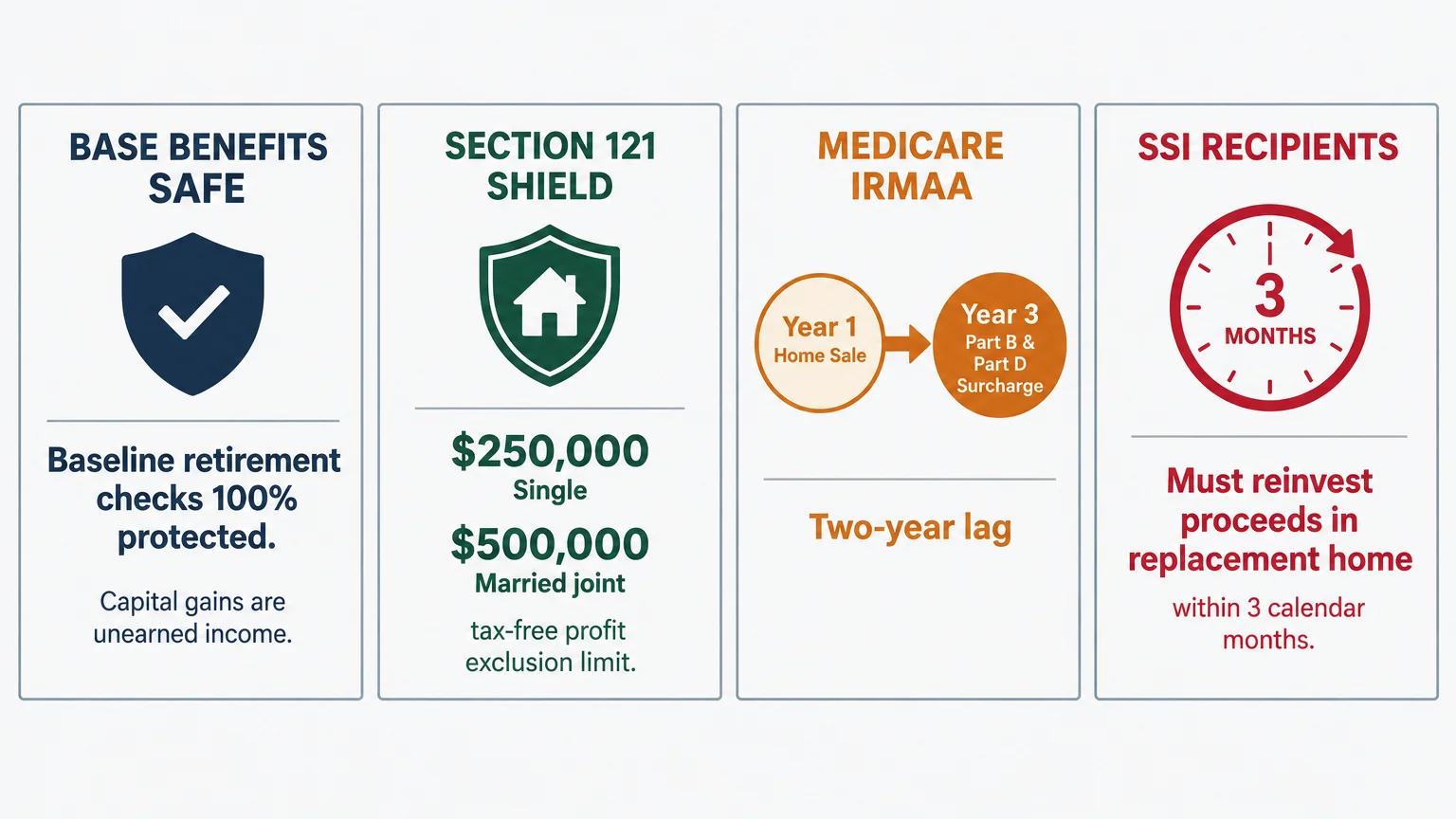
- Base Benefits Are Safe: Selling a primary home never reduces standard Social Security retirement benefit checks, regardless of how much profit you make.
- The Earnings Test Does Not Apply: Capital gains from real estate are unearned income and do not trigger benefit withholding before Full Retirement Age.
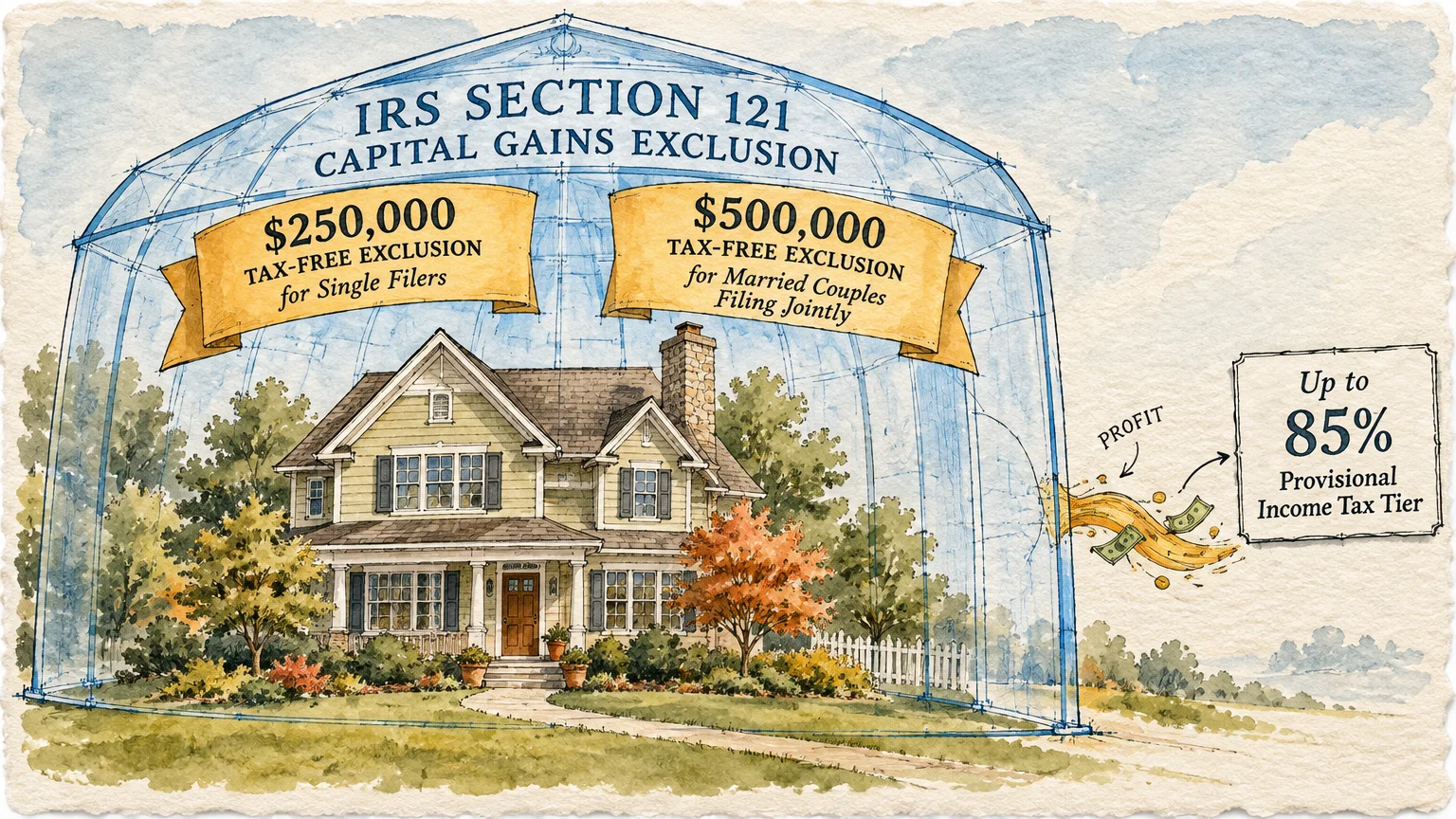
- Section 121 Tax Protection: You can exclude up to $250,000 in capital gains as a single filer or $500,000 as a married couple filing jointly.
- Taxation of Benefits: Any taxable gain above the exclusion limit raises your provisional income, which can make up to 85% of your Social Security benefits subject to federal income tax.
- Medicare IRMAA Surcharges: Substantial profits can increase your Modified Adjusted Gross Income, causing higher Medicare Part B and Part D premiums two years later.
- SSI Requires Immediate Action: Supplemental Security Income recipients must spend proceeds on a replacement home within three calendar months to avoid losing benefits.
The Primary Rule: Your Monthly Retirement Benefit Remains Safe
When you sell a home, the proceeds represent a return of capital and potential investment profit. The Social Security Administration (SSA) categorizes this profit as unearned income.
Social Security calculates your monthly check strictly using your highest thirty-five years of earned income from payroll wages or net self-employment earnings. Investment profits do not factor into this benefit formula.
Even if you realize a profit of several hundred thousand dollars on your closing statement, your baseline retirement benefit stays exactly the same. The agency will not alter your primary insurance amount because of home equity.
This protection applies regardless of whether you claim benefits at age 62, at your Full Retirement Age, or at age 70. Your underlying monthly payout is shielded from real estate transactions.
Selling Before Full Retirement Age: The Earnings Test Explained
Many retirees worry that selling a home before reaching their Full Retirement Age will penalize their monthly income. This fear comes from a common misunderstanding of the Social Security Retirement Earnings Test.
The earnings test only limits active wages earned by working a job or operating a business. For 2026, the annual earnings test limit is $24,480, rising to $25,560 in 2027.
If you earn more than that threshold from employment before your Full Retirement Age year, the SSA temporarily withholds one dollar in benefits for every two dollars earned above the cap.
Capital gains from downsizing never count toward this annual limit. You could pocket $300,000 in net profit from your sale, and the SSA will not withhold a single dollar under the earnings test.
The IRS Section 121 Exclusion: Protecting Your Home Equity
Federal tax law provides one of the most generous tax shields available to homeowners under Section 121 of the Internal Revenue Code. This rule allows you to exclude a major portion of your capital gain from taxable income.
Single filers can exclude up to $250,000 in profit from the sale of their primary residence. Married couples filing jointly can exclude up to $500,000 in profit.
To qualify for this exclusion, you must satisfy the ownership and use tests established by the IRS. You must have owned and occupied the home as your principal residence for at least two of the five years immediately preceding the sale.
The two years do not need to be consecutive; you simply need 730 total days of primary occupancy during that sixty-month window. Vacation homes and pure rental properties do not qualify for this personal exclusion.
“It’s not how much money you make, but how much money you keep, how hard it works for you, and how many generations you keep it for.” — Robert Kiyosaki
How to Calculate Your Adjusted Basis and Minimize Taxable Profit
Your capital gain is not simply your final sale price minus your original purchase price. You determine your taxable gain by subtracting your home’s adjusted cost basis from the net sales proceeds.
Start with the original purchase price of your property, including the settlement fees and title insurance paid when you bought it. Then, add the documented cost of all qualifying capital improvements made over the years.
Capital improvements include substantial renovations that add lasting value, adapt the home to new uses, or prolong its useful life. Adding a new roof, replacing HVAC systems, remodeling kitchens, and installing storm windows all increase your basis.
Routine maintenance tasks, such as interior painting or patching drywall, do not increase your basis. Next, deduct your selling expenses, including real estate commissions, transfer taxes, and legal fees, from the gross selling price.
For example, if you bought a home for $200,000, invested $80,000 in major improvements, and paid $30,000 in selling fees, your adjusted basis is $310,000. If you sell for $600,000, your realized gain is $290,000.
A married couple filing jointly would easily exclude that entire $290,000 profit under Section 121. Because none of the profit becomes taxable, the sale creates zero impact on their tax return.
The Tax Torpedo: How Capital Gains Trigger Taxes on Social Security
If your home sale profit exceeds the Section 121 limits, the remaining gain flows onto your federal tax return as taxable long-term capital gain. This taxable income can quickly trigger the taxation of your Social Security benefits.
The IRS uses a specific formula known as “provisional income” to determine whether your Social Security benefits are taxable. Your provisional income equals your Adjusted Gross Income, plus any tax-exempt interest, plus exactly half of your annual Social Security benefits.
The provisional income thresholds have remained fixed for decades without inflation adjustments. Consequently, even a modest taxable capital gain easily pushes most retirees over the statutory limits.
- Single Filers: Provisional income between $25,000 and $34,000 makes up to 50% of benefits taxable. Provisional income above $34,000 makes up to 85% of benefits taxable.
- Married Filing Jointly: Provisional income between $32,000 and $44,000 makes up to 50% of benefits taxable. Provisional income exceeding $44,000 makes up to 85% of benefits taxable.
Suppose a married couple receives $48,000 in combined annual Social Security benefits and claims a taxable capital gain of $60,000 above their Section 121 exclusion. Half of their benefits ($24,000) plus their capital gain ($60,000) equals an $84,000 provisional income.
Because $84,000 comfortably exceeds the $44,000 joint threshold, the maximum 85% of their Social Security benefits ($40,800) becomes subject to federal income tax. This surprise tax bill catches many unprepared downsizers off guard.
The Two-Year Medicare Cliff: Understanding IRMAA Surcharges
The financial impact of a large home sale does not stop with the IRS. Taxable capital gains can also trigger substantial surcharges on your Medicare Part B and Part D premiums.
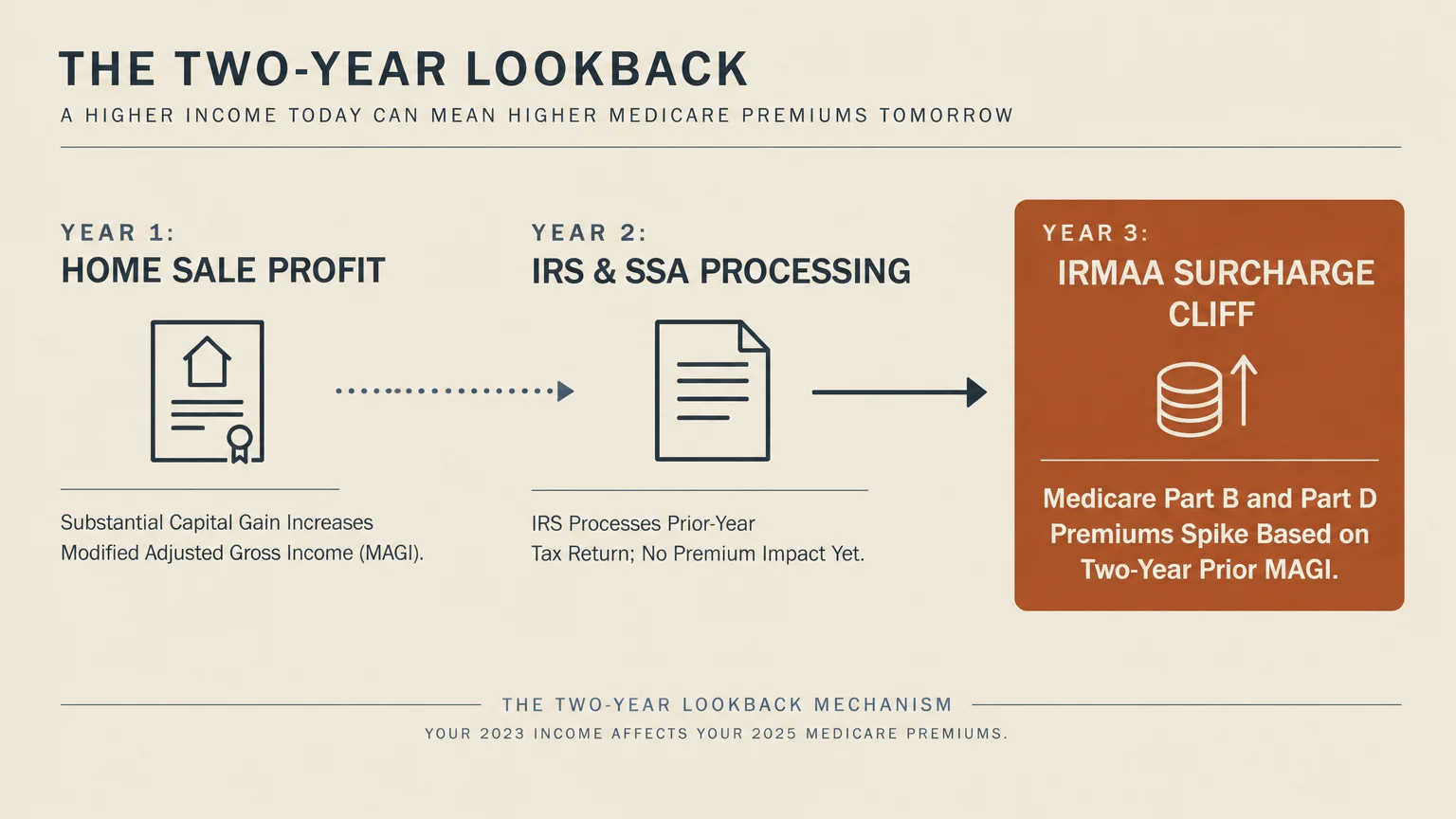
These surcharges are known as the Income-Related Monthly Adjustment Amount, or IRMAA. Social Security enforces IRMAA using a strict two-year lookback rule based on your federal tax return.
Under this system, the income reported on your 2026 tax return determines your Medicare premiums in 2028. Similarly, a property sold in 2024 dictates your Medicare costs throughout 2026.
In 2026, the standard Medicare Part B premium is $202.90 per month, with an annual deductible of $283. Single filers with a Modified Adjusted Gross Income (MAGI) over $109,000 and joint filers over $218,000 must pay IRMAA surcharges.
Depending on your income tier, total 2026 Part B premiums range from $284.10 to $689.90 per person each month. Part D prescription drug plans carry additional monthly surcharges ranging from $14.50 to $91.00.
For 2027, the initial IRMAA brackets rise to $114,000 for single filers and $228,000 for married couples filing jointly. The projected standard Part B premium reaches $209.50 per month.
Because IRMAA surcharges are deducted directly from your monthly Social Security checks, your net monthly deposit can drop significantly during that surcharge year. For a married couple, top-tier IRMAA charges can erase over $14,000 in combined annual retirement cash flow.
The Form SSA-44 Reality: Why You Cannot Appeal Home Sale IRMAA
Many retirees believe they can eliminate an IRMAA surcharge by filing an appeal with the government. The SSA provides Form SSA-44 for beneficiaries requesting an IRMAA reduction.
However, the agency only grants appeals for specific, federally recognized “Life-Changing Events.” These events include marriage, divorce, the death of a spouse, work stoppage, work reduction, or the loss of income-producing property due to a disaster.
A one-time spike in income caused by selling a primary home is not an eligible life-changing event. The SSA will summarily reject an appeal based on capital gains from downsizing.
The surcharge will remain in effect for the entire twelve months of that specific premium year. Fortunately, the surcharge automatically disappears the following year once your tax return reflects normal retirement income.
Supplemental Security Income (SSI): Strict Asset Limits and the 3-Month Clock
While standard Social Security retirement benefits ignore personal assets, Supplemental Security Income (SSI) operates under completely different rules. SSI is a needs-based program designed for low-income seniors and disabled individuals.
SSI enforces strict countable resource limits that remain frozen at $2,000 for an individual and $3,000 for an eligible couple. In 2026, maximum federal SSI payments are $994 for individuals and $1,491 for couples, rising in 2027 to $1,029 and $1,544.
A primary residence is an excluded resource while you live in it, regardless of its market value. But the moment you complete a sale, the net cash proceeds become a countable liquid asset.
The SSA offers a temporary grace period known as the three-month replacement rule. Under this regulation, proceeds from selling your home remain excluded from the resource limit for up to three full calendar months.
To maintain this exclusion, you must intend to purchase another primary residence and execute the purchase within that strict three-month timeframe. If any cash proceeds remain in your possession after the third month, they count against the asset cap.
Holding unspent home equity past three months immediately suspends your monthly SSI payments. In most states, losing SSI eligibility also terminates your Medicaid coverage, exposing you to severe healthcare expenses.
Comparing Standard Retirement Benefits and SSI During a Home Sale
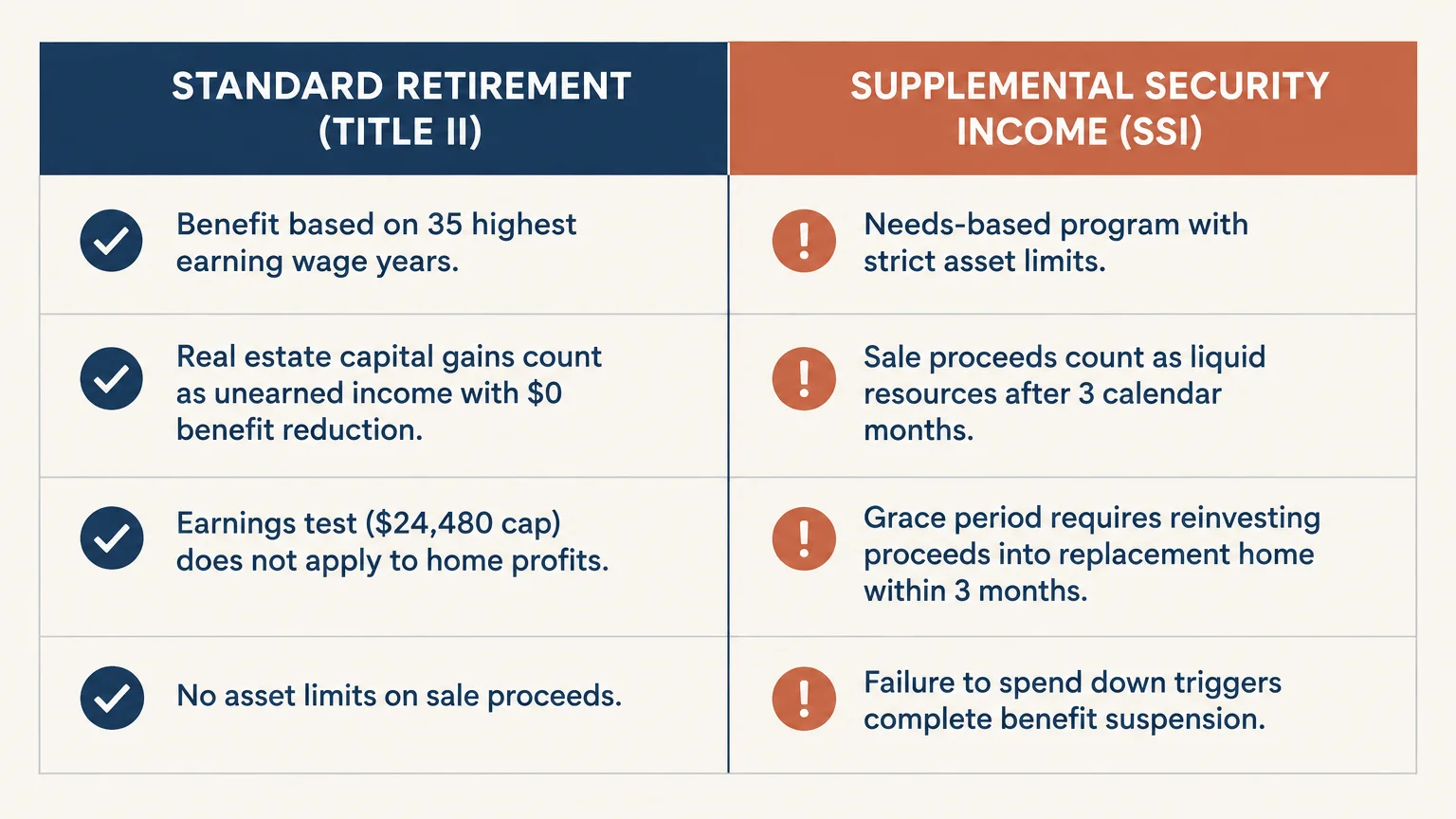
Understanding which program pays your monthly benefit is vital before signing a real estate contract. The regulatory differences between standard Social Security and SSI are stark.
| Factor | Social Security Retirement | Supplemental Security Income (SSI) |
|---|---|---|
| Monthly Benefit Impact | No direct reduction; base benefit remains 100% intact. | Benefits suspended if unspent proceeds exceed resource limits. |
| Resource & Asset Limits | None. You can hold unlimited cash from your sale. | Strict limits: $2,000 for individuals, $3,000 for married couples. |
| Reinvestment Deadline | No deadline. You may invest or save the cash indefinitely. | Must reinvest proceeds into a replacement home within 3 calendar months. |
| Medicare & Medicaid Impact | Taxable gains can trigger IRMAA surcharges on Medicare. | Excess cash can cause immediate termination of Medicaid eligibility. |
| Tax Exposure | Gains can make up to 85% of benefits subject to income tax. | SSI benefits are never subject to federal income taxation. |
Capital Gains Brackets and the Net Investment Income Tax
When your downsizing profit exceeds the Section 121 exclusion, you must pay federal long-term capital gains tax on the remainder. These profits are taxed using preferential rates rather than ordinary income brackets.
For the 2026 tax year, the long-term capital gains brackets operate as follows:
- 0% Rate: Taxable income up to $49,450 for single filers; up to $98,900 for married couples filing jointly.
- 15% Rate: Taxable income from $49,451 to $545,500 for single filers; $98,901 to $613,700 for joint filers.
- 20% Rate: Taxable income exceeding $545,500 for single filers; exceeding $613,700 for joint filers.
For sales closing in 2027, the IRS has indexed these capital gains brackets upward to adjust for inflation:
- 0% Rate: Taxable income up to $51,050 for single filers; up to $102,100 for married couples filing jointly.
- 15% Rate: Taxable income from $51,051 to $563,200 for single filers; $102,101 to $633,600 for joint filers.
- 20% Rate: Taxable income exceeding $563,200 for single filers; exceeding $633,600 for joint filers.
High-profit sales may also encounter the Net Investment Income Tax (NIIT). This 3.8% surtax applies to whichever is less: your net investment income or the amount your MAGI exceeds statutory limits.
These statutory thresholds are $200,000 for single individuals and $250,000 for married couples filing jointly. Congress did not index the NIIT thresholds for inflation, so home sellers frequently cross these barriers.
For more detailed rules on reporting investment gains and retirement income, consult the official guidance provided by the Internal Revenue Service.
“The goal of retirement is to live off your assets—not live off your regrets.”
Common Retirement Traps
Downsizing should simplify your living situation and bolster your savings, but paperwork errors can prove costly. Navigating the move requires sidestepping several common traps.
The first trap is failing to document your home’s capital improvements over decades of ownership. Without receipts, permits, or contracts, the IRS will disallow basis increases, unnecessarily inflating your taxable gain.
The second trap involves forgetting the two-year lag of Medicare IRMAA surcharges. Retirees spend their home sale profits immediately, only to face higher monthly healthcare premiums two years later.
The third trap is moving out of your home too early before completing the sale. If you rent out your property or leave it vacant for over three years, you lose the Section 121 residency test.
The fourth trap occurs when surviving spouses delay selling their family home. A surviving spouse can use the full $500,000 exclusion only if the sale occurs within two years of the partner’s death.
Missing that two-year window drops the exclusion back down to the single limit of $250,000. That reduction can expose an extra $250,000 of home equity to immediate federal capital gains taxes.

When to Consult a Professional
Downsizing involves the intersection of real estate law, state property taxes, federal income taxes, and entitlement programs. In several scenarios, expert guidance pays for itself many times over.
Work with a Certified Public Accountant (CPA) if your home profit approaches or exceeds the Section 121 exclusion limits. A CPA helps reconstruct your historical cost basis and calculates estimated tax payments to prevent underpayment penalties.
Consult an elder law attorney immediately if you or your spouse receive Supplemental Security Income or Medicaid benefits. An attorney structures home sales to protect program eligibility and handles compliant reinvestment timelines.
Engage a fee-only financial planner to evaluate how holding substantial cash proceeds alters your retirement portfolio. A planner models the tax effects on your Social Security benefits and maps out required minimum distributions.
Frequently Asked Questions
Does selling my home affect my Social Security retirement benefit amount?
No, selling your primary residence will never reduce your monthly Social Security retirement benefit checks. Real estate profits are unearned capital gains, which the SSA excludes from benefit formulas and the earnings test.
Can I appeal a Medicare IRMAA surcharge caused by selling my home?
No, the SSA does not permit IRMAA appeals for capital gains from home sales. A real estate sale is not considered a qualifying life-changing event under Form SSA-44 guidelines.
How long can an SSI recipient hold home sale proceeds before losing benefits?
An SSI recipient has exactly three calendar months to reinvest home sale proceeds into a replacement residence. Any cash held after the third month counts toward the strict asset limit and suspends benefits.
Will a profitable home sale permanently increase the taxes on my Social Security?
No, the tax impact lasts only for the specific tax year in which you realize the capital gain. In subsequent years, your benefit taxation returns to normal based on your ongoing retirement income.
Next Steps for a Smooth Transition
Before listing your property, gather all records of capital improvements, original closing papers, and property tax statements to calculate your estimated basis. Knowing your projected gain in advance eliminates surprises and allows you to plan for any tax exposure.
Set aside an emergency tax reserve from your closing proceeds if your gains exceed federal exclusions or trigger future Medicare surcharges. Careful preparation today ensures that your downsizing move delivers financial freedom rather than unexpected administrative stress.
Information in this article reflects current rules as of the publication date and may change. Always confirm benefit details directly with Social Security Administration, Medicare.gov, or relevant government agencies before making decisions.
Last updated: November 2026. Medicare and Social Security rules change annually—always verify current details at official government sources.