Finalizing a divorce just a few weeks before your tenth anniversary can quietly wipe out a substantial retirement income stream. An arbitrary calendar date determines whether you qualify for valuable spousal benefits or walk away empty-handed.
The Social Security Administration enforces a strict ten-year marriage threshold with zero exceptions for near misses. Missing this cutoff by a single day means forfeiting up to $24,912 every single year in divorced spouse benefits.
Understanding how the federal government evaluates your timeline allows you to protect your financial security before signing final dissolution paperwork.
What You Need to Know
Before examining the legal mechanics, review the baseline requirements that govern divorced spousal payments.
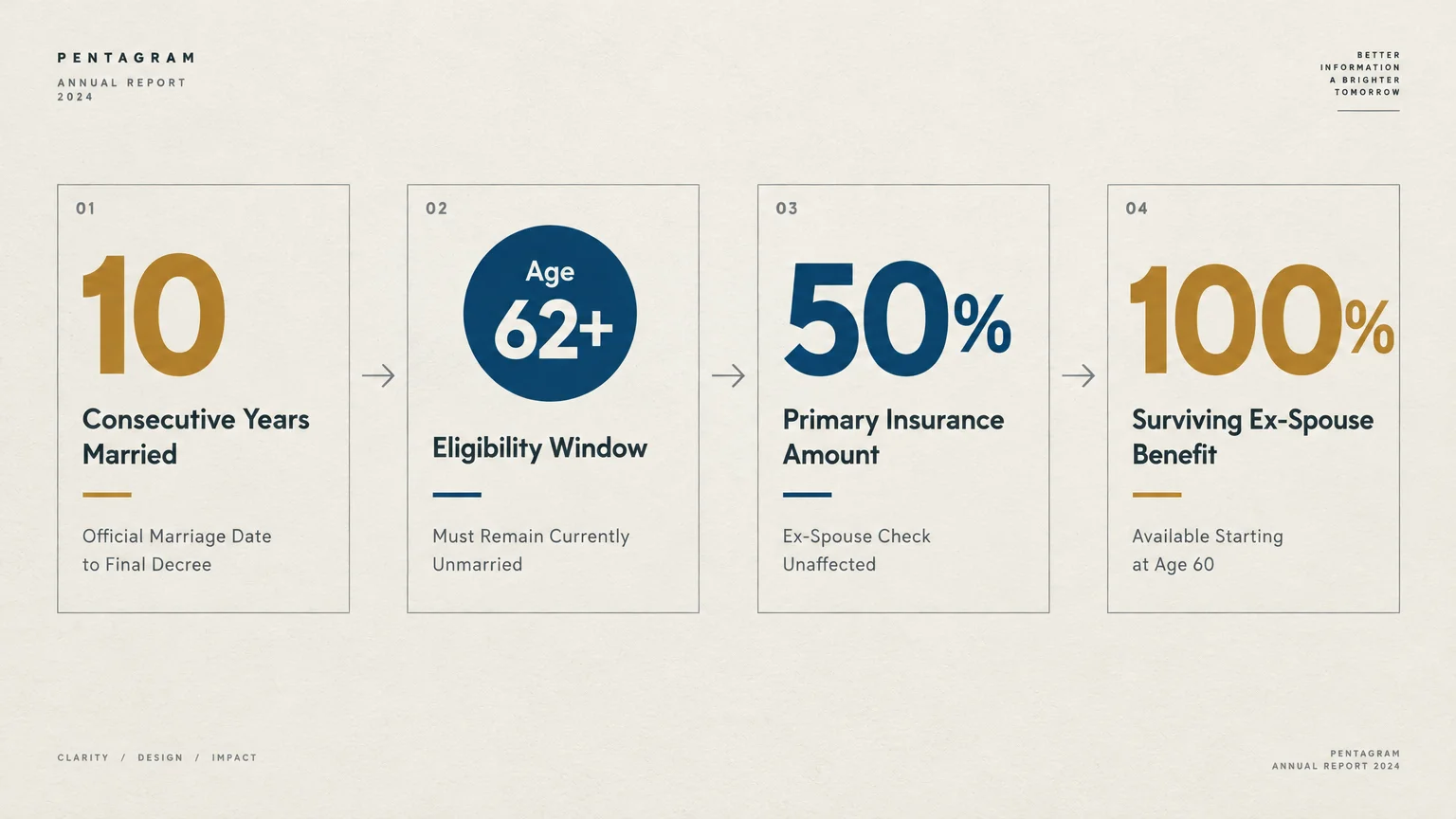
- Your marriage must have lasted at least 10 consecutive years before the date your divorce became final.
- You must be at least age 62 and currently unmarried to collect on a living ex-spouse’s record.
- Eligible spouses receive up to 50% of the ex-partner’s Full Retirement Age benefit without affecting the ex-partner’s check.
- Surviving ex-spouses can receive up to 100% of the deceased worker’s benefit starting at age 60.
- Recent federal legislation eliminated the Government Pension Offset, restoring full spousal benefits for public servants.
The Social Security 10-Year Marriage Rule Explained
Under federal regulations, the Social Security Administration (SSA) requires a marriage to reach a minimum duration of 10 consecutive years. If your marriage lasted nine years and 11 months, you do not qualify for benefits.
The agency shows no administrative flexibility on this timeline. Even if you were separated for years while remaining legally wed, only the official dates matter.
Your clock starts on the calendar date shown on your official marriage certificate. It ends precisely on the date your divorce judgment or dissolution decree is signed by the judge and entered into the court record.
Filing dates, temporary separation orders, and informal move-out days carry no weight with the SSA. As long as you remain legally married under state law, the clock continues to run.
One narrow exception exists if you divorced and later remarried the exact same spouse. In that specific scenario, the agency can combine the two marriage durations to meet the 10-year rule.
However, that exception requires your remarriage to occur no later than the calendar year immediately following the year your divorce became final. If you remarry anyone else, or wait beyond that calendar window, the prior years are lost.
“The goal of retirement is to live off your assets—not live off your regrets.”
The Financial Toll: Calculating What You Lose
Losing divorced spouse benefits can dramatically reduce your cash flow during retirement. The maximum spousal payout equals 50% of your former partner’s Primary Insurance Amount (PIA) at their Full Retirement Age.
Following a 2.8% cost-of-living adjustment, the average retired worker collects approximately $2,071 to $2,089 per month. A 50% spousal check on that average record provides roughly $1,035 to $1,044 per month.
That average benefit delivers nearly $12,500 in dependable annual income. Over a standard 20-year retirement, walking away from that baseline payment costs you $250,000 in lost purchasing power.
The stakes climb substantially if your former spouse was a high earner. For a worker retiring at Full Retirement Age, the maximum monthly benefit stands at $4,152.
A qualifying ex-spouse entitled to 50% of that maximum record can receive $2,076 each month. That totals $24,912 every single year in auxiliary retirement support.
With an upcoming 3.6% COLA increasing the maximum Full Retirement Age benefit to $4,188, the top spousal check will reach $2,094 per month. Missing the 10-year mark forfeits every penny of those inflation-adjusted funds.
You can verify potential benefit amounts using the official Social Security Retirement Estimator to calculate your projected earnings baseline.

How Divorced Spouse Benefits Work While Your Ex Is Alive
Many individuals hesitate to claim divorced spouse benefits because they fear friction with their former partner. Fortunately, the system operates completely independently of your ex-spouse’s personal choices.
Claiming a divorced benefit has zero impact on your ex-spouse’s monthly payments. Their current benefit amount remains completely untouched regardless of what you draw.
Your claim also has no effect on what their current spouse or dependent children might receive. The Social Security Administration does not notify your ex-spouse when you file a claim against their record.
To file on a living ex-spouse’s record, you must be at least age 62 and currently unmarried. If you remarried someone else, you cannot claim benefits on your former spouse while that subsequent marriage remains intact.
Should your subsequent marriage end through divorce, death, or annulment, your eligibility on your first partner’s record instantly revives. You can then collect whichever spousal benefit produces the highest monthly check.
The “Independently Entitled” Two-Year Rule
When married couples seek spousal benefits, the primary earner must generally file for retirement before the dependent spouse can collect. For divorced couples, federal law eliminates this hurdle through independent entitlement rules.
If your divorce has been legally final for at least two continuous years, you can claim divorced spousal payments even if your ex has not applied yet. Your ex must simply be at least age 62 and fully insured under Social Security.
This protection ensures an uncooperative former spouse cannot block your retirement income by delaying their own claim until age 70. Once that two-year post-divorce milestone passes, you control your claiming timeline.
If your ex is already actively receiving their retirement payments, you do not need to wait two years. In that case, you can apply immediately upon reaching age 62.
Early Filing Penalties and Full Retirement Age Reductions
While you can file for divorced spouse benefits at age 62, claiming early triggers a permanent reduction in your monthly check. To receive the full 50% spousal maximum, you must wait until your own Full Retirement Age.
For anyone born in 1960 or later, Full Retirement Age is 67. Claiming at age 62 reduces your divorced spousal payout down to 32.5% of your ex-partner’s Primary Insurance Amount.
That reduction represents a permanent 35% cut to your auxiliary check. Furthermore, divorced spouse benefits do not earn delayed retirement credits.
While your personal retirement benefit grows by 8% per year for every year you delay past Full Retirement Age up to age 70, spousal benefits stop growing at age 67. Waiting past your Full Retirement Age to claim an ex-spouse benefit provides zero financial advantage.
Federal law also enforces “deemed filing” regulations for all retirement beneficiaries. When you submit an application, the agency automatically treats you as filing for both your personal retirement benefit and your divorced spousal benefit.
You cannot elect to receive an ex-spouse payment while allowing your own retirement benefit to build delayed credits until age 70. The agency calculates both amounts and simply pays you the higher total.
If you claim benefits before Full Retirement Age while continuing to work, the Retirement Earnings Test applies. The agency withholds $1 in benefits for every $2 earned above the annual earnings limit of $24,480.
That earnings limit rises to $25,560 under updated guidelines. In the specific calendar year you reach Full Retirement Age, the threshold jumps to $65,160, increasing to $67,920, with $1 withheld for every $3 earned above the limit.
“It’s not how much money you make, but how much money you keep, how hard it works for you, and how many generations you keep it for.” — Robert Kiyosaki
Surviving Divorced Spouse Benefits: An Even Larger Risk
The financial loss of missing the 10-year rule becomes even more severe if your former spouse predeceases you. Surviving divorced spouse benefits are far more generous than living spousal benefits.
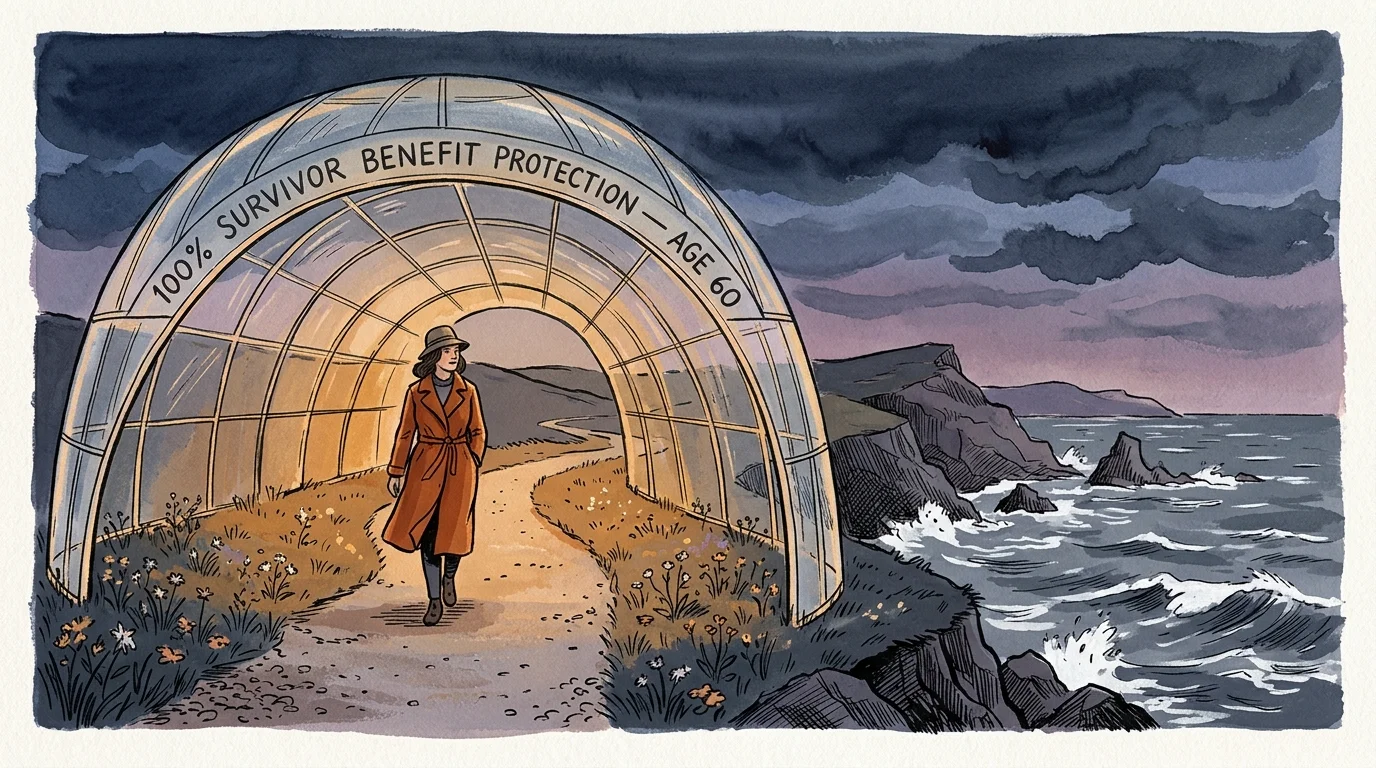
As a surviving divorced spouse, you can receive up to 100% of your late ex-partner’s actual benefit amount, including any delayed credits they accrued. A 50% living spousal benefit converts into a full 100% survivor payout upon their death.
Surviving divorced spouses can claim benefits as early as age 60, or age 50 if disabled, rather than waiting until age 62. Filing before your survivor Full Retirement Age reduces the payment, but the lifetime security remains substantial.
Deemed filing does not apply to survivor benefits. You can choose to collect a reduced survivor benefit at age 60, let your own retirement benefit grow, and switch to your maximum personal benefit at age 70.
Remarriage rules are also much more forgiving for surviving ex-spouses. If you remarry at age 60 or older, or age 50 if disabled, your remarriage will not disqualify you from collecting surviving divorced spouse benefits.
Missing the 10-year marriage mark by a few days permanently forfeits this entire category of survivor protection. That single error can easily strip hundreds of thousands of dollars from your later years.
The Social Security Fairness Act: GPO and WEP Repealed
Public-sector employees previously faced severe restrictions when attempting to claim spousal benefits after divorce. The Government Pension Offset (GPO) historically wiped out spousal benefits for retired teachers, police officers, and municipal workers.
The GPO previously reduced spousal payments by two-thirds of the amount of any public pension earned without paying Social Security taxes. For most public servants, this offset completely erased their divorced spouse checks.
On January 5, 2025, the Social Security Fairness Act became law, retroactively repealing both the Government Pension Offset and the Windfall Elimination Provision. This historic reform completely transforms retirement planning for public workers.
Public employees who met the 10-year marriage rule can now claim full divorced spousal and survivor benefits without any pension penalty. If you worked in public education or civil service, qualifying under the 10-year rule has never been more valuable.

Comparing Benefit Outcomes: Reaching 10 Years vs. Falling Short
Review the direct financial and legal consequences of finalizing a divorce before reaching the 10-year mark compared to reaching full qualification.
| Benefit Category | Divorced at 9 Years, 11 Months | Divorced at 10 Full Years |
|---|---|---|
| Living Ex-Spouse Benefit | $0 per month | Up to 50% of ex-spouse PIA ($2,076 – $2,094/mo max) |
| Surviving Ex-Spouse Benefit | $0 per month | Up to 100% of deceased ex-spouse check ($4,152+/mo) |
| Earliest Claiming Age | Must rely on own record at age 62 | Age 62 for living ex; age 60 for survivor |
| Impact of Remarriage at Age 60+ | Ineligible for any ex-spouse benefits | Retains full eligibility for survivor benefits |
| Public Pension Offset (GPO) | Not applicable ($0 benefit) | Full benefits payable due to 2025 GPO repeal |
Don’t Make These Mistakes
Retirees often sacrifice substantial benefits simply because they misunderstand legal timelines or federal administrative rules. Avoid these costly missteps during and after marital dissolution.
- Rushing the final decree: Pushing a divorce through court a few weeks early to achieve emotional closure can permanently forfeit your retirement safety net.
- Confusing separation with divorce: Assuming that moving into separate residences or signing separation agreements terminates your marriage clock.
- Remarrying before age 60: Entering a new marriage before age 60 permanently eliminates your right to claim surviving divorced spouse benefits if your first partner dies.
- Believing your ex must consent: Delaying a claim because you assume your ex-spouse must sign off or provide permission for you to collect.
- Failing to locate marriage records: Neglecting to secure certified copies of your marriage certificate and final divorce decree before documents are archived or misplaced.
What to Do If Your Divorce Is Still Pending
If you are currently negotiating a divorce and your marriage is approaching the 10-year threshold, pause immediately. Calculate the exact calendar dates involved before proceeding with any court filings.
Instruct your family law attorney to slow down the proceedings so that the final judgment entry date falls after your tenth anniversary. Courts routinely accommodate agreed scheduling delays for financial and tax considerations.
If your spouse demands a swift resolution, negotiate directly. You can offer concessions on property division, personal property, or legal fees in exchange for postponing the final entry date.
Point out to your spouse that qualifying for Social Security costs them absolutely nothing. Spousal benefits are paid entirely from the federal trust fund, not from your partner’s bank account.
Review consumer protections and financial planning guidance from the Consumer Financial Protection Bureau to understand how marital transitions alter long-term solvency.
If your divorce was already finalized just short of 10 years, focus on optimizing your own earnings history. Working additional years can replace lower-earning quarters and maximize your independent Social Security benefit.

When Professional Advice Is Worth It
Navigating the intersection of state family law and federal retirement regulations requires careful precision. In many cases, engaging experienced professionals provides massive financial returns.
Work with a Certified Divorce Financial Analyst (CDFA) while structuring your property settlement. A CDFA can quantify the present value of potential spousal benefits and help craft an equitable separation agreement.
Consult an elder law attorney or Social Security claiming specialist if your marriage ended near the 10-year boundary. They can inspect your court records to confirm the exact legal decree date recognized by federal agencies.
If you have multiple past marriages that each lasted over 10 years, professional guidance is crucial. A specialist can help you time your claims to extract the maximum payments from eligible records over your lifetime.
Frequently Asked Questions About Social Security After Divorce
Can my ex-spouse find out that I am collecting on their record?
No, the Social Security Administration maintains strict privacy protocols. The agency will never notify your ex-spouse that you have applied for or are receiving benefits based on their work history.
What documents do I need to claim divorced spouse benefits?
You must present your birth certificate, your marriage certificate showing the wedding date, and your final divorce decree. You will also need your former spouse’s Social Security number or their full legal name, date of birth, and parents’ names.
Does my ex-spouse have to be retired for me to claim benefits?
Not if your divorce has been legally final for at least two consecutive years. As long as you are 62 and your ex is at least 62 and eligible, you can claim benefits even if they continue working.
What happens if my ex-spouse remarries?
Your ex-spouse’s remarriage has no effect on your eligibility. You can still claim up to 50% of their benefit, even if their new spouse is also collecting spousal payments on the same record.
Next Steps for Your Retirement
Pull out your original marriage certificate and review your dissolution documents to verify your precise legal dates. If your divorce is currently pending, speak with your attorney immediately to ensure your final decree crosses the 10-year finish line.
Taking control of your retirement timeline today ensures you capture every dollar of auxiliary income you earned through years of marriage.
Retirement rules and benefit amounts vary based on individual work history, income, and circumstances. This article provides general guidance only. Consult a SHIP counselor, financial advisor, or elder law attorney for advice specific to your situation.
Last updated: November 2026. Medicare and Social Security rules change annually—always verify current details at official government sources.