The IRS announced substantial increases to retirement savings limits for 2027, giving you an unprecedented opportunity to shield more income from taxes. If you are approaching retirement, these higher contribution caps can accelerate your final savings sprint.
Workers aged 50 and older can now stash away tens of thousands of dollars each year across tax-advantaged accounts. Maximizing these larger balances requires navigating new rules and strategic timing before your working years close.
Understanding how to position your elective deferrals, employer contributions, and catch-up dollars will determine how much wealth you retain. Here is what the new numbers mean for your retirement timeline.

Breaking Down the 2027 401(k) Contribution Limits
The Internal Revenue Service published its annual cost-of-living adjustments on November 12, 2026, through Notice 2026-66 and news release IR-2026-136. These official updates establish the new benchmarks for workplace savings plans across the country.
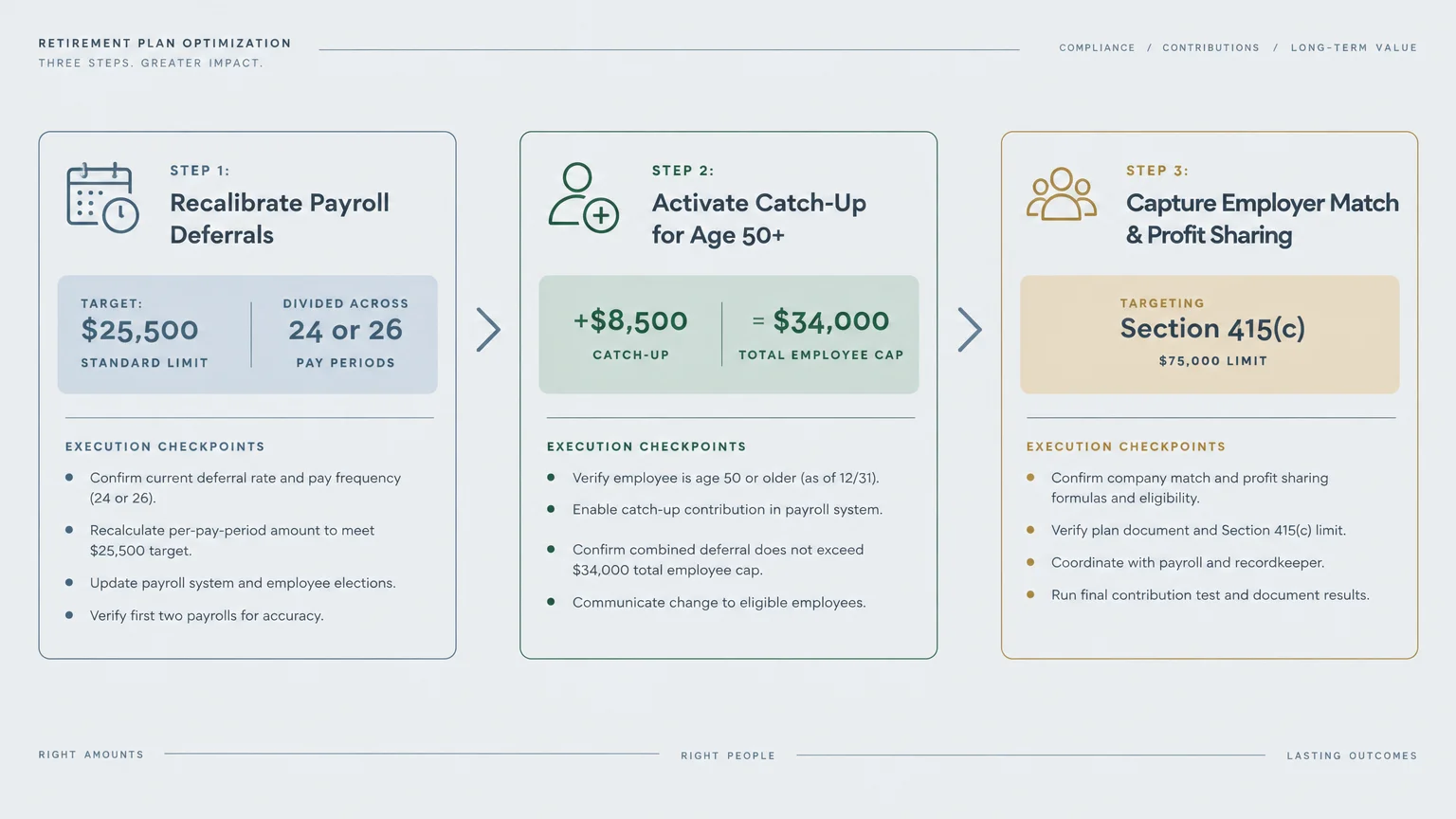
For 2027, the standard employee elective deferral limit jumps to $25,500. This represents a solid $1,000 increase from the 2026 ceiling of $24,500.
This standard limit applies across the board to traditional and Roth 401(k) plans. It also governs 403(b) programs, most 457 plans, and the federal Thrift Savings Plan.
If you participate in multiple workplace accounts across different jobs during the year, this aggregate cap binds your total personal contributions. You cannot exceed $25,500 in total elective deferrals across separate employer plans.
Beyond your own elective deferrals, the IRS also expanded the combined limit for all plan additions under Internal Revenue Code Section 415(c). This overall cap rises to $75,000 in 2027, up from $72,000 in 2026.
The Section 415(c) limit encompasses your personal contributions, employer matching funds, profit-sharing allocations, and voluntary after-tax dollars. Business owners and self-employed individuals with solo 401(k) plans gain substantial room under this expanded cap.
Additionally, the annual compensation cap under Section 401(a)(17) climbs to $375,000 for 2027. Employers cannot count earnings above this $375,000 threshold when calculating matching formulas or non-elective contributions.
You can review detailed regulatory guidelines on qualifying plan structures directly through the IRS Retirement Plans portal to verify your plan compliance.
Catch-Up Contributions: Expanding Wealth for Older Workers
If you celebrate your 50th birthday on or before December 31, 2027, federal law grants you valuable catch-up privileges. These extra allowances help older savers close historical savings gaps before exiting the workforce.
The standard catch-up contribution limit for savers aged 50 and older climbs to $8,500 in 2027. This reflects a $500 bump over the $8,000 limit in place for 2026.
When you combine your base deferral of $25,500 with the standard catch-up of $8,500, your total employee savings ceiling reaches $34,000. That marks a notable jump from the previous $32,500 total.
This $34,000 total represents only your payroll deductions. Employer matching contributions and company profit-sharing allocations sit on top of this figure.
With standard catch-up contributions factored in, the absolute statutory cap under Section 415(c) increases to $83,500 for eligible participants aged 50 and older. Highly compensated employees and business owners can accumulate remarkable balances within a single tax year.
Catch-up deferrals provide a reliable mechanism to lower your current adjusted gross income while compounding investment returns in a tax-sheltered shelter.
“The best time to plan for retirement was 20 years ago. The second best time is today.”
The Super Catch-Up for Ages 60 to 63
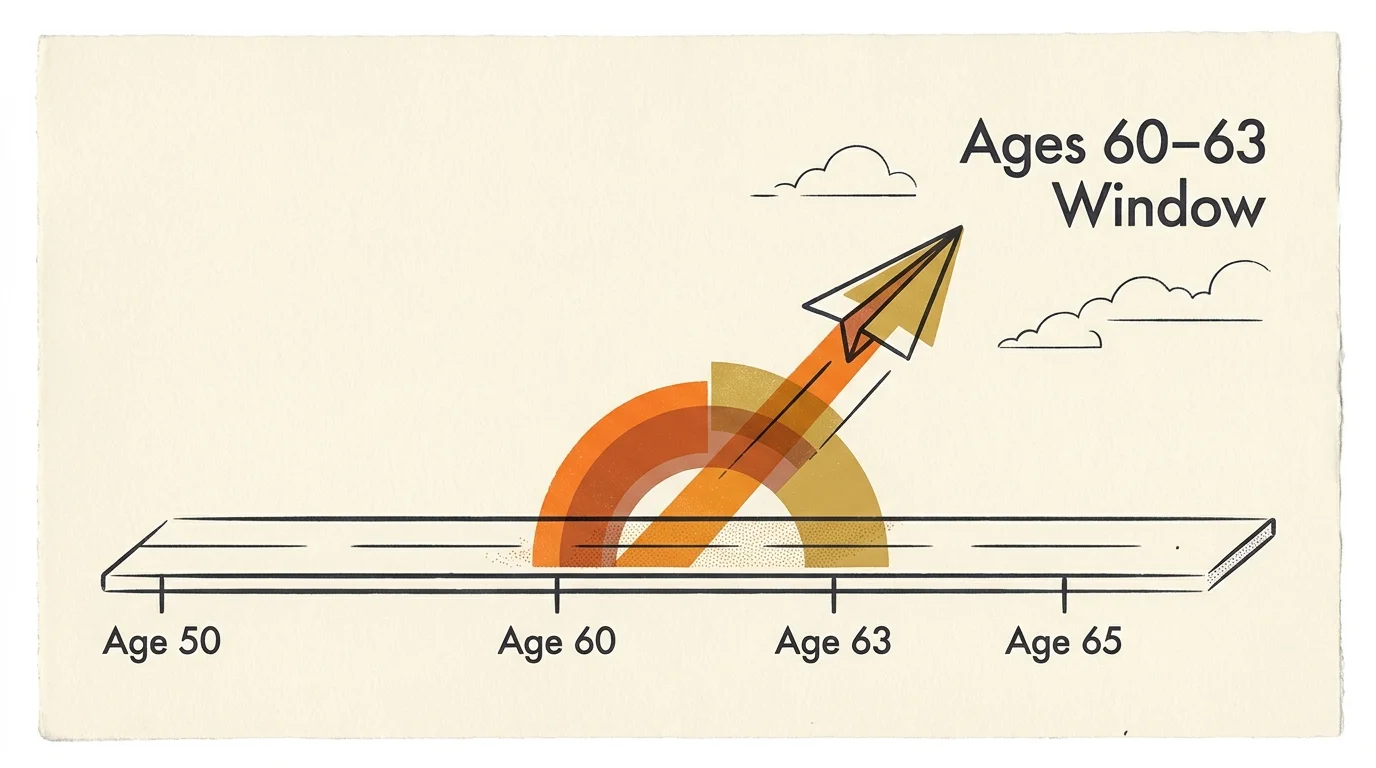
The SECURE 2.0 Act introduced an enhanced savings provision that creates a temporary contribution window. Financial planners routinely refer to this mechanism as the super catch up 60 to 63.
For the 2027 plan year, the super catch-up limit increases to $11,750, up from $11,250 in 2026. This special allowance directly replaces the standard $8,500 catch-up for qualifying employees.
To qualify for this enhanced deferral, you must reach age 60, 61, 62, or 63 during the 2027 calendar year. If your employer’s plan allows it, you can direct significant capital into your account.
When you pair the standard $25,500 deferral limit with the $11,750 super catch-up, your personal contribution cap surges to $37,250. That represents a $1,500 jump compared to the 2026 maximum.
When your employer adds matching funds or profit sharing, your combined total additions can hit an extraordinary $86,750. This creates an unmatched wealth-building engine right before full retirement age.
Timing matters tremendously with this specific provision. You only hold access to the super catch-up during the calendar years you turn 60 through 63.
The moment you reach age 64, your allowed catch-up drops right back to the standard catch-up limit of $8,500. You must proactively plan your cash flow to exploit this four-year window fully.
2026 vs. 2027 401(k) Limits Comparison
Visualizing these adjustments side by side clarifies how much extra capital you can shelter from current taxes. The table below outlines the primary limit changes taking effect for the 2027 tax year.
| Contribution Category | 2026 Limit | 2027 Limit | Year-Over-Year Change |
|---|---|---|---|
| Standard Employee Deferral (Under Age 50) | $24,500 | $25,500 | +$1,000 |
| Standard Catch-Up (Ages 50–59 & 64+) | $8,000 | $8,500 | +$500 |
| Total Maximum Employee Deferral (Ages 50–59 & 64+) | $32,500 | $34,000 | +$1,500 |
| Super Catch-Up (Ages 60–63 Only) | $11,250 | $11,750 | +$500 |
| Total Maximum Employee Deferral (Ages 60–63) | $35,750 | $37,250 | +$1,500 |
| Total Defined Contribution Limit (IRC Sec. 415(c)) | $72,000 | $75,000 | +$3,000 |
| Combined Maximum with Super Catch-Up (Sec. 415(c)) | $83,250 | $86,750 | +$3,500 |
| Annual Compensation Limit (IRC Sec. 401(a)(17)) | $360,000 | $375,000 | +$15,000 |
Every dollar added under these expanded caps compound free from annual dividend and capital gains taxes. Maximizing these limits creates a defensive perimeter around your accumulated earnings.

The Mandatory Roth Catch-Up Rule for Higher Earners
A critical SECURE 2.0 mandate alters how certain high earners fund their catch-up contributions. You must evaluate your prior-year earnings to determine whether you can use traditional pre-tax dollars for your catch-up.
For the 2027 plan year, the statutory wage threshold increases to $155,000. This threshold is tied to your 2026 Social Security wages, reported in Box 3 of your Form W-2.
If your 2026 Box 3 wages from your current sponsoring employer exceeded $155,000, you face strict mandatory restrictions. You cannot make any pre-tax catch-up contributions during 2027.
Instead, the law dictates that all your catch-up contributions must flow into an after-tax Roth 401(k) account. This applies to both the standard $8,500 catch-up and the $11,750 super catch-up.
Your base deferral of $25,500 can remain completely pre-tax if you choose. Only the catch-up portion gets redirected into the Roth bucket by federal statute.
This mandate introduces a potential risk if your employer sponsors a traditional 401(k) without a designated Roth option. If your plan lacks a Roth feature, higher-earning workers cannot make any catch-up contributions whatsoever.
Check with your benefits department immediately to verify that your company offers a designated Roth 401(k) option. Confirming this setup prevents unwelcome surprises when you submit your payroll elections.
“It’s not how much money you make, but how much money you keep, how hard it works for you, and how many generations you keep it for.” — Robert Kiyosaki
Coordinating 401(k) Caps with IRAs, HSAs, and the Saver’s Match
Your workplace 401(k) serves as the anchor of your retirement strategy, but coordinating it with other tax shelters enhances your financial security. Several other retirement vehicle rules shift for 2027.
Individual Retirement Account contribution limits remain steady at $7,500 for 2027. The age 50 and older catch-up contribution also holds at $1,100, providing an aggregate $8,600 cap.
However, the income phase-out ranges for deductible traditional IRAs and Roth IRAs expanded upward. The Roth IRA phase-out range now spans $158,000 to $173,000 for single filers, and $250,000 to $260,000 for married couples filing jointly.
If you carry a high-deductible health plan, pairing your 401(k) with a Health Savings Account provides triple-tax advantages. HSA limits rise in 2027 to $4,500 for self-only coverage and $9,000 for family coverage.
Savers aged 55 and older who are not yet enrolled in Medicare can contribute an additional $1,000 HSA catch-up. Using an HSA alongside your 401(k) shields you against unpredictable future medical expenses.
Starting with the 2027 tax year, the landmark federal Saver’s Match takes effect, completely replacing the former non-refundable Saver’s Credit. Eligible lower- and moderate-income workers receive a direct federal deposit of up to 50% of their contributions.
The government deposits this match, up to a maximum of $1,000 per person, directly into your qualifying retirement account. You can explore broader national savings initiatives through USA.gov Retirement Resources to identify additional assistance.
Actionable Strategies to Maximize the 2027 Caps
Capitalizing on higher contribution caps requires deliberate planning rather than passive payroll deductions. Implementing proactive strategies ensures you extract every dollar of benefit without destabilizing your household budget.
1. Recalibrate Your Payroll Withholdings Early
Do not wait until spring to adjust your payroll contributions. Review your company’s benefits portal in December 2026 to establish your new contribution schedule for the very first paycheck of 2027.
If you are paid biweekly (26 pay periods) and want to maximize the $25,500 standard limit, direct roughly $981 per paycheck into your plan. Spreading payments evenly guarantees smooth cash flow.
If you qualify for the $8,500 standard catch-up, your combined goal is $34,000. That requires a biweekly payroll deferral of approximately $1,308 across 26 pay cycles.
If you qualify for the $11,750 super catch-up, reaching the $37,250 employee cap demands roughly $1,433 per biweekly paycheck. Setting this figure early automates your discipline.
2. Safeguard Your Full Employer Match
Aggressive savers often make the mistake of front-loading their contributions and maxing out their accounts by mid-year. While this puts money to work early, it can accidentally sacrifice employer matching funds.
Many corporate plans match employee deferrals on a per-paycheck basis rather than looking at your annual aggregate total. If you max out your cap in August, you contribute 0% from September through December.
Without ongoing contributions, you might forfeit the employer match for those remaining months. Check whether your employer’s plan document contains a “true-up” matching provision.
A true-up provision instructs the plan administrator to recalculate your match at year-end, restoring any forfeited dollars. If your plan lacks a true-up, pace your contributions across every single pay period.
3. Explore the Mega-Backdoor Roth Strategy
If you possess surplus income and max out your standard deferrals, investigate whether your plan accommodates after-tax contributions. This pathway is widely known as the mega-backdoor Roth strategy.
Remember that the overall Section 415(c) additions cap stands at $75,000 for 2027. If you contribute $25,500 and your company matches $10,000, that leaves $39,500 in unused contribution capacity.
If your plan allows voluntary non-Roth after-tax contributions and in-service distributions, you can fund that remaining room. You then immediately convert those after-tax dollars into a Roth 401(k) or Roth IRA.
This sophisticated technique allows you to move tens of thousands of extra dollars into permanent, tax-free growth each year. Confirm your plan guidelines before attempting this transaction.
Common Retirement Traps
Even seasoned investors stumble into costly errors when regulatory limits change. Staying alert to common retirement traps protects your portfolio against penalties and lost earnings.
- Assuming Catch-Ups Are Automatic: Many payroll systems reset elective deferrals or require a separate election for catch-up contributions. Verify that your human resources platform actively deducts catch-up funds.
- Overlooking the Prior-Year Wage Rule: If your 2026 W-2 Box 3 wages top $155,000, submitting pre-tax catch-up requests triggers compliance rejections. Direct those catch-up deferrals to a Roth account from day one.
- Falling Off the Age 64 Cliff: Remember that the super catch-up disappears the year you turn 64. If you fail to drop your withholding back to $8,500, your plan may reject excess deferrals.
- Sacrificing Liquid Emergency Reserves: Tying up excessive cash in employer accounts can leave you vulnerable to unexpected living costs. Maintain adequate reserves in an accessible high-yield savings vehicle.
- Ignoring Plan Investment Fees: Contributing more capital to an employer plan with high administrative fees erodes long-term returns. Evaluate your plan’s expense ratios and request low-cost index options.
Navigating these pitfalls preserves your capital and prevents bureaucratic headaches during tax season. For additional guidance on consumer safeguards, review materials from the Consumer Financial Protection Bureau.

When to Consult a Professional
While standard workplace deferrals remain straightforward, orchestrating late-career wealth strategies often involves layered tax rules. Knowing when to engage an expert can prevent irreversible tax mistakes.
If your annual income approaches or exceeds the $155,000 threshold, collaborate with a Certified Financial Planner (CFP) or CPA. They can evaluate whether pre-tax or Roth allocations yield better long-term outcomes for your bracket.
Navigating voluntary after-tax contributions and in-service Roth conversions also calls for professional oversight. Executing a mega-backdoor Roth without precise tracking can create unexpected tax liabilities.
Furthermore, coordination between your 401(k) drawdown timeline and your Social Security claiming strategy requires customized mathematical modeling. Check your estimated retirement benefits directly on the Social Security Administration website before finalizing your distribution plans.
Elder law attorneys and estate planning specialists can also help you review beneficiary designations on expanding 401(k) balances. Harmonizing your retirement balances with your estate directives protects your family’s future.
Frequently Asked Questions
Can I make both the standard catch-up and the super catch-up in 2027?
No, you cannot combine both catch-up amounts in the same calendar year. The super catch-up of $11,750 completely replaces the standard $8,500 catch-up for workers aged 60 through 63.
What happens if I turn 60 halfway through 2027?
You qualify for the full super catch-up for the entire calendar year. As long as you reach age 60 on or before December 31, 2027, you can contribute up to the full $11,750 super catch-up limit.
Does my employer have to offer the super catch-up contribution?
Plan sponsors are not strictly required to adopt optional SECURE 2.0 provisions. Most major employers update their plan documents to remain competitive, but you should verify your employer’s specific plan rules.
Can self-employed individuals with a Solo 401(k) use the super catch-up?
Yes, self-employed savers who operate a solo 401(k) can utilize the super catch-up if they meet the age criteria. Your business net earnings must be sufficient to support the higher contribution amount.
Next Steps for Your 2027 Retirement Plan
Log into your workplace benefits portal today and review your current deferral elections. Calculate the exact dollar adjustment necessary to reach your target contribution level across the 2027 calendar year.
Speak with your plan administrator about whether your company plan supports Roth catch-ups and true-up matching contributions. Taking decisive action today ensures your money works aggressively for your retirement future.
This article is for informational purposes only and does not constitute financial, legal, or medical advice. Medicare rules, Social Security benefits, and tax laws change regularly—verify current details at Medicare.gov, SSA.gov, or with a licensed professional.
Last updated: November 2026. Medicare and Social Security rules change annually—always verify current details at official government sources.