Working past traditional retirement age can supercharge your savings, but unexpected tax traps and health hurdles often catch older workers off guard. Making informed retirement age considerations ensures you maximize your wealth without sacrificing your well-being.
While the benefits of retiring later are significant, staying on the job past age 65 introduces complex federal rules. Missing critical deadlines can trigger permanent lifetime financial penalties.
Navigating delayed retirement risks requires a clear roadmap for Medicare, Social Security, and taxes. Here are seven crucial realities you must know before extending your career.

1. You May Not Control When You Actually Stop Working
Gallup research reveals a persistent disconnect between retirement expectations and reality. Non-retired workers expect to retire at an average age of 66, yet the actual average retirement age sits between 61 and 62.
Unexpected life events frequently disrupt late retirement timelines. Chronic health diagnoses, corporate downsizings, or sudden family caregiving responsibilities regularly force employees into early retirement.
Assuming you can work indefinitely creates serious delayed retirement risks. Relying on wages into your late 60s leaves your household budget vulnerable if illness strikes early.
You can protect yourself by stress-testing your financial plan against an unexpected departure at age 62. Building an emergency reserve ensures financial stability regardless of when your career ends.

2. Social Security Growth Stops Permanently at Age 70
Delaying Social Security past your Full Retirement Age (FRA) provides a dependable return. For anyone born in 1960 or later, Full Retirement Age is 67.
For every year you delay claiming benefits beyond FRA, the Social Security Administration increases your monthly payout by 8%. Delaying from age 67 to age 70 yields a permanent 24% boost.
However, delayed retirement credits stop accumulating the month you turn 70. Delaying your claim past age 70 produces zero additional financial gain and permanently forfeits monthly benefits.
Apply for your benefits three months before turning 70 to ensure your monthly checks begin immediately. Waiting even one month past 70 leaves money on the table.
Reaching your FRA also eliminates the Social Security Retirement Earnings Test. Once you attain FRA, you can earn unlimited wages without any withholding from your monthly benefit.
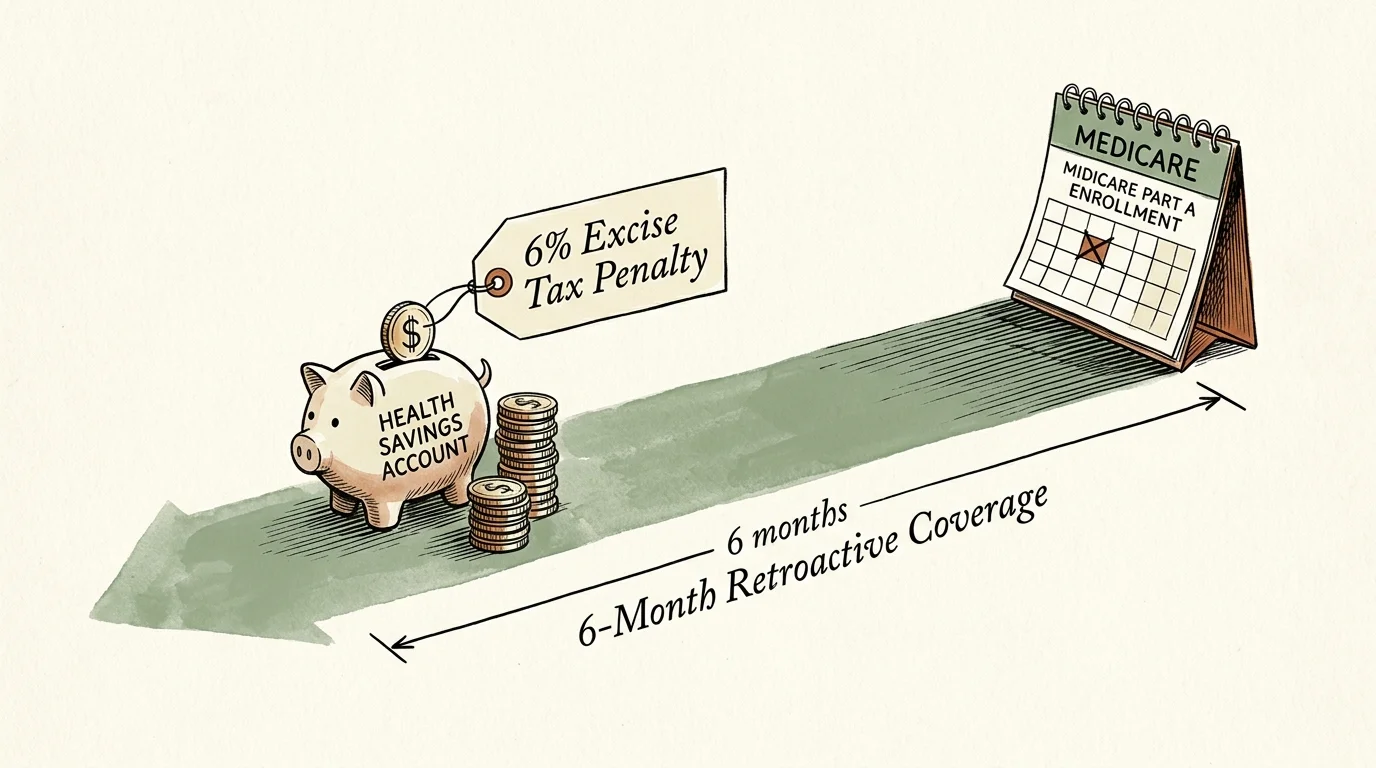
3. The 6-Month Retroactive Medicare Part A HSA Tax Trap
Working past age 65 allows you to continue building tax-advantaged savings through employer healthcare plans. However, pairing late retirement with a Health Savings Account (HSA) carries a severe tax trap.
When you enroll in Medicare Part A after age 65, the federal government automatically backdates your coverage by six full months. This retroactive start date will not precede your 65th birthday month.
Under strict IRS regulations, you cannot make HSA contributions while enrolled in Medicare Part A or Part B. The retroactive enrollment instantly makes your recent contributions ineligible.
Excess HSA contributions trigger a 6% excise tax penalty for every year the funds remain uncorrected. You will also owe standard income tax on the disallowed contribution amounts.
To avoid penalties, stop all HSA contributions at least six months before applying for Medicare or claiming Social Security. Prorate your annual contributions during your final working year.
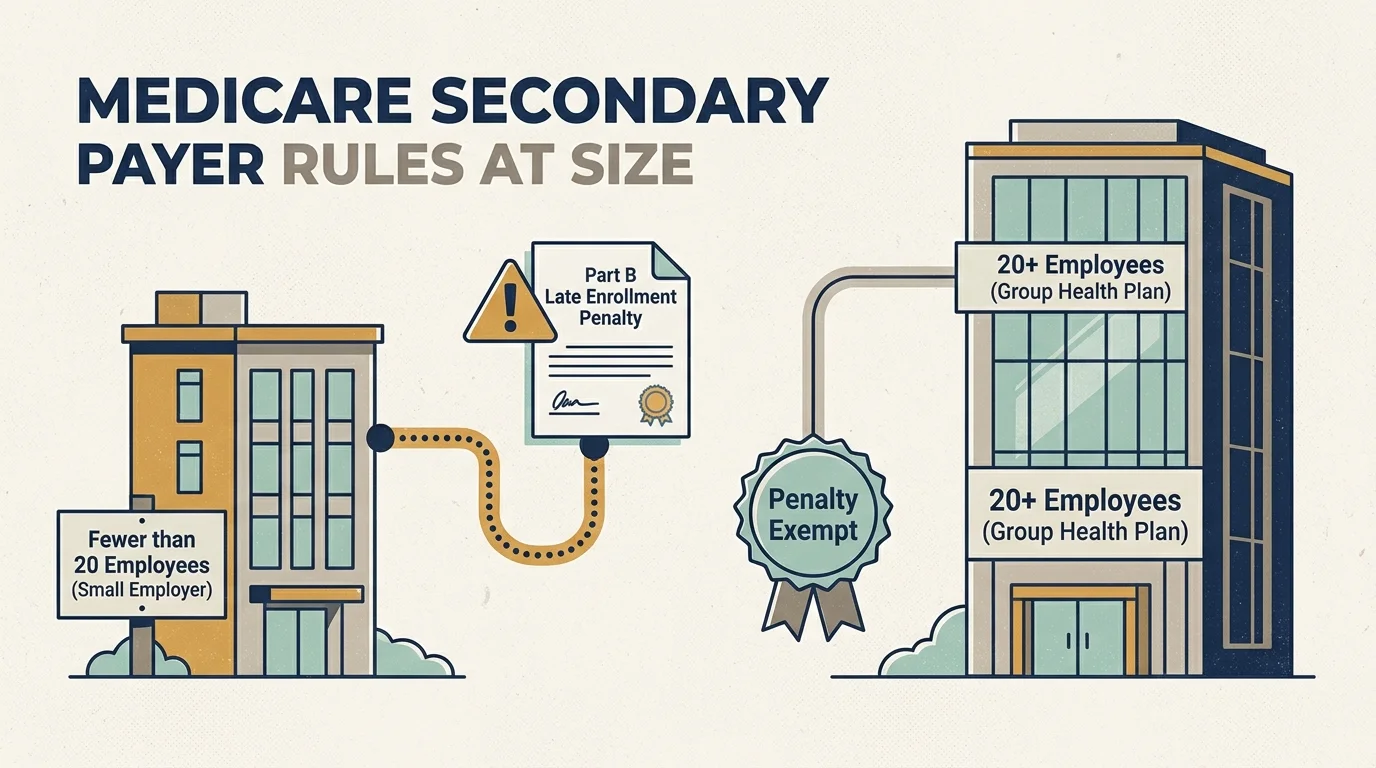
4. Small-Employer Coverage Triggers Lifetime Medicare Penalties
Many older workers assume that active employment health insurance always exempts them from Medicare enrollment. That costly misunderstanding leads to permanent financial surcharges.
Federal rules dictate that you can only delay Medicare Part B penalty-free if your employer has 20 or more employees. For companies with fewer than 20 workers, Medicare is legally your primary insurer.
If your small employer plan acts as secondary coverage, it may refuse to pay medical claims if you lack Medicare. Failing to enroll at age 65 leaves you responsible for substantial hospital bills.
Furthermore, missing your initial enrollment window triggers a lifetime penalty. Medicare.gov assesses a 10% premium penalty for every full 12-month period you delayed Part B enrollment.
Consult your human resources department before your 65th birthday to confirm your company size. If your employer has fewer than 20 staff members, enroll in Part B immediately.

5. The “Still-Working” RMD Exception Excludes Traditional IRAs
Under the SECURE 2.0 Act, Required Minimum Distributions (RMDs) begin at age 73, rising to age 75 in 2033. Retiring later in life offers a valuable loophole for workplace savings plans.
If you work past age 73, you can use the “still-working exception” to postpone RMDs from your current 401(k) or 403(b). You must not own more than 5% of the business employing you.
This exception allows your current workplace portfolio to compound tax-deferred until April 1 following the calendar year you retire. However, this rule does not apply to all retirement accounts.
Traditional IRAs, SEP IRAs, SIMPLE IRAs, and 401(k) accounts from previous employers remain fully subject to RMD rules at age 73. You must calculate and withdraw those distributions on schedule.
Failing to take an RMD on time results in a steep excise tax of up to 25% on the undistributed amount. Consolidating old retirement accounts into your active 401(k) before age 73 can simplify management.

6. Your “Go-Go” Years Cannot Be Reclaimed Later
Retirement consists of three distinct physical stages: the go-go years, the slow-go years, and the no-go years. Your 60s represent the decade when your energy, mobility, and vitality peak.
Data from the National Institute on Aging demonstrates that functional mobility naturally decreases with advancing age. Spending your late 60s in an office consumes your most physically capable leisure years.
Financial security is valuable, but money cannot buy back physical agility. Postponing travel, athletic hobbies, and family adventures until your 70s often means adapting to physical limitations.
“The goal of retirement is to live off your assets—not live off your regrets.”
Balance your portfolio goals against your biological clock. Continuing to work makes sense only if the professional fulfillment outweighs the irreplaceable personal time you give up.

7. Workplace Shifts and Surcharges Reduce Net Pay
Remaining in your career past traditional retirement age often changes your professional environment. Corporate restructuring, new software adoption, and leadership changes can shift workplace dynamics.
Long-tenured employees sometimes face subtle alienation as company culture evolves. Navigating shifting expectations or feeling disconnected from younger management teams can turn a beloved career into a daily grind.
Additionally, late retirement disadvantages include diminishing financial returns from high marginal tax brackets. Earning a high salary while collecting investment income can push you into steep tax territory.
High earners also trigger Medicare Income-Related Monthly Adjustment Amounts (IRMAA). These federal surcharges significantly increase your monthly Part B and Part D premiums.
“Don’t simply retire from something; have something to retire to.” — Harry Emerson Fosdick
Calculate your true net income after factoring in federal taxes, state taxes, IRMAA surcharges, and commuting costs. You may find you are working for a fraction of your nominal salary.

Late Retirement Rules and Strategic Milestones
Tracking federal deadlines is essential when you delay your departure from the workforce. Use this comparison table to navigate your key milestones and avoid expensive administrative missteps.
| Milestone Age | Key Benefit or Rule | Critical Action Required |
|---|---|---|
| Age 65 | Initial Medicare eligibility window opens. | Verify employer size (20+ workers) or enroll in Part B to prevent penalties. |
| 6 Months Pre-Medicare | HSA contribution disqualification rule. | Stop all HSA payroll contributions to avoid the 6% excise penalty. |
| Age 67 (FRA) | Social Security earnings limit disappears. | Earn unlimited wages without benefit withholding; credits grow 8% annually. |
| Age 70 | Delayed retirement credits permanently end. | Claim Social Security benefits immediately to avoid forfeiting monthly income. |
| Age 73 (75 in 2033) | Mandatory RMDs begin on retirement assets. | Take IRA distributions; utilize the still-working exception for active 401(k)s. |
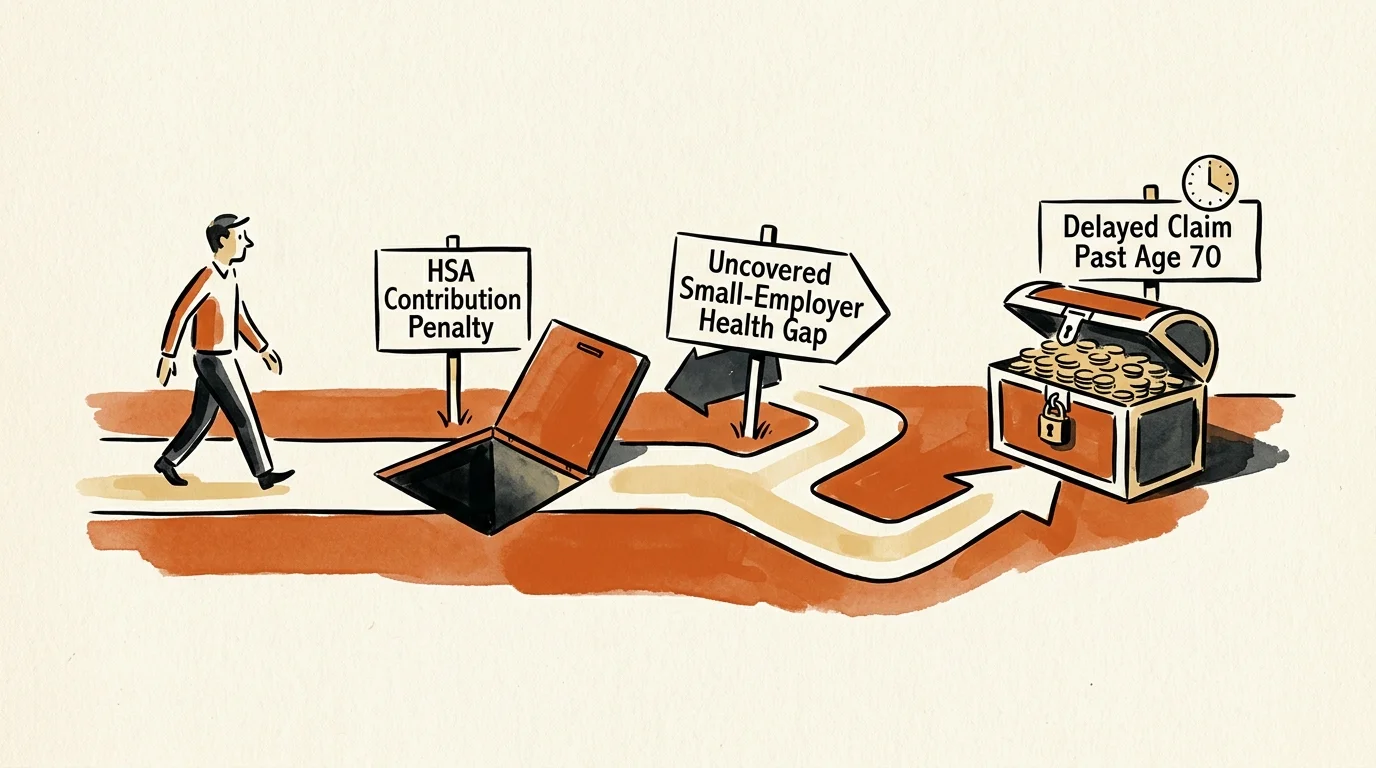
Errors That Cost Retirees Thousands
Even financially savvy professionals stumble over complex late-career regulations. Avoid these expensive pitfalls as you finalize your retirement timeline:
- Contributing to an HSA after enrolling in Medicare Part A: Triggers annual excise tax penalties until the excess deposits are withdrawn.
- Assuming small-employer coverage waives Medicare Part B: Results in a permanent 10% premium penalty for every year enrollment was missed.
- Waiting past age 70 to claim Social Security: Permanently surrenders monthly checks with zero increase in benefit amounts.
- Ignoring RMDs on old retirement accounts: Creates an IRS excise tax penalty of up to 25% on forgotten 401(k) or IRA balances.
- Overlooking IRMAA thresholds: Pushes Medicare premiums higher due to wage income combined with mandatory investment distributions.

When to Get Expert Help
Navigating late-career transitions requires coordinated legal, tax, and healthcare strategies. Specific professionals provide crucial guidance as you finalize your plans:
Consult a State Health Insurance Assistance Program (SHIP) counselor for objective Medicare guidance. They clarify employer coverage coordination rules without sales pressure.
Work with a fee-only Certified Financial Planner (CFP) to build an optimal Social Security claiming timeline. They model tax-efficient withdrawal strategies across your various taxable and tax-deferred accounts.
Engage a Certified Public Accountant (CPA) to manage HSA corrections and IRMAA mitigation strategies. They ensure your late-career wages do not trigger avoidable tax brackets.
Visit an elder law attorney to update healthcare proxies, financial powers of attorney, and estate plans. Proper legal documentation protects your assets if unexpected health challenges arise.
Frequently Asked Questions
Can I collect Social Security while working full-time past age 67?
Yes. Once you reach Full Retirement Age, the Social Security Administration eliminates the Retirement Earnings Test.
You can earn unlimited employment income without any reduction or withholding applied to your monthly Social Security benefit checks.
Do I have to take RMDs if I am 74 and still working?
You can delay RMDs from your current employer’s 401(k) or 403(b) plan under the still-working exception.
However, you must still take required distributions from Traditional IRAs and retirement accounts held with past employers.
What happens if I delay Medicare Part B while working for a small business?
If your employer has fewer than 20 employees, Medicare is your primary coverage at age 65.
Delaying Part B leaves you with unpaid medical bills and triggers a lifetime 10% premium penalty for every missed year.
How do I calculate my HSA contribution limit during my retirement year?
Prorate your annual contribution limit based on the number of months you had qualifying high-deductible coverage before Medicare enrollment.
Remember that Medicare Part A enrolls retroactively up to six months, which directly reduces your allowed HSA contribution months.
Moving Forward with Confidence
Choosing to work late in life can strengthen your financial foundation and provide meaningful intellectual engagement. However, successful late retirement requires managing strict federal regulations and protecting your physical health.
Audit your healthcare coverage, coordinate your retirement accounts, and establish a firm date for claiming Social Security at age 70. Taking proactive control of these milestones ensures your extra working years reward your future.
Information in this article reflects current rules as of the publication date and may change. Always confirm benefit details directly with Social Security Administration, Medicare.gov, or relevant government agencies before making decisions.
Last updated: February 2026. Medicare and Social Security rules change annually—always verify current details at official government sources.