For decades, the standard blueprint for the golden years involved packing up, heading south, and buying a condo near a beach or a golf course. Yet recent data paints a radically different picture of what actually drives senior satisfaction. Relocating to a sweltering climate without considering healthcare access, walkability, or cultural engagement often leads to profound buyer’s remorse. As we navigate 2026, the definition of an ideal retirement destination has shifted away from purely weather-based decisions toward community, comprehensive medical care, and intellectual stimulation.
The happiest retirees aren’t simply those with the most days of sunshine; they are individuals living in environments that actively support their independence and well-being. Selecting a retirement city requires balancing your financial realities with your lifestyle aspirations. A low cost of living means very little if you cannot access top-tier specialists when a medical need arises, just as beautiful scenery loses its charm if you feel entirely isolated from a supportive community.
“Don’t simply retire from something; have something to retire to.” — Harry Emerson Fosdick
Rethinking the Retirement Blueprint: What Drives True Satisfaction
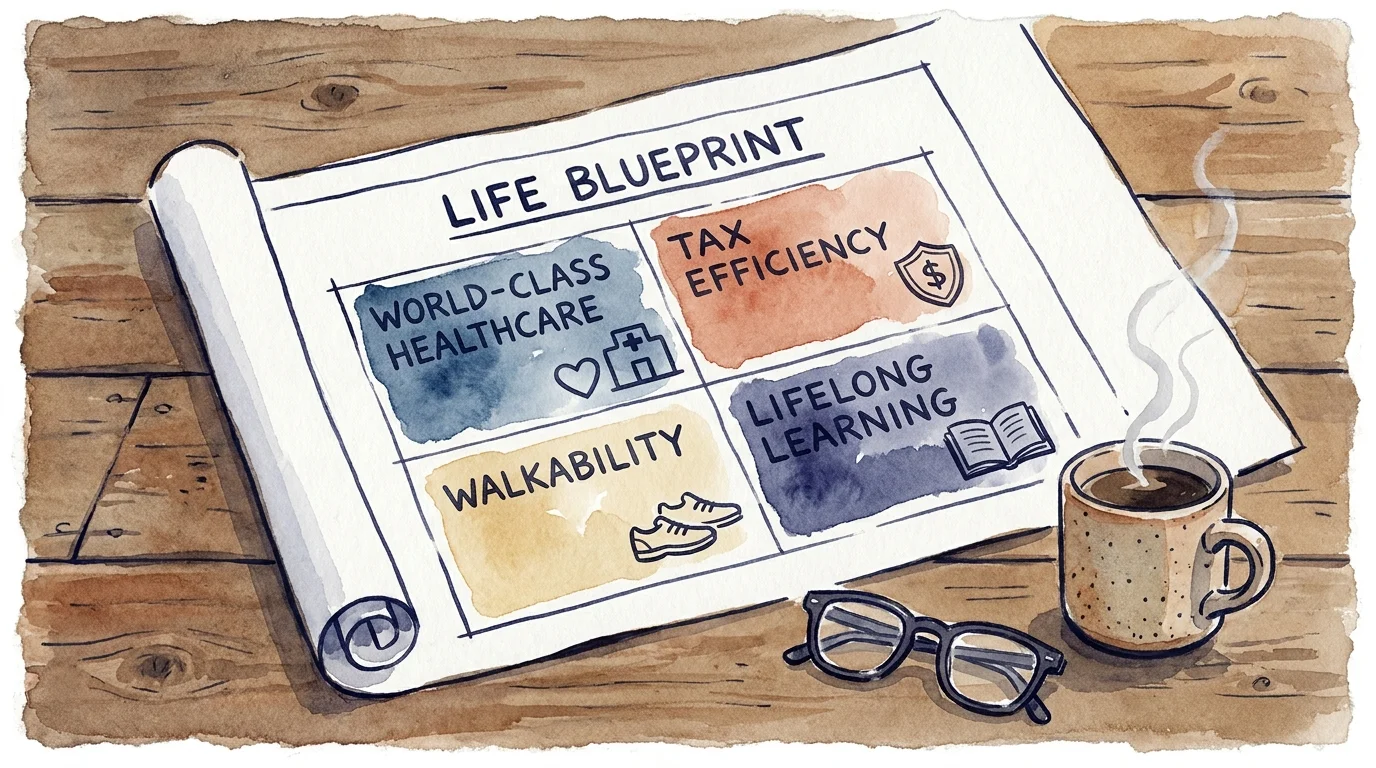
Before packing boxes and hiring movers, you must identify what elements genuinely contribute to a fulfilling daily life. The top retirement cities emerging in 2026 share several common characteristics that elevate the quality of life for their older residents.
- World-Class Healthcare Networks: Proximity to major teaching hospitals and comprehensive healthcare systems ensures that as medical needs grow more complex, you do not have to travel hours for specialized treatments.
- Tax Efficiency: Finding states that do not tax Social Security benefits, or those offering substantial deductions for pension and retirement account income, helps your savings stretch decades longer.
- Walkability and Transit: As driving becomes less appealing or less viable over time, living in an area with safe sidewalks, robust public transportation, and nearby amenities helps maintain your independence.
- Lifelong Learning and Culture: University towns consistently rank high for senior satisfaction because they offer access to continuous education, arts, theater, and intergenerational social environments.
1. Roanoke, Virginia: The Blue Ridge Health Hub
Tucked away in the Blue Ridge Mountains, Roanoke has quietly transformed into one of the best places to retire in the USA. While it offers stunning mountain views and an abundance of outdoor recreation, its real draw for retirees is its surprisingly robust medical infrastructure. The presence of the Carilion Clinic and the Virginia Tech Carilion School of Medicine provides residents with cutting-edge healthcare typically reserved for much larger metropolitan areas.
Roanoke provides an incredibly balanced cost of living. Housing costs remain well below the national average, allowing you to downsize comfortably without draining your retirement accounts. The downtown area has been revitalized to emphasize walkability, featuring farmers’ markets, local museums, and dining options that rival major coastal cities. Furthermore, Virginia offers favorable tax treatment for retirees, including significant deductions for those over age 65, making it an economically sound choice for stretching a fixed income.
2. Lancaster, Pennsylvania: Accessible Charm and Premier Care
When searching for the happiest cities for retirees, Lancaster consistently defies expectations. Often stereotyped merely for its Amish countryside, the city itself boasts a vibrant, highly walkable downtown filled with historic architecture, art galleries, and an acclaimed culinary scene. Lancaster strikes a perfect balance—offering a slower, peaceful pace of life while placing you just a short train ride away from major hubs like Philadelphia and New York City.
Pennsylvania is exceptionally friendly to retirees from a tax perspective; the state does not tax Social Security benefits, and it exempts distributions from 401(k)s, IRAs, and traditional pensions once you reach retirement age. On the medical front, Penn Medicine Lancaster General Health provides exceptional care, ensuring you have access to premier specialists right in your backyard. The combination of low taxes, high-quality medical care, and a tight-knit community makes Lancaster a powerhouse for senior satisfaction.
3. Fort Collins, Colorado: Active Living for the Modern Senior
If your vision of how to retire happy involves staying physically active and intellectually engaged, Fort Collins demands your attention. Situated at the foothills of the Rocky Mountains, this city is tailor-made for those who want to spend their later years biking, hiking, and exploring nature. It routinely ranks as one of the most bike-friendly cities in America, featuring miles of paved, flat trails that are accessible for all mobility levels.
As the home of Colorado State University, Fort Collins offers deep cultural and educational benefits. Retirees can audit classes, attend university sporting events, and participate in a lively arts community. While the cost of living is slightly higher here than in some Midwestern or Southern alternatives, Colorado provides generous property tax exemptions for seniors and competitive income tax rates. The emphasis on wellness and outdoor living translates directly to lower stress levels and higher overall life satisfaction.
4. Ann Arbor, Michigan: Intellectual Stimulation Meets Medical Excellence
Many Americans immediately cross Northern states off their retirement lists due to the fear of winter weather. However, Ann Arbor proves that community and healthcare dramatically outweigh January snowfall. Home to the University of Michigan, the city offers unparalleled access to Michigan Medicine—consistently ranked among the absolute best hospital systems in the entire country. When managing chronic conditions or seeking advanced surgical care, having a world-renowned medical center minutes from your home is invaluable.
Michigan has also made massive strides in recent years regarding retirement taxation, significantly rolling back the “retirement tax” and offering broad exemptions for public and private pensions. Ann Arbor features a highly educated population, extensive public parks, a fully accessible public transit system, and a deeply ingrained culture of arts and music. For those who prioritize mental stimulation and elite healthcare over year-round sunshine, Ann Arbor represents one of the top retirement cities available.
5. Greenville, South Carolina: Southern Hospitality with a Modern Edge
Greenville has masterfully blended its historic Southern charm with a modern, progressive urban design. The city centers around the breathtaking Falls Park on the Reedy, giving residents a beautiful, natural gathering place right in the middle of downtown. Greenville’s focus on creating wide, shaded sidewalks, accessible public spaces, and a thriving local restaurant scene has attracted a massive influx of retirees seeking a high quality of life without the congestion of coastal cities.
From a financial standpoint, South Carolina is incredibly welcoming to older adults. The state does not tax Social Security benefits and offers a generous $15,000 income tax deduction for other types of retirement income once you turn 65. The climate is distinctly mild; you will enjoy four distinct seasons, but the winters are generally short and manageable. With a rapidly expanding local healthcare system and proximity to larger medical hubs in Charlotte and Atlanta, Greenville secures its spot as a premier destination.
6. Boise, Idaho: Safety, Space, and Senior Community
Boise offers a unique blend of safety, expansive natural beauty, and a rapidly growing economy that actively supports its aging population. The city is defined by its cleanliness, exceptionally low crime rates, and the beautiful Boise River Greenbelt—a 25-mile tree-lined pathway that provides safe, scenic routes for walking and cycling. Retirees flock to Boise for the peace of mind it offers, knowing they are living in a secure, neighborly environment.
Healthcare access in Boise has expanded massively over the past decade to meet the needs of its growing population, with St. Luke’s Health System providing comprehensive care across numerous specialties. While housing prices surged a few years ago, the market in 2026 has stabilized, offering practical downsizing opportunities in safe, suburban neighborhoods. For those who want to step away from the chaotic pace of major urban centers while retaining access to high-quality amenities, Boise is an exceptional choice.
Comparing the Top Retirement Cities for 2026
To help you weigh your options, the following table breaks down the essential criteria for these six surprising retirement destinations. Note that housing markets fluctuate; these reflect current 2026 regional baselines.
| City & State | Primary Lifestyle Draw | State Tax on Social Security | Healthcare Infrastructure |
|---|---|---|---|
| Roanoke, VA | Mountain recreation & affordability | None | Carilion Clinic Hub |
| Lancaster, PA | Walkability & East Coast access | None | Penn Medicine LGH |
| Fort Collins, CO | Active outdoor living & biking | None (Deductible) | UCHealth System |
| Ann Arbor, MI | Elite education & arts | None | Michigan Medicine |
| Greenville, SC | Mild climate & urban parks | None | Prisma Health |
| Boise, ID | Safety & expansive nature | None | St. Luke’s Health |
Errors That Cost Retirees Thousands When Relocating
The decision to relocate in retirement involves far more than simply finding a house you love in a city that looks great on paper. Unfortunately, many Americans make critical oversight errors during the moving process that jeopardize both their physical health and their financial security.
“The goal of retirement is to live off your assets—not live off your regrets.”
Failing to Verify Medicare Network Changes: This is arguably the most dangerous mistake a relocating retiree can make. If you are enrolled in Original Medicare, you can generally see any doctor who accepts Medicare nationwide. However, if you rely on a Medicare Advantage (Part C) plan, those networks are strictly localized. Moving to a new state—or even a new county—usually triggers a Special Enrollment Period. If you move to a new city without verifying that the local hospital systems accept your specific plan, you could be left paying completely out-of-pocket for essential services. You should always use the official Medicare Plan Finder to research available plans in your target zip code long before signing a lease or a mortgage.
Underestimating Hidden State Taxes: While a state might not tax your Social Security benefits, they may heavily tax your property, your sales purchases, or your estate. Moving from a state with high income tax to a state with no income tax often feels like a win until you realize the local property taxes are three times higher. You must calculate the total tax burden of a specific municipality rather than relying on broad state-level assumptions.
Buying Before Renting: It is incredibly risky to purchase a home in a new city without spending significant time there first. A neighborhood that feels charming during a long weekend vacation might feel entirely different when you are dealing with local traffic patterns, accessing the grocery store, or managing winter weather. Renting an apartment or a smaller home for six to twelve months allows you to test the waters. If the city does not align with your expectations, you can simply pack up and move without the massive financial friction of selling a house.
When to Get Expert Help for Your Relocation
Because relocating across state lines touches every aspect of your financial and medical life, building a team of professionals is a wise investment. You do not have to navigate these complex transitions alone.
First, consider speaking with a fiduciary financial advisor or a tax professional regarding your state-to-state move. They can model exactly how a new state’s tax laws will impact your required minimum distributions (RMDs), pension payouts, and estate plans. What works perfectly in California or New York may trigger entirely different tax liabilities in South Carolina or Idaho.
Second, utilize local resources designed specifically to support aging adults. The Administration for Community Living funds the Eldercare Locator, a phenomenal public service that connects you to local Area Agencies on Aging. Before you move, you can contact the agency in your target city to learn about local transportation services, senior community centers, and volunteer opportunities. Additionally, scheduling an appointment with a local SHIP (State Health Insurance Assistance Program) counselor in your new state guarantees you receive unbiased, free guidance on navigating the local Medicare landscape.
Frequently Asked Questions About Retiring Out of State
Do I have to change my Medicare plan if I move to a different state?
If you are enrolled in a Medicare Advantage (Part C) plan or a standalone Part D prescription drug plan, yes. These plans operate on specific county and zip code service areas. Moving out of your plan’s service area triggers a Special Enrollment Period, giving you two full months after your move to enroll in a new plan. If you have Original Medicare (Part A and Part B) along with a standardized Medigap policy, your coverage generally travels with you nationwide, though you still need to update your address with the Social Security Administration.
How can I find reliable information on a new city’s livability for seniors?
Aside from spending physical time in the location, leveraging data-driven tools is highly effective. The AARP provides a comprehensive “Livability Index” that scores neighborhoods and communities across the United States based on housing affordability, neighborhood safety, transportation options, environmental quality, and social engagement opportunities. This is an excellent starting point for comparing different municipalities.
Will moving out of state affect my Social Security payment amount?
No. Your monthly Social Security benefit is a federal program; the gross amount you receive does not change based on your residential zip code. However, the net amount you keep in your bank account might change depending on whether your new state levies a state income tax on Social Security benefits. By 2026, the vast majority of states exempt Social Security from state income taxation, but you must verify the specific rules of your intended destination.
The landscape of retirement has fundamentally evolved. You are no longer restricted to the handful of traditional sunshine states that previous generations defaulted to. By prioritizing access to elite healthcare, financial efficiency, and vibrant community engagement, you can identify a city that doesn’t just host your retirement, but actively enhances it. Take the time to visit these surprising cities, walk their neighborhoods, and visualize your daily routine. Your next great chapter deserves a setting that fully supports the life you have worked so hard to build.
Information in this article reflects current rules as of the publication date and may change. Always confirm benefit details directly with Social Security Administration, Medicare.gov, or relevant government agencies before making decisions.