Finding the perfect active adult community often becomes a frustrating battle between desirable amenities and the dread of escalating monthly expenses. You might spot a gorgeous home with an affordable listing price, only to discover that sky-high Homeowners Association (HOA) dues completely shatter your fixed-income budget. Fortunately, you do not have to sacrifice resort-style swimming pools, maintained golf courses, or vibrant social calendars just to keep overhead low. Across the country, several well-established 55+ neighborhoods offer an incredible lifestyle for a fraction of the typical monthly cost. By targeting communities that manage their resources wisely, you can protect your retirement savings while still enjoying the premium, maintenance-free living you deserve.

Why Monthly Association Dues Dictate Your True Cost of Living
When you purchase a home in an age-restricted neighborhood, the listing price represents only a portion of your long-term housing obligation. Monthly dues fund the lifestyle that draws you to the community in the first place—everything from manicured common areas to state-of-the-art fitness centers and guarded entry gates. However, luxury developments frequently charge upwards of $600 to $800 every month, a recurring expense that never disappears and typically increases with inflation.
A low monthly association fee provides critical breathing room in your budget. By minimizing fixed overhead, you retain the flexibility to travel, manage unexpected healthcare costs, or simply enjoy a higher quality of daily life. When projecting your long-term housing costs, utilize resources from the Consumer Financial Protection Bureau (CFPB) — Retirement to ensure you accurately calculate inflation and fixed-income constraints over a twenty-year horizon.
“The goal of retirement is to live off your assets—not live off your regrets.”
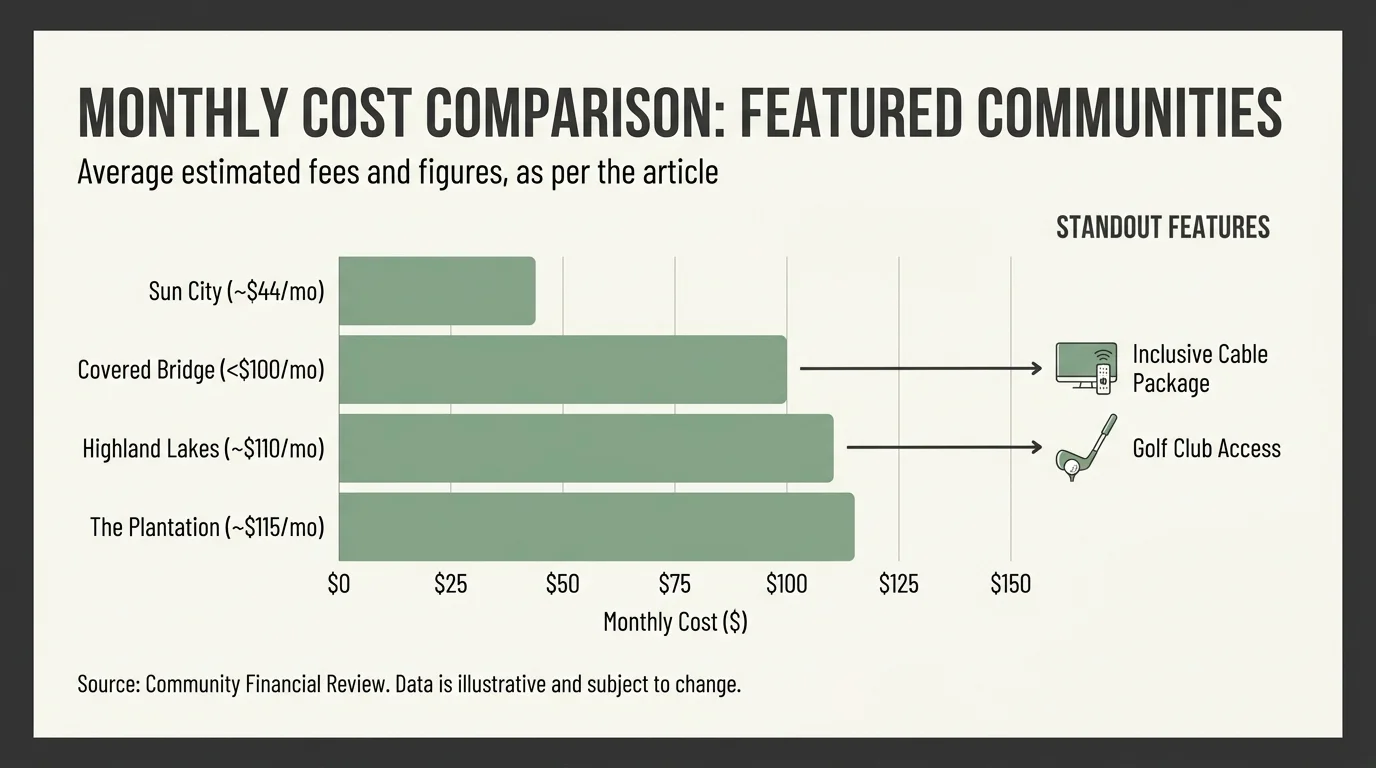
9 Active Adult Neighborhoods Where Your Dollar Stretches Further
Finding a community that balances desirable location, quality homes, and budget-friendly dues requires extensive research. The following nine communities represent some of the best values in the country, proving that you can secure a vibrant, active lifestyle without paying a premium.
| Community Name | Location | Estimated HOA/Base Fee | Standout Feature |
|---|---|---|---|
| Covered Bridge | Lake Placid, FL | Under $100/month | Includes lawn care and basic cable |
| Highland Lakes on Lake Tarpon | Palm Harbor, FL | ~$110/month | Free access to 27-hole golf course |
| Sun City | Sun City, AZ | ~$525/year (~$44/month) | Massive scale with 7 recreation centers |
| Oaks North | San Diego, CA | Under $100/month (select homes) | Ultra-rare affordable SoCal living |
| The Plantation at Leesburg | Leesburg, FL | ~$115/month | Two 18-hole championship golf courses |
| Sun City Center | Sun City Center, FL | ~$650/year total per couple | 43,000-sq-ft clubhouse and golf cart access |
| Glen at Masons Creek | Hainesport, NJ | Exceptionally low for the region | Intimate 255-home Northeast community |
| Rancho Resort | Sahuarita, AZ | Highly competitive for the region | Award-winning master-planned amenities |
| Pennbrooke Fairways | Leesburg, FL | ~$200–$300/month | Covers internet, cable, and RV storage |
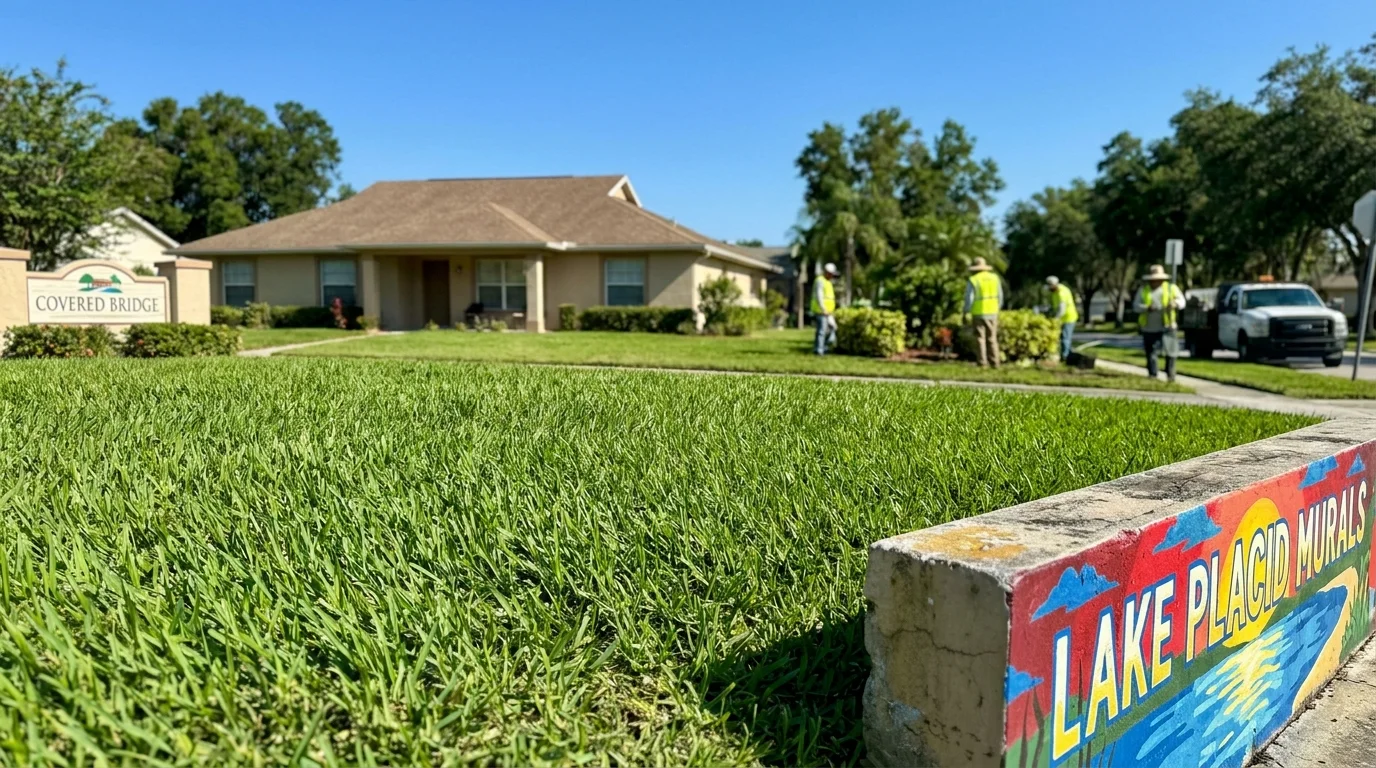
1. Covered Bridge (Lake Placid, Florida)
Lake Placid holds the title of the “Town of Murals” and offers a quiet, central Florida lifestyle away from intense coastal congestion. Covered Bridge features durable block construction homes and a tight-knit neighborhood atmosphere. The monthly fee is remarkably low—often hovering just under $100. This nominal fee punches far above its weight by covering comprehensive lawn maintenance, basic cable television, and access to a clubhouse equipped with a heated pool, hot tub, and exercise room. You gain all the essential perks of an active adult lifestyle without funding extravagant, rarely used amenities.

2. Highland Lakes on Lake Tarpon (Palm Harbor, Florida)
Finding a neighborhood that includes free golf in the base monthly fee is incredibly rare. Highland Lakes on Lake Tarpon delivers exactly that. For a fee that typically sits near $110 per month, residents gain unlimited access to a 27-hole executive golf course. The community rests right on the shores of Lake Tarpon, providing pontoon boats for residents to use at no extra charge. With a massive clubhouse, multiple swimming pools, and a dedicated arts and crafts building, your monthly contribution works incredibly hard to keep your social calendar full.
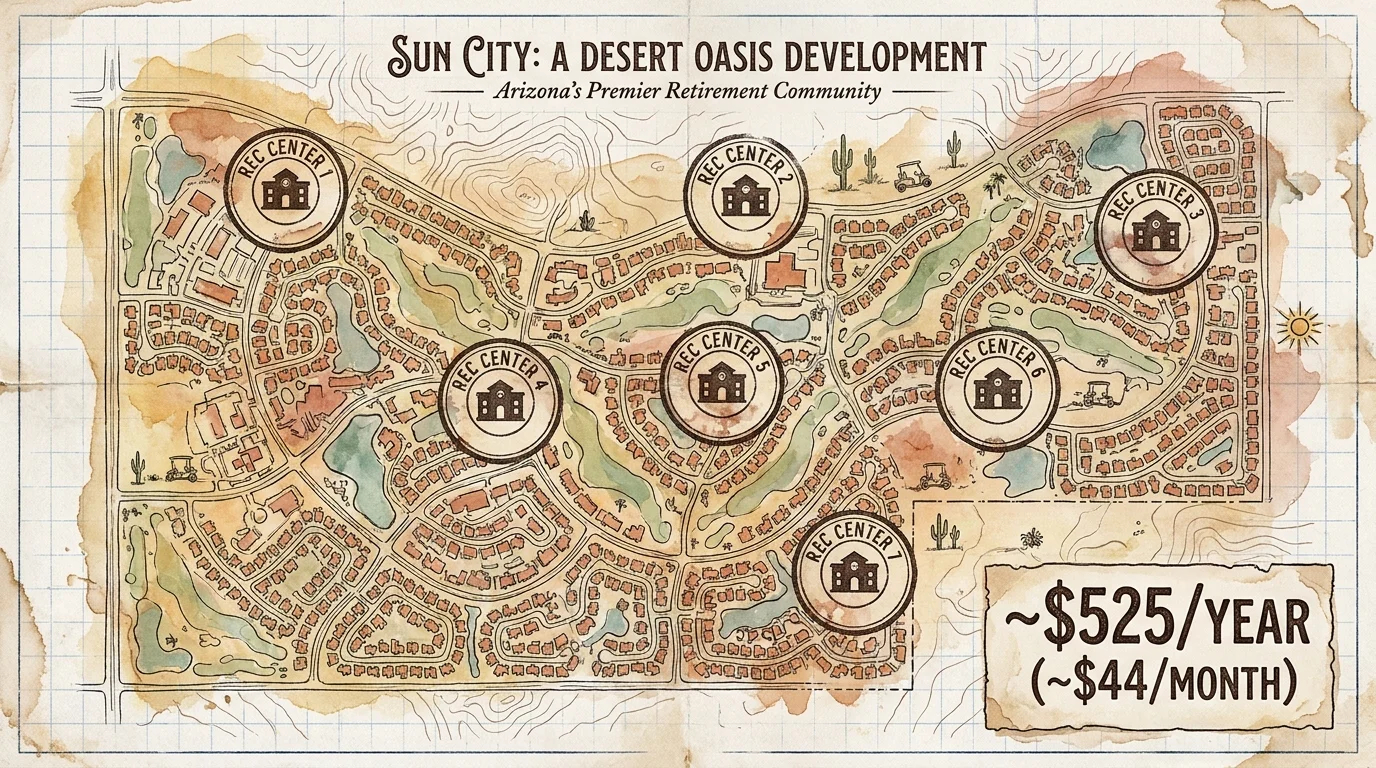
3. Sun City (Sun City, Arizona)
As the original 55+ master-planned community built by Del Webb in 1960, Sun City established the blueprint for active adult living. Because the community is fully developed and municipally independent, property taxes and association fees remain famously low. Instead of a traditional monthly bill, homeowners pay an annual recreation fee—usually around $525 per year, which breaks down to less than $45 a month. This incredibly low rate grants access to seven distinct recreation centers, eight golf courses, multiple swimming pools, and an indoor amphitheater. You simply will not find a better ratio of cost to amenities anywhere in the Southwest.

4. Oaks North (San Diego, California)
Southern California is notorious for a high cost of living, making affordable retirement options a true anomaly. Oaks North in Rancho Bernardo breaks the mold. While the attached condos carry higher dues to cover exterior building maintenance, some of the detached, single-family homes feature fees well under $100 per month. Residents still enjoy full access to the Oaks North Community Center, which features tennis courts, a pristine swimming pool, lawn bowling, and a fitness center. You get to enjoy the legendary San Diego climate without the legendary price tag.

5. The Plantation at Leesburg (Leesburg, Florida)
Central Florida serves as a magnet for relocating retirees, but some gated communities leverage their popularity to charge exorbitant monthly dues. The Plantation at Leesburg manages to keep its fees highly competitive—typically around $115 per month. This baseline fee grants you access to a meticulously guarded gate, two 18-hole championship golf courses, three clubhouses, and multiple heated pools. The community spans over 2,500 acres, providing plenty of green space for walking and biking while keeping your baseline expenses highly predictable.

6. Sun City Center (Sun City Center, Florida)
Located just south of Tampa, Sun City Center utilizes a unique fee structure that greatly benefits fixed-income buyers. Instead of a single, massive monthly bill, residents pay an annual master association fee and a per-person amenity fee. Combined, a couple can expect to pay around $600 to $700 annually—equating to roughly $50 to $60 a month. This unlocks a massive 43,000-square-foot clubhouse, indoor and outdoor swimming pools, specialized craft rooms, and a thriving golf cart culture where you can legally drive your cart to the local grocery store and medical offices.

7. Glen at Masons Creek (Hainesport, New Jersey)
Retiring in the Northeast usually requires accepting high property taxes and steep housing costs. Glen at Masons Creek offers a refreshing exception. This intimate, 255-home community in Burlington County features ultra-low fees that represent a fraction of what neighboring developments charge. You still enjoy a beautifully appointed clubhouse, an outdoor pool, tennis courts, and peaceful walking trails. It provides an excellent opportunity to downsize and stay close to family in New Jersey or Pennsylvania without draining your investment accounts.
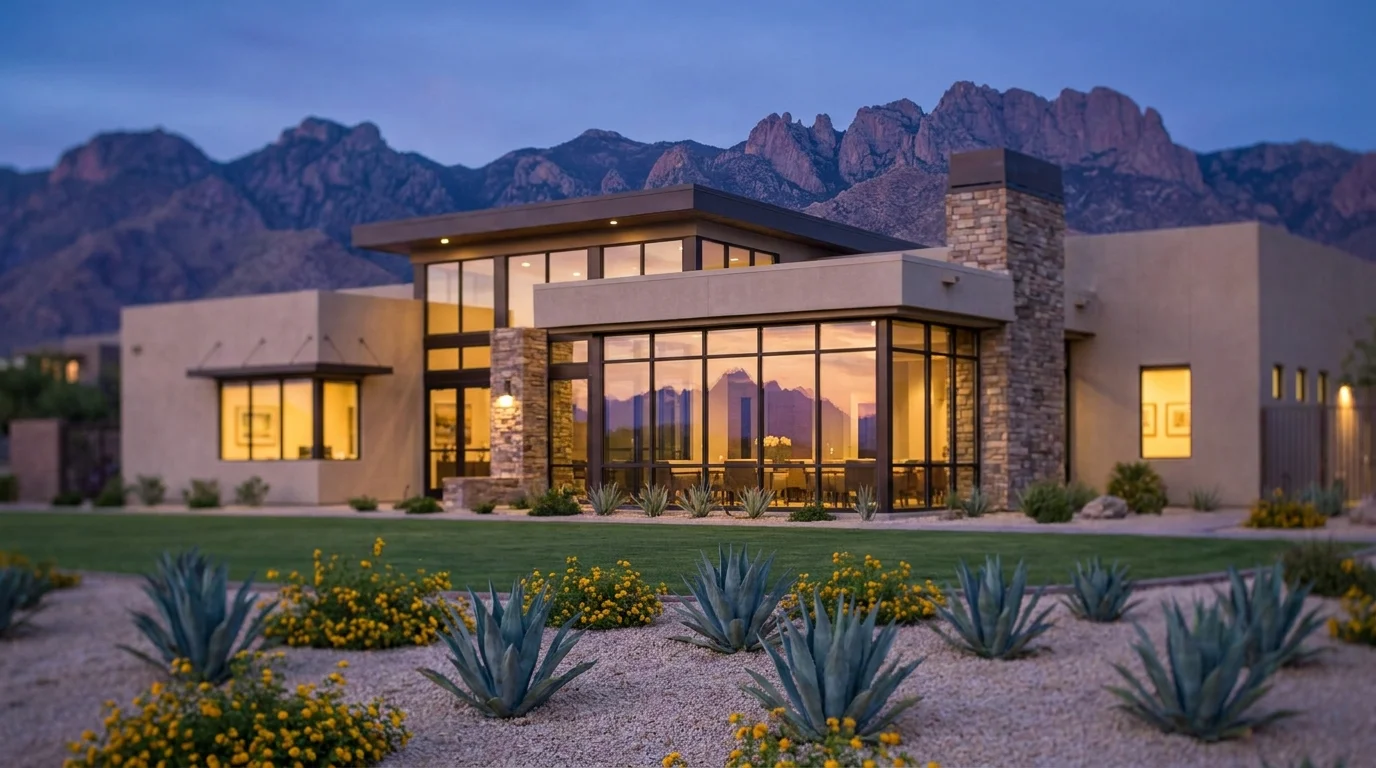
8. Rancho Resort (Sahuarita, Arizona)
Situated just south of Tucson, Rancho Resort provides an upscale desert lifestyle for a surprisingly affordable price. The community features homes priced significantly lower than those in the Phoenix metro area, and the monthly dues match that affordability. The fees cover the maintenance of the Rancho Resort Clubhouse, a resort-style swimming pool, pickleball courts, and a vibrant social calendar organized by a full-time lifestyle director. You get comprehensive, resort-style amenities while keeping your monthly housing expenses well below the national average.

9. Pennbrooke Fairways (Leesburg, Florida)
While the monthly fee at Pennbrooke Fairways ranges from $200 to $300, the sheer volume of included services makes it an unbelievable overall value. Unlike communities where the fee only covers common areas, Pennbrooke includes high-speed internet, cable television, and comprehensive lawn care right in the monthly bill. When you subtract the cost of paying for internet, cable, and landscaping separately, the true cost of the HOA is virtually zero. Residents also gain access to three golf courses, two swimming pools, and dedicated RV and boat storage.
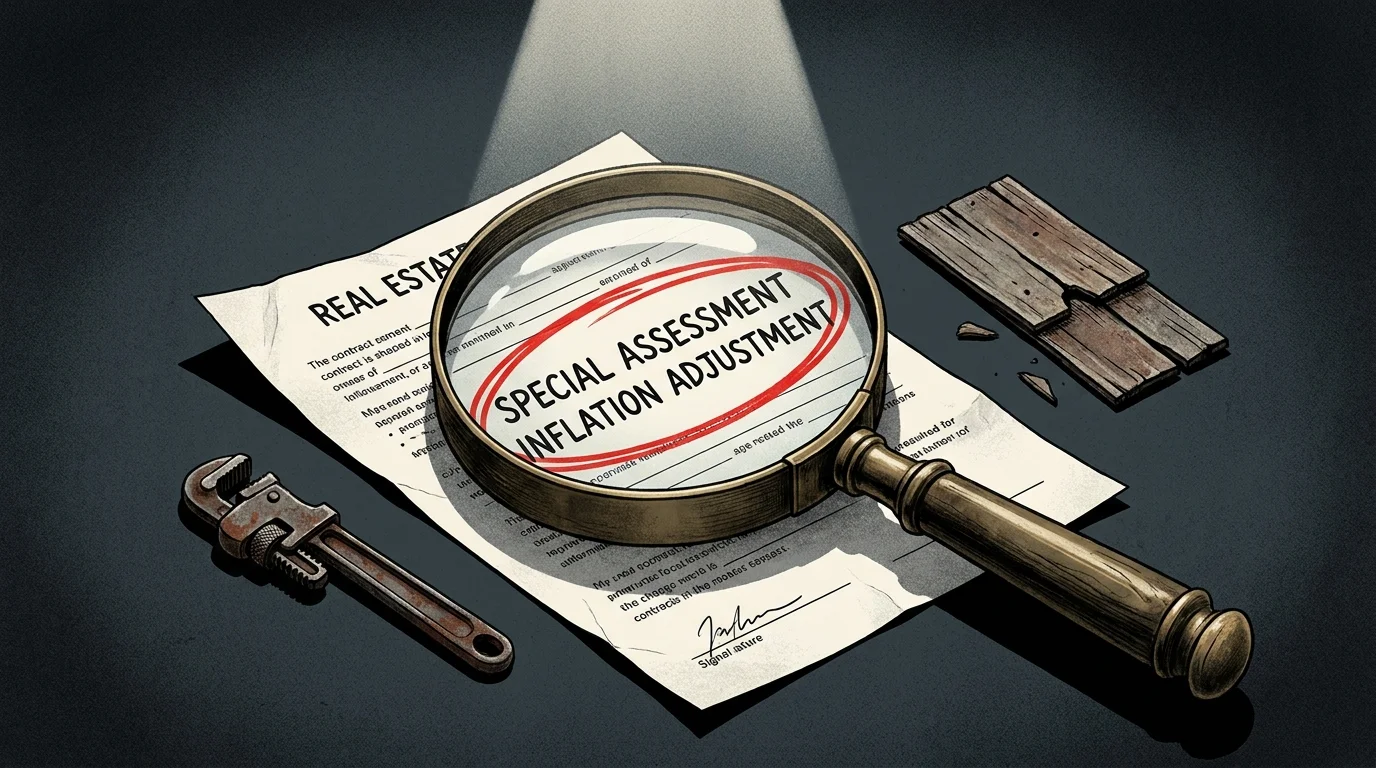
Costly Mistakes to Avoid
When hunting for an affordable neighborhood, the raw dollar amount of the monthly fee only tells part of the story. Buyers frequently make critical errors during the evaluation process that cost them thousands of dollars down the road. Protect yourself by avoiding these common traps:
- Ignoring the Reserve Study: An association with rock-bottom fees but no emergency funds is a ticking time bomb. When the community pool needs resurfacing or the clubhouse roof fails, the board will issue a massive “special assessment” demanding thousands of dollars from each homeowner. Always demand to see a current reserve study before purchasing.
- Confusing Base Fees with Neighborhood Fees: In large master-planned communities, you often pay a base master association fee plus a specific neighborhood fee. Make sure your real estate agent provides the combined total so you are not blindsided at closing.
- Failing to Calculate Included Utilities: A $100 fee that covers nothing but a front gate is functionally more expensive than a $250 fee that covers high-speed internet, premium cable, roof repair, and full lawn care. Always analyze the net value of the included services.
“It’s not how much money you make, but how much money you keep, how hard it works for you, and how many generations you keep it for.” — Robert Kiyosaki

Don’t DIY These Decisions
Evaluating the financial health of an association is not a project you should tackle alone. Buried within hundreds of pages of Covenants, Conditions, and Restrictions (CC&Rs) are rules about fee increases, rental restrictions, and maintenance obligations. Relying purely on the seller’s word or a glossy marketing brochure is a recipe for disaster.
Hire a specialized Seniors Real Estate Specialist (SRES) who understands the nuances of 55+ housing. They know how to audit community financials and spot warning signs of impending fee hikes. Furthermore, consider running the community’s financials past your fiduciary financial advisor to ensure the worst-case scenario aligns with your long-term retirement plan. If you need assistance understanding localized senior services and housing protections before relocating, the Eldercare Locator serves as an excellent, unbiased starting point.
Frequently Asked Questions
Do HOA fees typically increase over time?
Yes. Because communities must pay for landscaping, insurance, and maintenance materials, inflation directly impacts their operating budgets. You should generally expect a modest annual increase of 2% to 5%. If a community has artificially suppressed fees for a decade, prepare for a sudden, dramatic rate hike to compensate.
Why do attached condos usually have higher fees than single-family homes?
When you buy a detached home, you are responsible for your own roof, exterior painting, and structural insurance. In a condominium or attached villa, the association typically takes responsibility for the exterior structure, roof replacement, and master insurance policies, which drives the monthly assessment higher.
Are association dues tax-deductible?
For primary residences, monthly association dues are not tax-deductible. They are considered personal living expenses by the IRS. The only exception occurs if you use the property as a rental income generator, in which case the fees may be deducted as a business expense.
Can I opt out of the community amenities to lower my bill?
No. When you purchase a home within a deed-restricted community, you agree to the governing documents. The fees are mandatory whether you swim in the pool every day or never set foot in the clubhouse.
Protect Your Peace of Mind and Your Wallet
Choosing the right neighborhood defines your daily routine, your social circle, and your financial security. Take the time to request the current financial disclosures, speak with existing residents, and run a complete budget simulation before committing to a purchase. You can find additional community evaluation tools through AARP to determine if a prospective neighborhood truly aligns with your aging-in-place goals.
As you finalize your housing budget, remember that your available income relies heavily on your federal benefits. Information in this article reflects current rules as of the publication date and may change. Always confirm benefit details directly with Social Security Administration, Medicare.gov, or relevant government agencies before making decisions.
Last updated: May 2026. Medicare and Social Security rules change annually—always verify current details at official government sources.