Choosing your Medicare coverage alone often feels like deciphering a complex tax code in an unfamiliar language. A single wrong choice can cost you thousands of dollars in unexpected hospital bills and prescription drug expenses.
Working with an independent Medicare broker cuts through the confusion and gives you an experienced advocate in your corner. Best of all, their personalized advice costs you absolutely nothing out of pocket.
Discover how choosing Medicare with an agent protects your retirement nest egg, secures your preferred doctors, and insulates you from major healthcare disruptions.

The Critical Role of an Independent Medicare Broker
Many retirees assume they must navigate healthcare options entirely on their own. You might spend hours reading confusing mailers or trying to decipher government plan finders.
An independent broker serves as your personal liaison across the insurance landscape. Unlike captive agents tied to a single company, independent brokers partner with multiple private carriers.
This independence allows an agent to evaluate your unique health needs objectively. They compare options across local networks to find coverage tailored to your specific budget and lifestyle.
Agents also understand the subtle regulatory differences that govern Medicare Advantage, Medicare Supplement (Medigap), and standalone Part D prescription plans. Their ongoing training ensures you receive precise, compliant advice.
By leveraging professional medicare plan help, you bypass misleading sales pitches. You receive factual, clear comparisons that empower your healthcare decisions for the long haul.
“The goal of retirement is to live off your assets—not live off your regrets.”
1. Professional Guidance Costs You Exactly Zero Dollars
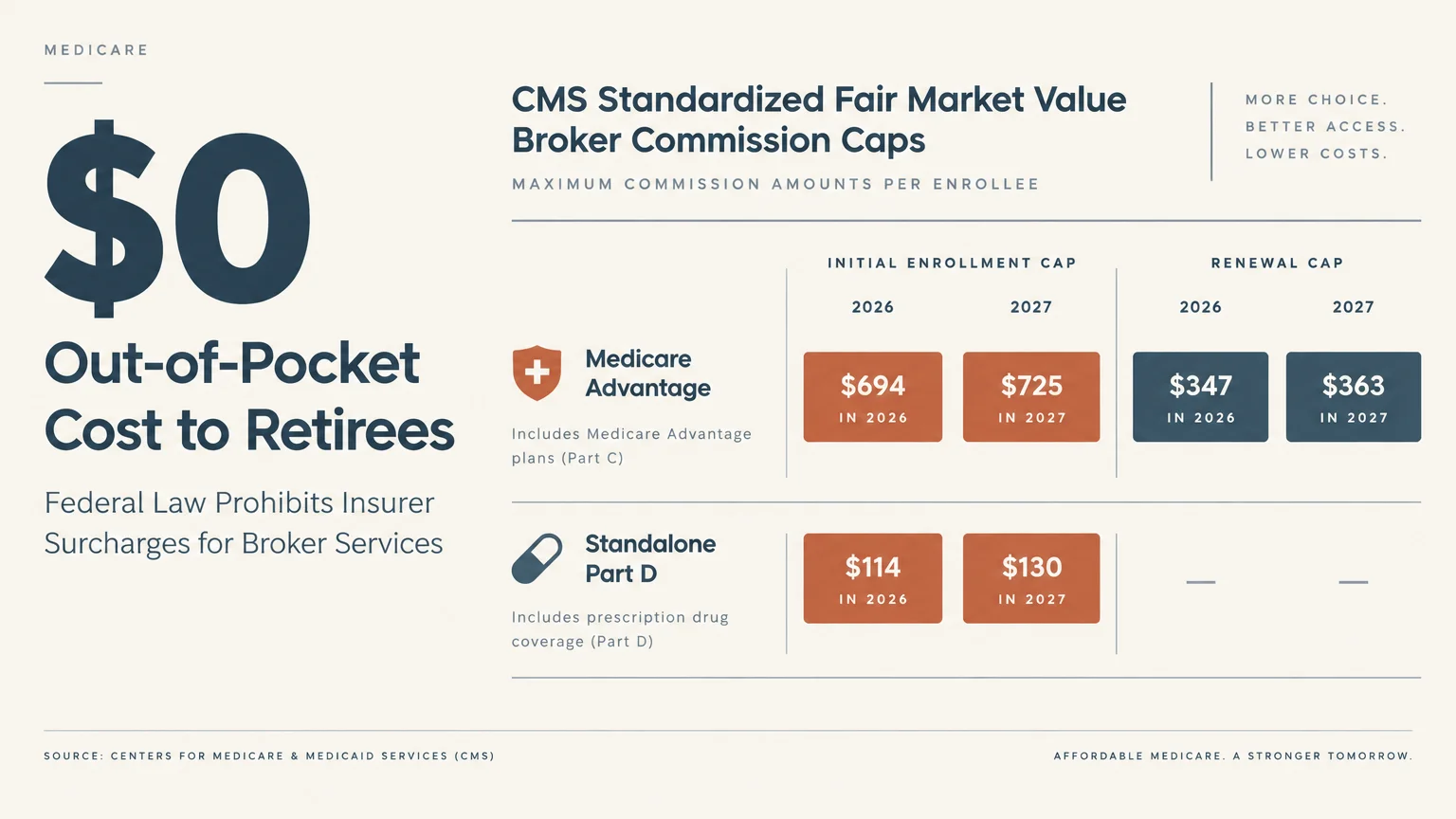
The most surprising fact for many retirees is the price tag: using a licensed Medicare agent costs zero dollars. You will never pay an hourly fee, enrollment charge, or hidden retainer for their services.
Insurance companies compensate agents directly when you enroll in a plan. More importantly, federal law forbids insurance carriers from charging you higher premiums to cover broker compensation.
Your plan costs the exact same dollar amount whether you enroll through a broker, contact the insurer directly, or use Medicare.gov.
To eliminate kickbacks and protect consumers, the Centers for Medicare & Medicaid Services (CMS) strictly regulates broker pay. CMS sets standardized Fair Market Value caps on agent commissions nationwide.
For Medicare Advantage, the national baseline broker commission is capped at $694 for initial enrollments in 2026, rising to $725 in 2027. Annual renewals are capped at $347 in 2026 and $363 in 2027.
Standalone Part D commissions are similarly capped at $114 for initial enrollments in 2026 and $130 in 2027. Because commissions are legally capped, quality brokers focus purely on finding your best fit.

2. Cutting Through the Paralysis of Dozens of Plan Options
Retirees face an overwhelming volume of healthcare choices. According to research from KFF, the average beneficiary can choose among 39 different Medicare Advantage plans in 2026.
For 2027, the average beneficiary still faces roughly 35 Medicare Advantage plans per county. Over 28 of those options include integrated prescription drug benefits.
Analyzing dozens of 50-page summary documents triggers decision fatigue and anxiety. Comparing maximum out-of-pocket limits, dental allowances, and ambulance copayments across dozens of carriers takes weeks.
A seasoned broker uses professional analytical software to filter available plans instantly. They narrow 39 confusing alternatives down to the two or three policies that address your exact priorities.
This targeted approach saves you countless hours of stressful research. You can review clear, side-by-side cost comparisons rather than drowning in carrier marketing booklets.

3. Navigating Massive Market Disruptions and Plan Cancellations
The Medicare market experiences major annual shifts that directly disrupt your coverage. Over 51% to 55% of all eligible beneficiaries—roughly 36 million Americans—now enroll in Medicare Advantage plans.
Because of rising medical expenses, major carriers like Humana, CVS/Aetna, and UnitedHealthcare frequently withdraw from unprofitable counties. These business decisions create widespread disruptions across the country.
Industry contractions have forced approximately 3.2 million seniors to lose their existing Medicare Advantage coverage. These beneficiaries must shop for replacement coverage before their existing plans terminate.
Losing your coverage without a proactive plan leaves you vulnerable to expensive coverage gaps. If your carrier drops your county, you need fast, decisive guidance.
A Medicare broker alerts you immediately when your plan issues a non-renewal notice. They identify comparable replacement networks and transition your coverage seamlessly before January 1 strikes.
4. Protecting Your Preferred Doctors and Hospital Networks
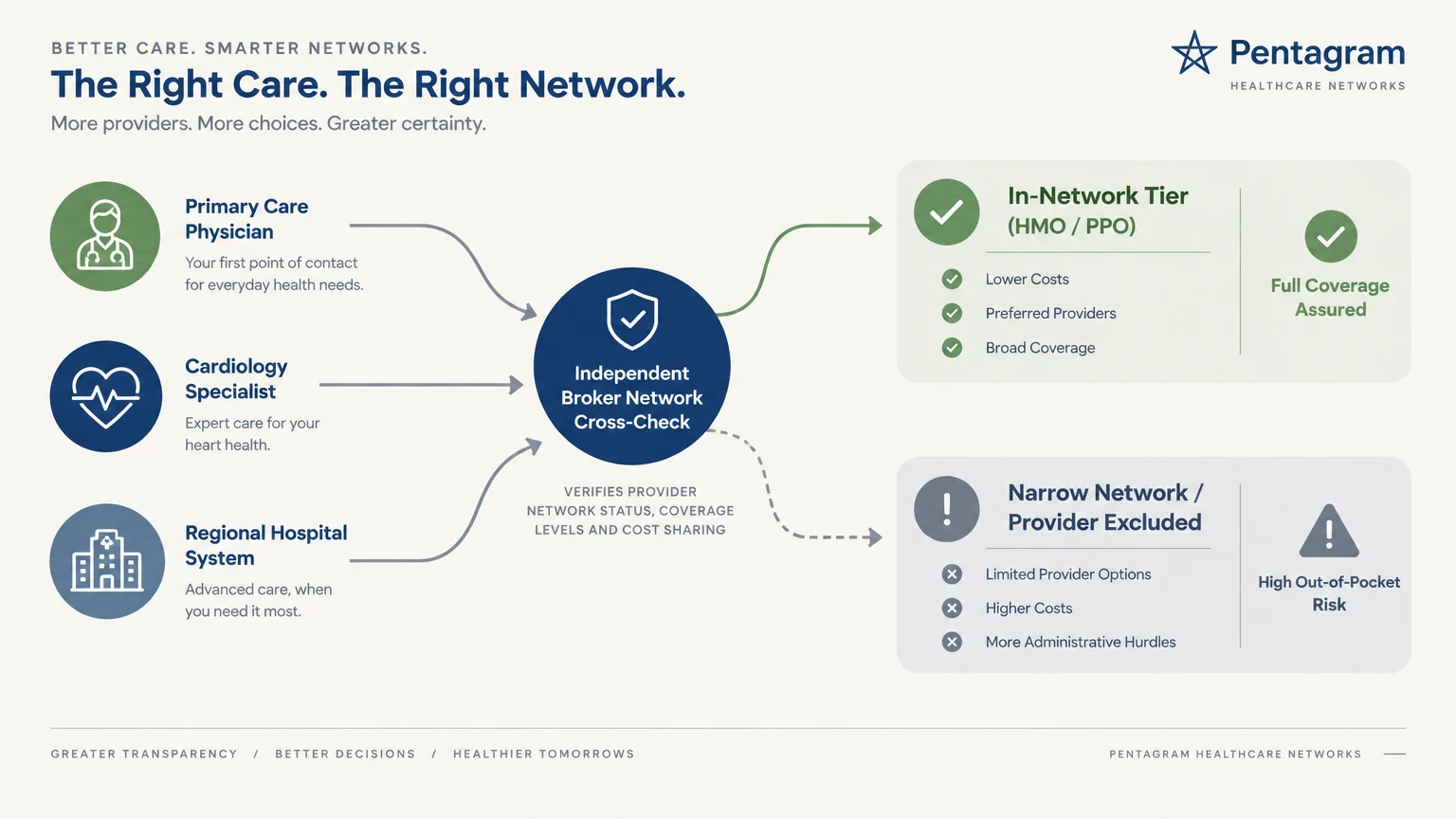
Nothing creates more retirement distress than discovering your longtime oncologist or cardiologist does not accept your new insurance card. Provider networks change constantly without direct warning to patients.
Health Maintenance Organization (HMO) plans generally provide zero coverage for out-of-network care except during genuine medical emergencies. Preferred Provider Organization (PPO) plans permit out-of-network visits, but you pay substantially higher coinsurance rates.
Doctor directories printed online are notoriously inaccurate and outdated. Insurers frequently list retired physicians or clinics that stopped accepting new Medicare patients months earlier.
A dedicated agent verifies your medical team directly before submitting an application. They collect your physicians’ National Provider Identifier (NPI) numbers and confirm participation directly with billing offices.
This verification safeguards your established patient-doctor relationships. You receive necessary medical treatments without worrying about denied claims or out-of-network penalties.

5. Optimizing Part D Prescription Formularies and Shifting Caps
Prescription medications represent one of the most volatile recurring expenses in retirement. Every Medicare drug plan maintains its own unique formulary, dividing medications into distinct pricing tiers.
Federal drug laws establish an annual out-of-pocket maximum on covered prescription drugs: $2,100 in 2026, increasing to $2,400 in 2027. While that cap protects you from catastrophic drug costs, monthly plan designs still vary widely.
For example, the Part D maximum allowable deductible is $615 in 2026, jumping to $700 in 2027. Some carriers waive deductibles entirely on generic drugs, while others apply them across every tier.
The expiration of temporary federal premium stabilization subsidies at the end of 2026 creates dramatic shifts in monthly drug premiums and coverage tiers. Formularies shift annually, and insurers frequently drop specific brand-name medications.
A broker enters your exact drug dosages into analytical databases to run sophisticated pricing models. You can also research program assistance through tools like BenefitsCheckUp to locate supplemental support.
Your agent identifies which pharmacy—mail-order or local retail—yields the lowest annual copayments. This formulary optimization ensures you never overpay for your essential daily prescriptions.
6. Shielding Yourself from Costly Lifetime Late-Enrollment Penalties
Medicare enrollment rules contain rigid deadlines enforced by permanent financial penalties. Missing your initial enrollment window can haunt your finances for decades.
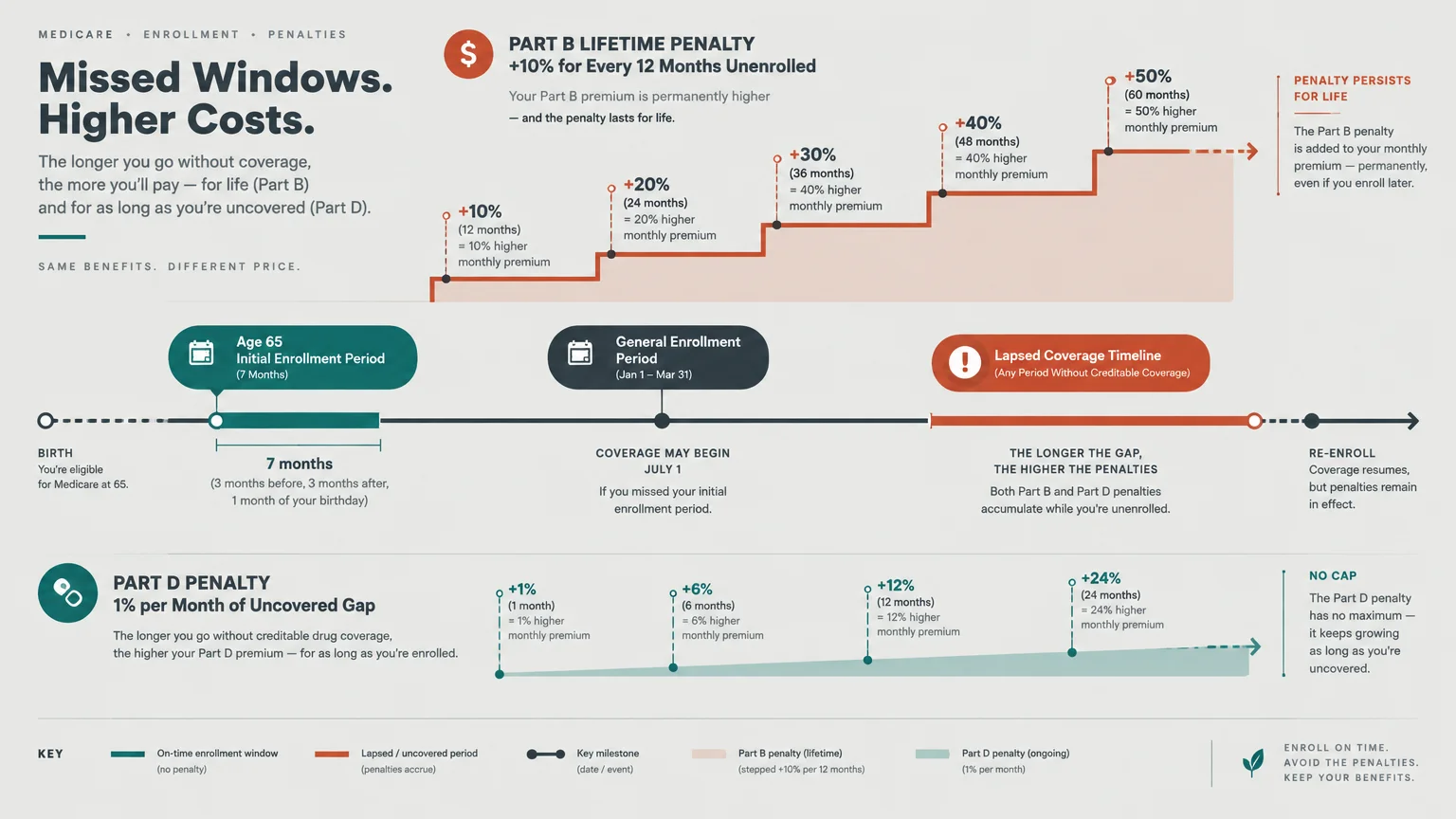
Your Initial Enrollment Period (IEP) spans seven months: three months before your 65th birthday, your birthday month, and three months after. If you fail to enroll without creditable employer coverage, penalties accrue quickly.
The Part B penalty adds 10% to your standard monthly premium for every full 12-month period you delayed enrollment. You pay this surcharge every single month for the rest of your life.
With the standard Part B premium at $202.90 per month in 2026, a 20% penalty adds over $40 to your monthly bill forever. Part B premiums rise each year, meaning your dollar penalty expands over time.
Part D carries a lifetime penalty calculated at 1% of the national base beneficiary premium multiplied by your uncovered months. An agent reviews your active employer coverage to confirm it qualifies as legally creditable.
Working alongside an agent guarantees you file timely applications through the Social Security Administration. You dodge lifelong penalties and keep more money in your retirement bank account.

7. Securing Guaranteed Issue Rights During Medigap Windows
Medicare Supplement insurance, commonly called Medigap, pays remaining out-of-pocket expenses under Original Medicare. Under Original Medicare, Part A carries a $1,736 hospital deductible in 2026, while Part B leaves an uncapped 20% coinsurance.
Your golden opportunity to buy Medigap coverage arrives during your six-month Medigap Open Enrollment Period. This window begins the month you turn 65 and enroll in Part B.
During these six months, private insurers cannot review your medical history or deny coverage due to pre-existing conditions. They must sell you any policy they offer at standard non-smoking rates.
Once this one-time federal window expires, insurers in most states can enforce strict medical underwriting. A history of heart disease, cancer, or diabetes can cause carriers to reject your application outright.
A knowledgeable agent evaluates your long-term health trajectory to decide whether Medigap fits your lifestyle. They help you lock in lifetime guaranteed-issue protections before this vital enrollment door slams shut.

8. Faster Access with Modern Same-Day Consultations
Federal compliance rules exist to protect seniors from high-pressure sales tactics. For years, beneficiaries suffered under a mandatory 48-hour waiting period between signing a Scope of Appointment (SOA) and discussing plans.
The CMS Contract Year 2027 Final Rule officially eliminated that mandatory 48-hour waiting period. As of late 2026, beneficiaries can complete a Scope of Appointment and consult with an agent immediately.
This regulatory update makes securing professional medicare plan help far more convenient. If an urgent health issue arises, you no longer wait two full days simply to compare local policies.
Agents still follow rigorous consumer protections, including mandatory call recording retained for six years. They also disclose upfront whether they represent every available plan in your service area.
These modern guidelines blend robust consumer protection with fast, on-demand customer service. You receive immediate answers to pressing healthcare questions without bureaucratic delays.

9. Providing Year-Round Advocacy When Billing Disputes Happen
The true value of a broker becomes evident long after your initial enrollment forms are filed. When billing disputes, claim denials, or pharmacy rejections occur, calling an insurer’s general customer service line leads to endless hold times.
Your agent acts as your personal advocate throughout the lifetime of your policy. If an insurer erroneously denies coverage for an MRI, your agent steps in to examine the diagnostic billing codes.
Agents maintain direct back-office contacts with regional provider representatives and carrier billing managers. They resolve messy administrative logjams that leave individual consumers feeling hopeless.
If you need an urgent prior authorization appeal for a critical specialty drug, an agent knows the precise medical documentation required. They coordinate directly between your prescribing physician and the insurance carrier.
This hands-on advocacy brings tremendous peace of mind to older adults and their family caregivers. You can focus on your health recovery while your agent battles carrier bureaucracy.

10. Conducting Essential Annual Policy Reviews
Medicare is never a “set-it-and-forget-it” arrangement. Private carriers adjust deductibles, out-of-pocket maximums, doctor networks, and prescription formularies every single autumn.
The annual open enrollment window runs from October 15 through December 7 each year. During the Annual Enrollment Period (AEP), you can change Medicare Advantage or Part D plans freely for coverage starting January 1.
Additionally, the Medicare Advantage Open Enrollment Period (MA OEP) spans January 1 to March 31. This second window allows existing Medicare Advantage enrollees to switch plans or return to Original Medicare if dissatisfied.
A dedicated agent checks in every autumn to conduct a thorough policy checkup. They cross-reference your updated medication list against changing formularies using the official Medicare Plan Finder.
If your existing plan drops coverage or hikes copayments, your broker switches you to a more competitive policy. These annual tune-ups protect your retirement budget from silent cost increases.
“The best time to plan for retirement was 20 years ago. The second best time is today.”
Comparing Medicare Enrollment Approaches
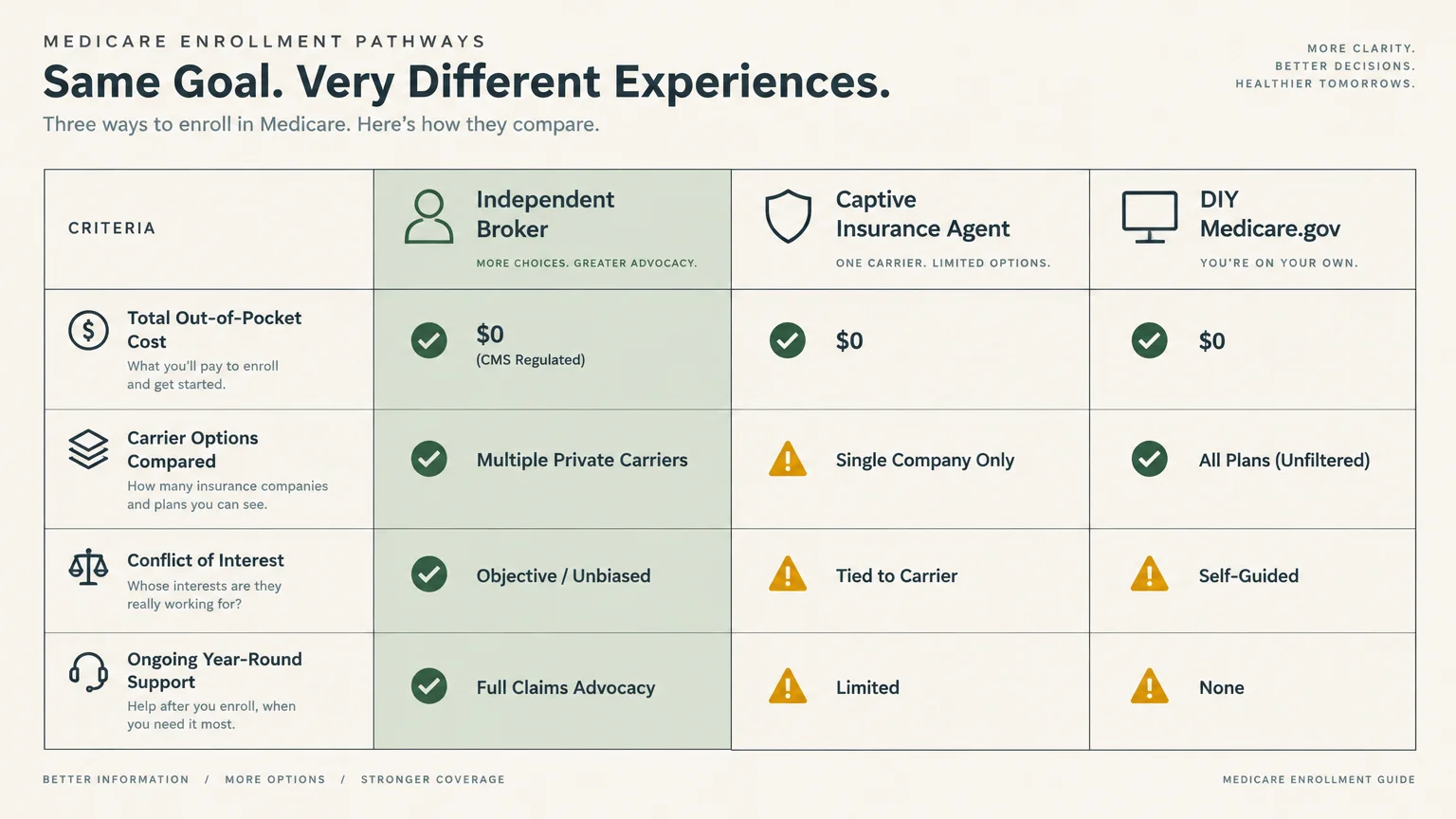
Retirees generally select one of three paths when establishing Medicare coverage: researching alone, calling a single insurance company, or partnering with an independent broker. Understanding the differences clarifies why use a medicare agent.
| Enrollment Feature | DIY (Self-Enrolled) | Captive Carrier Agent | Independent Broker |
|---|---|---|---|
| Cost to Retiree | $0 | $0 | $0 |
| Plan Selection | All local plans | Only 1 carrier’s plans | Multiple top carriers |
| Carrier Objectivity | Unbiased (User dependent) | Biased to their employer | High (Commissions regulated) |
| Claims Advocacy | None (You call 1-800 lines) | Limited carrier support | Direct, personal advocacy |
| Annual Reviews | Manual self-review | Keeps you with same carrier | Unbiased multi-carrier checkup |
Enrolling alone often leaves you buried under confusing fine print and fine-print coverage exceptions. Calling a single insurance company limits your horizon exclusively to the policies that company sells.
An independent broker combines multi-carrier variety with individualized service. You gain an experienced professional who compares market alternatives without charging you a penny.

Common Retirement Traps
Navigating healthcare transitions involves costly hazards. Understanding these frequent missteps will help protect your retirement savings from preventable losses.
- Trusting Celebrity Commercials: Television ads often promise free groceries or utility cash backs. These benefits are usually restricted to dual-eligible Medicaid recipients living in specific ZIP codes.
- Assuming Your Spouse’s Plan Protects You: Medicare does not offer family or spousal plans. You and your spouse must enroll separately based on individual medical histories and prescription needs.
- Ignoring Annual Notice of Change (ANOC) Letters: Insurers mail this document every September detailing network, tier, and premium adjustments. Tossing it unopened often leads to shocking January pharmacy surprises.
- Missing the 6-Month Medigap Window: Skipping your initial Medigap enrollment period can permanently lock you out of supplemental coverage if chronic medical conditions develop later.
- Forgetting About Prior Authorizations: Choosing Medicare Advantage without reviewing prior authorization requirements can delay critical diagnostic tests, elective surgeries, and specialist referrals.
Working with a trusted licensed agent helps you steer clear of each of these costly pitfalls. They verify the fine print before you sign an application.

When to Consult a Professional
While an independent broker handles insurance plan selection, certain retirement circumstances demand specialized professional guidance. Knowing whom to call ensures all aspects of your retirement stay protected.
If you have low retirement income and limited assets, reach out to your local State Health Insurance Assistance Program (SHIP). SHIP counselors provide unbiased support and connect you with Medicare Savings Programs (MSP) or Extra Help.
For complex wealth transfer, long-term care asset protection, or Medicaid spend-down strategies, hire an elder law attorney. Insurance brokers cannot draft legal trusts or provide formal estate planning advice.
When coordinating pension payouts, 401(k) required minimum distributions, and Social Security timing, consult a certified financial planner. Their tax strategies prevent unexpected spikes in your Medicare Part B and Part D Income-Related Monthly Adjustment Amount (IRMAA).
Frequently Asked Questions About Medicare Agents
How do Medicare brokers get paid if their services are free to me?
Medicare brokers receive standard commission payments directly from the insurance company after you enroll. The federal government strictly caps these commissions to ensure agents recommend plans that fit your health needs rather than higher payouts.
Can an agent switch my coverage without my explicit permission?
No, an agent cannot enroll you or alter your plan without your informed, written or recorded consent. CMS requires brokers to secure a signed Scope of Appointment form and maintain recorded enrollment confirmations for six years.
What is the difference between a captive agent and an independent broker?
A captive agent works directly for a single insurance carrier and can only sell that company’s specific policies. An independent broker partners with numerous competing insurance companies, offering a broader, more objective view of your local market options.
Do I have to re-enroll through my agent every year?
Medicare plans automatically renew each January if you choose to take no action. However, scheduling a brief autumn review with your agent ensures your doctor networks, drug tiers, and monthly premiums remain competitive for the coming year.
Take Control of Your Healthcare Future
Securing the right healthcare coverage protects both your physical wellness and your hard-earned retirement nest egg. The subtle differences between plans often mean the difference between financial peace and surprise medical debts.
Take time this week to review your current medical usage, upcoming surgeries, and prescription medications. Then, reach out to an independent Medicare broker to compare your coverage against the latest plans available in your community.
Information in this article reflects current rules as of the publication date and may change. Always confirm benefit details directly with Social Security Administration, Medicare.gov, or relevant government agencies before making decisions.
Last updated: October 2026. Medicare and Social Security rules change annually—always verify current details at official government sources.