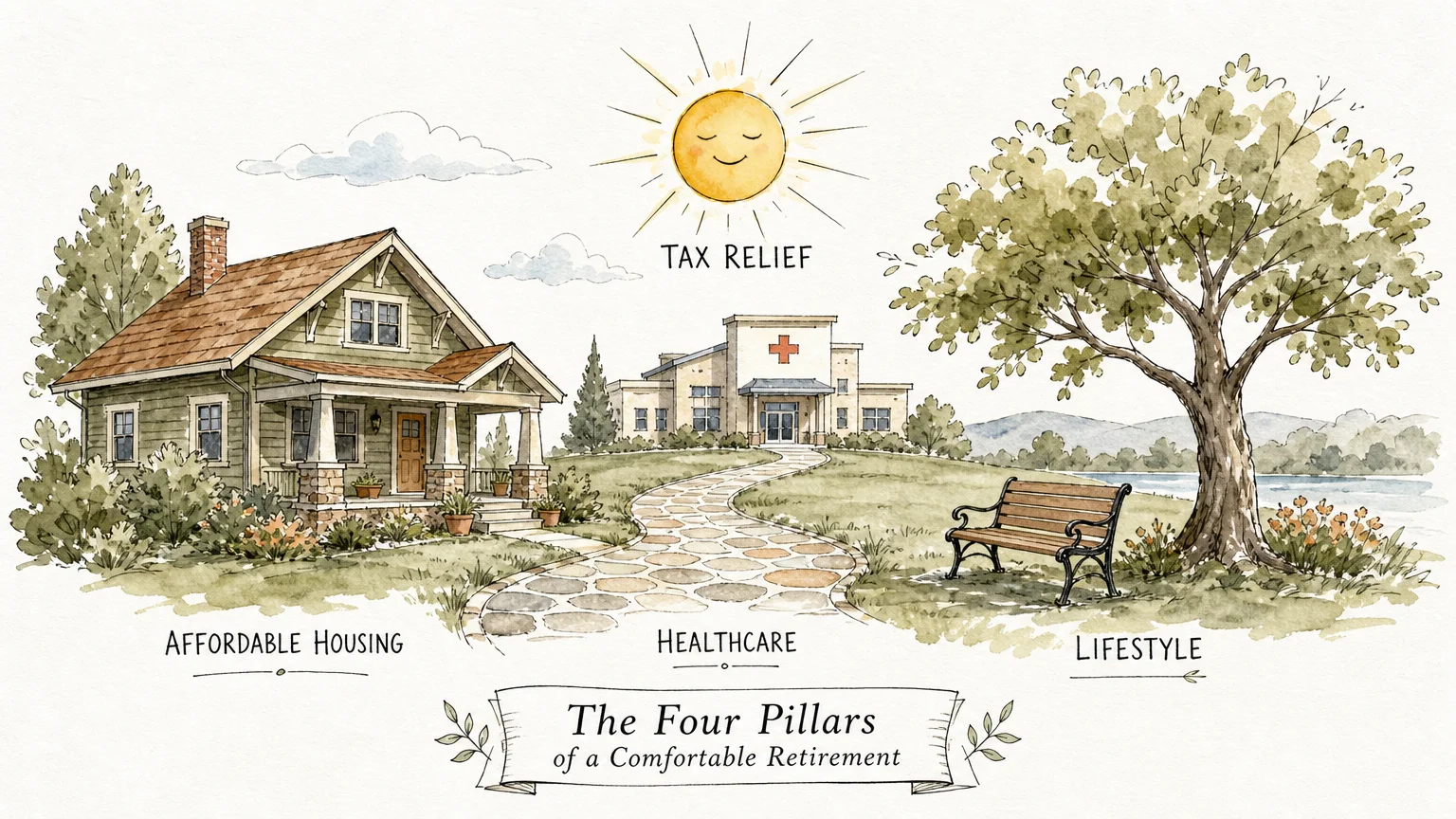
Fulfilling retirements do not require a six-figure income or a multimillion-dollar portfolio. You can build a rich, comfortable life on a retirement budget of $40,000 a year simply by choosing the right location. Geography plays a massive role in retiree finances, dictating everything from your property taxes to your healthcare costs. Relocating to an affordable retirement town stretches your Social Security benefits significantly further, giving you more freedom to travel, pursue hobbies, or spoil your grandchildren. By prioritizing areas with low cost living, excellent healthcare access, and vibrant communities, you can enjoy your golden years without constant financial stress. Explore these ten outstanding locations where your money works harder for you.

What You Need to Know
- Housing is the anchor: Keeping your housing costs (rent or mortgage, plus taxes and insurance) under $1,200 a month is the secret to thriving on a $40,000 annual income.
- Taxes matter as much as price: Several states exempt Social Security and pension income from state taxes, effectively giving you an instant raise.
- Healthcare access is non-negotiable: An affordable town is only viable if it features a robust local hospital system and plentiful Medicare providers.
- Lifestyle determines satisfaction: Low costs mean nothing if you are bored. The best towns offer free or inexpensive natural amenities, cultural events, and community centers.
How We Evaluated Affordable Retirement Towns
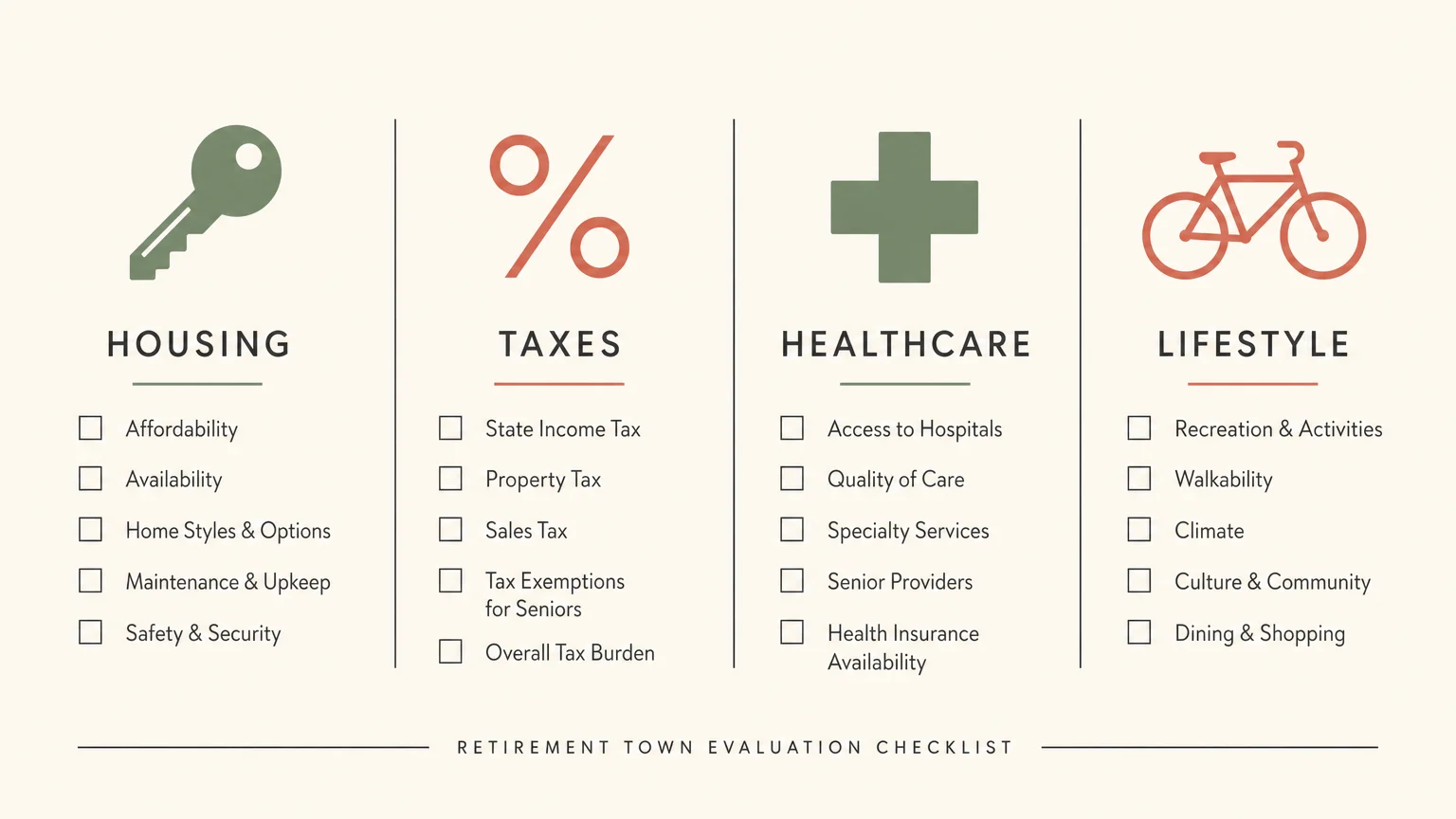
Living on $40,000 a year translates to a monthly income of roughly $3,333. To live comfortably on this amount without clipping coupons out of desperation, you need an environment designed for affordability. When evaluating the best towns to retire, we looked well beyond basic median home prices. A truly great retirement destination balances financial practicality with a high quality of life.
First, we analyzed real estate markets where securing a comfortable home or apartment leaves plenty of room in your monthly budget. Next, we examined the state and local tax burdens. Property tax rates and the taxation of retirement income can quietly drain your savings if you are not careful. We prioritized states that treat retiree finances gently.
Finally, we evaluated healthcare infrastructure. As you age, proximity to quality medical care dictates your independence and peace of mind. Every town on this list features strong regional medical centers. We also factored in the local lifestyle—because true low cost living includes access to parks, lakes, walking trails, and community organizations that keep you active without requiring a pricey country club membership.


10 Best Towns to Retire on $40,000 a Year
1. Hickory, North Carolina
Nestled in the foothills of the Blue Ridge Mountains, Hickory offers the scenic beauty of North Carolina without the steep price tag of nearby Asheville. The city has transformed from a historic furniture manufacturing hub into a vibrant community known for its parks, lakes, and craft culture. Retirees flock to the Lake Hickory area for boating, fishing, and peaceful walking trails.
From a financial standpoint, Hickory shines. Housing costs sit significantly below the national average, making it easy to find a comfortable single-family home or an affordable rental. North Carolina does not tax Social Security income, which helps preserve your retirement budget. For medical needs, the Frye Regional Medical Center provides comprehensive care right in town, ensuring you do not have to drive to Charlotte for routine specialists.
2. Fort Wayne, Indiana
If you appreciate Midwestern friendliness and distinct seasons, Fort Wayne delivers an exceptional quality of life for budget-conscious seniors. Indiana boasts a remarkably low cost of living index, and Fort Wayne amplifies this with an abundance of affordable housing options, from historic neighborhoods to quiet suburban developments.
The city has invested heavily in its public spaces, most notably the stunning Riverfront development, which offers accessible walking paths, accessible boat tours, and frequent free concerts. Parkview Health operates a massive, state-of-the-art medical network in the region, ensuring top-tier healthcare is always minutes away. Indiana also provides generous property tax deductions for residents over age 65, further easing the burden on your monthly cash flow.
3. Augusta, Georgia
While globally famous for the Masters golf tournament, Augusta is a remarkably accessible and affordable retirement town year-round. Located along the scenic Savannah River, the city features beautiful historic architecture, a mild winter climate, and excellent Southern hospitality.
Georgia is arguably one of the most tax-friendly states for retirees. The state does not tax Social Security, and it offers a massive retirement income exclusion—up to $65,000 per person for those 65 and older. This means your $40,000 a year will likely be completely free from state income tax. Housing in Augusta remains highly affordable, and the presence of the Medical College of Georgia means retirees have access to cutting-edge healthcare facilities and specialists.
4. Scranton, Pennsylvania
Scranton offers an appealing blend of small-town community feel and easy access to major metropolitan areas like New York City and Philadelphia. Located in the picturesque Lackawanna River valley, the city provides beautiful autumn foliage, rich industrial history, and numerous outdoor recreational areas.
Pennsylvania is a quiet powerhouse for retiree finances. The state completely exempts Social Security, public pensions, and private pensions from state income tax. When combined with Scranton’s highly affordable real estate market, your money stretches incredibly far. The Geisinger medical system serves the region with high-quality, specialized care, giving retirees peace of mind regarding their long-term health needs.
5. Abilene, Texas
For retirees seeking a warm climate and a distinctly Western flavor, Abilene is a hidden gem. Texas famously levies zero state income tax, meaning every dollar of your Social Security and retirement account withdrawals stays in your pocket. While property taxes in Texas can be high, Abilene’s exceptionally low housing prices offset this, making it easy to keep your total monthly housing costs manageable.
Abilene is home to a strong military community thanks to Dyess Air Force Base, making it an ideal landing spot for veterans seeking affordable access to base amenities. The community is tight-knit, the winters are mild, and Hendrick Health provides a comprehensive network of hospitals and clinics catering heavily to the senior population.
6. Roanoke, Virginia
Known as the “Star City of the South,” Roanoke sits in a spectacular valley surrounded by the Blue Ridge Mountains. If you want an active retirement filled with hiking, scenic drives along the Blue Ridge Parkway, and a thriving downtown farmers market, Roanoke is tough to beat.
Despite its natural beauty and vibrant culture, Roanoke maintains a cost of living that falls well below the national average. You can easily find comfortable housing options that fit neatly within a $40,000 annual budget. Furthermore, the city is a regional healthcare hub. The Carilion Clinic operates a massive, highly-rated hospital system in Roanoke, drawing top-tier medical talent to this affordable mountain town.
7. Peoria, Illinois
Perched along the beautiful Illinois River, Peoria is a classic Midwestern city offering big-city amenities at a fraction of the cost. The city boasts a beautiful riverfront, an impressive park district, a zoo, and numerous cultural institutions including a symphony orchestra and museums.
While Illinois generally has high property taxes, Peoria’s housing prices are so deeply affordable that your overall monthly housing payment remains very low. More importantly for your retirement budget, Illinois is one of the few states that exempts nearly all retirement income—including Social Security, 401(k) distributions, and pensions—from state income tax. OSF Saint Francis Medical Center anchors the local healthcare system, providing excellent medical infrastructure for aging residents.
8. Pensacola, Florida
Retiring in Florida does not have to mean paying premium prices in Naples or Boca Raton. Pensacola, located in the state’s western panhandle, offers stunning white-sand beaches and emerald waters at a much more accessible price point. The historic downtown area is highly walkable, featuring Spanish-influenced architecture, great seafood, and frequent community festivals.
Like the rest of Florida, Pensacola residents pay no state income tax. The heavy presence of the Naval Air Station brings excellent military retirement benefits and a built-in community for veterans. Renting or buying slightly inland from the immediate coast keeps housing costs well within a $40,000-a-year budget, while Baptist Health Care ensures you have access to excellent medical professionals.
9. Dayton, Ohio
Dayton is an incredibly affordable city with a rich history of aviation and innovation. Home to the National Museum of the United States Air Force and an extensive network of paved, multi-use trails, the city encourages an active, engaged lifestyle without requiring a massive budget.
Housing in Dayton is some of the most affordable in the country. Whether you want a historic home in a mature neighborhood or a modern, maintenance-free apartment, your housing dollar goes exceptionally far here. Ohio offers targeted tax credits for low-to-moderate-income seniors, and the Miami Valley Hospital system is nationally recognized for its clinical excellence, particularly in cardiac and elder care.
10. Winston-Salem, North Carolina
Rounding out our list is Winston-Salem, a city that perfectly blends historic charm with modern innovation. Known for its thriving arts district and the historic Old Salem museums, the city provides a rich cultural backdrop for your retirement years.
The cost of living in Winston-Salem sits comfortably below the national average. Because North Carolina does not tax Social Security, your baseline income goes further. The crown jewel of retiring here, however, is the healthcare. Atrium Health Wake Forest Baptist is a premier academic medical center, meaning retirees living in this affordable town have direct access to some of the most advanced medical care and clinical trials in the nation.

Maximizing Your $40,000 Retirement Budget
Living on $3,333 a month requires intention, but it provides plenty of room for enjoyment if you structure your finances correctly. The key is distinguishing between fixed necessities and flexible spending.
“The goal of retirement is to live off your assets—not live off your regrets.” — Anonymous
To ensure your affordable retirement town truly works for you, create a structured monthly budget before you pack your boxes. Here is a realistic breakdown of how a single retiree or a couple might allocate $3,333 a month in one of our highlighted towns:
| Expense Category | Estimated Monthly Cost | Percentage of Budget |
|---|---|---|
| Housing (Rent/Mortgage, Taxes, Insurance) | $1,100 | 33% |
| Groceries & Household Supplies | $500 | 15% |
| Healthcare (Medicare Premiums & Out-of-Pocket) | $450 | 14% |
| Transportation (Gas, Insurance, Maintenance) | $400 | 12% |
| Utilities (Electric, Water, Internet, Phone) | $350 | 10% |
| Entertainment, Dining, & Hobbies | $300 | 9% |
| Miscellaneous / Emergency Savings | $233 | 7% |
| Total Monthly Budget | $3,333 | 100% |
As you plan, utilize the Social Security Retirement Estimator to get an exact picture of your guaranteed monthly income. Knowing your baseline income dictates exactly how much house you can afford. Furthermore, healthcare is a massive variable. Use the Medicare Plan Finder to research the specific Advantage or Part D plans available in the zip code of your desired town. Network coverage varies drastically by county, and securing an affordable plan is critical to maintaining this budget.

Don’t Make These Mistakes
Relocating to stretch your retirement budget is a brilliant strategy, but it carries risks if you rush the process. Avoid these common pitfalls when moving to a new, affordable area.
Buying a home without visiting first. Real estate listings can be deceiving. A house might look like a steal online, but it could be located miles away from the nearest grocery store or hospital. Always rent an Airbnb or an apartment in your target town for at least a month before committing to a permanent purchase. Experience the traffic, the neighborhood noise, and the distance to essential services firsthand.
Ignoring property tax reassessments. In many states, a home’s property tax value is reassessed upon sale. The previous owner might have paid $1,000 a year in taxes based on a decades-old valuation, but your new tax bill could jump to $3,000 based on your purchase price. Always calculate your budget using the projected tax rate, not the historical one.
Leaving your support network without a plan. Moving hundreds of miles away to save money means leaving behind friends, family, and trusted doctors. The isolation can take a toll on your mental health. If you move to a new town, proactively join local senior centers, religious organizations, or hobby groups to build a new safety net immediately.

When Professional Advice Is Worth It
If you are relocating across state lines, coordinating your finances becomes more complex. Working with a fee-only fiduciary financial advisor or a local elder law attorney can save you thousands of dollars in the long run. They can help you understand the nuances of state estate taxes, structure your portfolio withdrawals to minimize state income taxes, and ensure your healthcare directives are valid in your new home state. Organizations like AARP also offer excellent free tools to help you compare the cost of living between your current city and your prospective new home.
Frequently Asked Questions
Can I realistically live on Social Security alone?
Yes, but it requires strict discipline and a low cost of living. The average monthly Social Security benefit is around $1,900. If two spouses each receive this amount, your household income is roughly $3,800 a month, which easily covers a $40,000 annual lifestyle. If you are single and relying solely on one $1,900 check, you will need to utilize subsidized senior housing or share expenses with a roommate to maintain a comfortable standard of living.
Are there taxes on Social Security benefits?
At the federal level, up to 85% of your Social Security benefits may be taxable depending on your combined income. However, at the state level, the rules vary. Many of the affordable retirement towns listed above are located in states that do not tax Social Security benefits at all, providing a significant boost to your net income.
Should I rent or buy when relocating for retirement?
Renting offers flexibility and predictable monthly costs, as the landlord handles repairs and maintenance. Buying locks in your housing costs (aside from taxes and insurance) and builds equity, but it ties up your capital and makes you responsible for expensive emergency repairs like a broken furnace or a leaky roof. If you are moving to a new town, renting for the first year is universally recommended.
Making Your Move
“The best time to plan for retirement was 20 years ago. The second best time is today.” — Anonymous
Finding a town where you can live comfortably on $40,000 a year is entirely within your reach. It simply requires you to look outside the most aggressively marketed retirement hot spots and focus on communities that offer genuine value, solid healthcare, and tax-friendly policies. Take the time to research these ten towns, run your personal numbers, and start planning your next great adventure. Choose one town from this list that sparks your interest, and schedule a week-long visit this spring to explore the neighborhoods for yourself.
This article is for informational purposes only and does not constitute financial, legal, or medical advice. Medicare rules, Social Security benefits, and tax laws change regularly—verify current details at Medicare.gov, SSA.gov, or with a licensed professional.
Last updated: June 2026. Medicare and Social Security rules change annually—always verify current details at official government sources.