Every autumn, millions of retirees open their mail to find an Annual Notice of Change, yet few realize how drastically private Medicare Advantage plans shift compared to Original Medicare. While Original Medicare maintains stable, nationwide access to any doctor accepting Medicare, Medicare Advantage plans alter their provider networks, prescription drug formularies, copays, and extra benefits every single calendar year. Navigating your medicare plan renewal effectively requires understanding these hidden structural shifts so you can protect both your healthcare access and your retirement budget. Comparing medicare advantage vs original medicare each fall ensures you never wake up in January with an unexpected bill or an out-of-network doctor.

The Structural Difference in Annual Medicare Renewals
To understand why your coverage shifts every January, you must first look at who manages your plan. Original Medicare consists of Part A (hospital insurance) and Part B (medical insurance), which the federal government administers directly. Because Original Medicare operates under standard statutory rules, its basic structure remains identical from year to year; private insurance carriers do not manage your core benefits or dictate which doctors you can see.
Medicare Advantage (Part C), on the other hand, operates through private insurance companies that contract annually with the Centers for Medicare & Medicaid Services (CMS). Currently, over 35 million beneficiaries—representing approximately 52% to 55% of all eligible Medicare enrollees—choose Medicare Advantage plans. Because private insurers renegotiate their medical contracts, drug prices, and network agreements annually, every Medicare Advantage policy resets its specific terms on January 1. What felt like a comprehensive, affordable plan in June can easily transform into a restricted, expensive policy by January.
When assessing medicare annual enrollment choices, recognizing this core distinction helps you separate permanent coverage guarantees from temporary private policy perks. While Original Medicare provides broad nationwide stability, Medicare Advantage delivers local managed care that demands yearly evaluation.

What Actually Changes in Medicare Advantage Plans Every Year
Private insurance carriers constantly adjust their plan structures to manage costs and maximize efficiency. When you examine medicare advantage pros and cons during renewal, pay close attention to four critical areas that regularly change:
- Provider and Hospital Networks: Doctors, specialists, physical therapists, and hospital systems enter and exit Medicare Advantage networks continuously. An insurer might drop your preferred hospital network or primary care physician without warning, reclassifying them as out-of-network for the upcoming plan year.
- Prescription Drug Formularies and Tiering: Plans modify their covered drug lists (formularies) every year. A medication you take daily might shift from Tier 2 (a preferred generic with a low copay) to Tier 3 or Tier 4, increasing your out-of-pocket costs significantly—even with current federal consumer protections in place.
- Cost-Sharing and Maximum Out-of-Pocket (MOOP) Limits: Insurers adjust copays for specialist visits, inpatient hospital stays, and outpatient surgeries annually. Furthermore, carriers frequently raise the plan’s annual Maximum Out-of-Pocket limit, forcing you to pay more before safety-net coverage kicks in.
- Supplemental Perks and Allowances: Popular extras—such as dental allowances, vision credits, hearing aid coverage, and over-the-counter (OTC) flex card dollars—are voluntary supplemental benefits. Insurers routinely scale back, re-restrict, or eliminate these extra perks from one year to the next.
Because these internal policy details change so frequently, staying enrolled in the same Medicare Advantage plan year after year without reviewing your annual notice can lead to costly surprises.

What Changes in Original Medicare (and Medigap) at Renewal
Original Medicare provides a far more predictable renewal process because the federal government standardizes costs across the entire nation. When you remain on Original Medicare, you do not need to worry about losing access to your doctors, as long as those providers accept Medicare assignment. You can visit any physician, specialist, or hospital nationwide without network restrictions or prior authorization requirements.
However, Original Medicare out-of-pocket threshold costs do adjust annually based on federal economic indicators:
- Medicare Part B Standard Premium: In 2026, the standard monthly Part B premium is $202.90 (up from $185.00 in 2025). Enrollees pay this standard premium directly or have it deducted automatically from their monthly Social Security benefit.
- Medicare Part B Annual Deductible: The Part B deductible is set at $283 for 2026 (up from $257 in 2025). Once you meet this annual deductible, Original Medicare generally pays 80% of approved outpatient medical expenses, leaving you responsible for the remaining 20%.
- Part D Out-of-Pocket Spending Cap: Under provisions of the Inflation Reduction Act, out-of-pocket prescription drug costs for covered Part D medications are capped at $2,100 per year in 2026. The maximum standard Part D deductible stands at $615 in 2026. This cap protects beneficiaries enrolled in standalone Part D prescription drug plans (PDPs) as well as those with integrated Medicare Advantage drug coverage.
If you pair Original Medicare with a Medicare Supplement (Medigap) policy, your coverage remains guaranteed renewable for life as long as you pay your premiums on time. A Medigap policy cannot drop you or alter your medical benefits due to newly diagnosed health conditions. While your Medigap premium may rise slightly due to age or inflation, the underlying coverage rules stay completely solid.

Side-by-Side Comparison: How Renewal Works
To help you compare your options clearly, the following table illustrates how key features change during the annual renewal cycle for both coverage pathways:
| Feature / Factor | Original Medicare + Medigap + Part D | Medicare Advantage (Part C) |
|---|---|---|
| Doctor & Hospital Access | Nationwide; see any doctor or hospital that accepts Medicare without network limitations. | Restricted to local HMO or PPO networks; out-of-network care costs significantly more or isn’t covered. |
| Annual Network Changes | None. Providers do not “leave the network” because private networks do not exist. | High. Doctors, specialists, and hospitals can enter or leave the plan network annually. |
| Cost Changes at Renewal | Federal Part B premium ($202.90 in 2026) and deductible ($283 in 2026) adjust predictably. Medigap benefits never decrease. | Insurers change copays, coinsurance rates, deductibles, and total out-of-pocket maximums every year. |
| Prescription Drug Coverage | Requires a standalone Part D plan; drug formularies, tiers, and premiums adjust annually under the $2,100 cap. | Usually integrated into the plan; drug formularies, tiers, and restrictions shift annually under the $2,100 cap. |
| Extra Perks (Dental, Vision, OTC) | Not included in basic Original Medicare; requires separate private dental/vision policies. | Included in many plans, but insurers frequently modify allowance amounts and usage rules annually. |
| Prior Authorization Rules | Rarely required for covered medical procedures; treatment decisions remain between you and your doctor. | Common. Insurers require prior approval for many specialist visits, tests, surgeries, and therapies. |

Key Enrollment Windows You Must Put on Your Calendar
Timing plays a vital role when you consider switching medicare plans or modifying your existing coverage. Missing key deadlines can lock you into unfavorable terms or higher medical costs for an entire year. Bookmark these crucial dates on your calendar:
September 30: The ANOC Arrival Deadline
By September 30, your current Medicare Advantage or Part D insurance carrier must mail (or electronically deliver) your Annual Notice of Change (ANOC). This vital document outlines all cost adjustments, network drops, formulary changes, and benefit reductions taking effect on January 1. Treat this document like an urgent bill—open and audit it immediately.
October 15 – December 7: Medicare Annual Enrollment Period (AEP)
The annual enrollment window allows all Medicare beneficiaries to make comprehensive changes. During AEP, you can switch from Original Medicare to Medicare Advantage, drop Medicare Advantage to return to Original Medicare, switch between different Medicare Advantage plans, or select a new Part D prescription drug plan. Any updates you make during this period take effect on January 1.
January 1 – March 31: Medicare Advantage Open Enrollment Period (MA OEP)
If you enter January and discover that your Medicare Advantage plan dropped your primary doctor or altered your drug copays unexpectedly, this dedicated window gives you a second chance. If you already hold a Medicare Advantage plan, you can make a one-time switch to a different Medicare Advantage policy or disenroll completely to return to Original Medicare (and add a standalone Part D plan).

Costly Mistakes to Avoid During Medicare Renewal
Navigating medicare plan renewal without a systematic strategy leaves you vulnerable to hidden expenses and lost coverage. Avoid these frequent and costly mistakes:
- Ignoring the ANOC Letter: Throwing away your September paperwork without reading it is dangerous. If your plan drops a critical drug or primary hospital system, you won’t realize it until you face a rejected prescription or a denied medical claim in January.
- Shopping Solely on Premium Amounts: Choosing a $0-premium Medicare Advantage plan might look attractive on the surface, but high specialist copays, restricted networks, or strict prior authorization hurdles can easily wipe out your premium savings if you develop a chronic condition.
- Assuming Your Doctor Stays In-Network: Never assume your doctor will remain in your plan next year simply because they treated you this year. Medical groups regularly terminate insurer contracts during late-year negotiations. Always verify your doctor’s network status directly with their office before December 7.
- Overlooking Drug Formulary Tier Changes: Even with the national $2,100 out-of-pocket Part D cap for 2026, shifting a specialty brand-name drug from Tier 3 to Tier 5 can require you to pay your entire annual out-of-pocket max in January instead of spreading costs evenly over the year.
- Forgetting Medigap Medical Underwriting Rules: If you decide to drop Medicare Advantage and return to Original Medicare after your initial trial period, keep in mind that Medigap insurance carriers in most states can require health screening (medical underwriting). Unless you qualify for a guaranteed issue right, an insurer can charge higher rates or decline your Medigap application based on pre-existing conditions.
“The goal of retirement is to live off your assets—not live off your regrets.”

Don’t DIY These Decisions: When to Seek Professional Guidance
Evaluating complex insurance contracts alongside long-term financial goals can feel overwhelming. You do not have to make these critical choices alone; several free and low-cost professional resources exist to guide you through the details:
State Health Insurance Assistance Program (SHIP): SHIP offers free, unbiased, localized Medicare counseling provided by trained volunteers. SHIP counselors do not sell insurance or receive commissions, making them an incredible resource when comparing complex plan terms.
Independent Medicare Brokers: An independent broker represents multiple insurance carriers rather than a single provider. Working with a reputable broker costs you nothing extra, and they can search across various market options to match your exact medications and preferred doctors. Make sure to choose an agent who discloses all local plan offerings clear and transparently.
Elder Law Attorneys & Fee-Only Financial Planners: If you face complex health transitions, long-term care decisions, or Medicaid spend-down questions, consult an elder law attorney or a fiduciary financial advisor. You can locate accredited community aging specialists through official federal databases such as the Eldercare Locator or explore educational guides hosted by the National Council on Aging (NCOA).
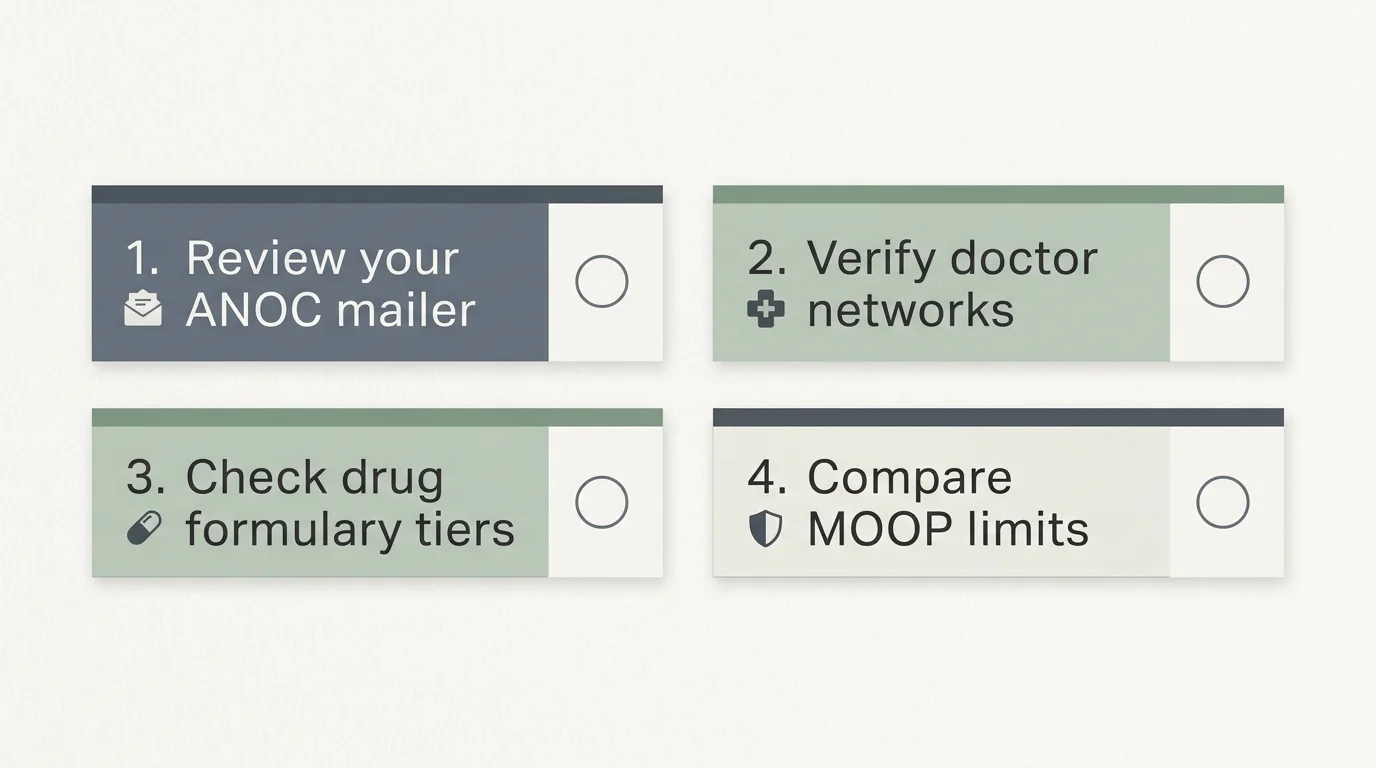
A Step-by-Step Audit Checklist for Your Medicare Plan Renewal
Take charge of your healthcare costs every autumn by following this practical step-by-step renewal checklist:
- Gather Your Medications: Write down exact drug names, dosages, daily frequencies, and preferred local or mail-order pharmacies.
- Read Your ANOC Letter Thoroughly: Highlight any changes to your plan’s monthly premium, maximum out-of-pocket limit, specialist copays, and drug tiers.
- Log Into the Official Medicare Portal: Visit Medicare.gov and access the official Medicare Plan Finder tool to input your preferred medications and doctors for an accurate cost projection.
- Confirm Doctor Network Participation: Call your primary care physician and key specialists directly. Ask their billing departments: “Will you participate in this exact plan contract for the upcoming calendar year?”
- Compare Estimated Total Annual Costs: Calculate your total annual expenses by adding 12 months of premiums together with expected out-of-pocket copays and deductibles—do not base your choice on monthly premium figures alone.
“It’s not how much money you make, but how much money you keep, how hard it works for you, and how many generations you keep it for.” — Robert Kiyosaki
Frequently Asked Questions
What happens if I do nothing during the Medicare Annual Enrollment Period?
If you take no action between October 15 and December 7, your current Medicare Advantage or Part D plan will automatically renew for the upcoming year—provided the insurer continues offering the policy. However, you automatically accept every price increase, network drop, or drug formulary alteration your carrier introduced in the Annual Notice of Change.
Can I switch back to Original Medicare if I dislike my Medicare Advantage plan?
Yes. You can switch back to Original Medicare during the Annual Enrollment Period (Oct 15 – Dec 7) or during the Medicare Advantage Open Enrollment Period (Jan 1 – Mar 31). However, securing a supplemental Medigap policy may require medical underwriting depending on your state laws and health history.
Why did my doctor stop accepting my Medicare Advantage plan mid-year?
Private insurance carriers and healthcare networks renegotiate payment contracts constantly. If an insurer and a medical system fail to reach financial terms, their contract terminates, leaving doctors out-of-network. If this occurs mid-year, you can ask for continuity of care exceptions or qualify for a Special Enrollment Period under specific hardship guidelines.
Does Original Medicare change its doctor network every year?
No. Original Medicare does not use private provider networks. You can receive care from any physician, hospital, or specialist in the United States who accepts Medicare assignment, giving you stable healthcare access without annual network disruptions.
Protecting Your Health and Financial Peace of Mind
Your healthcare needs and financial goals evolve throughout retirement. Treating your Medicare coverage as a permanent, set-and-forget product exposes you to unnecessary medical costs and frustrating access barriers. By reviewing your options each autumn, auditing your Annual Notice of Change, and running your medications through official comparison tools, you protect both your bodily health and your retirement savings.
Take time this week to review your current insurance documents, list your primary health priorities, and reach out to trusted local advisors if you need guidance. A single hour of annual preparation ensures you step into the new year with complete confidence in your coverage.
This article is for informational purposes only and does not constitute financial, legal, or medical advice. Medicare rules, Social Security benefits, and tax laws change regularly—verify current details at Medicare.gov, SSA.gov, or with a licensed professional.
Last updated: February 2026. Medicare and Social Security rules change annually—always verify current details at official government sources.